For a year, the argument over Trump's budget bill was about projections. How many people might lose coverage. What the cuts would mean.
That part is over. The numbers are in, and they are not forecasts anymore.
ACA marketplace coverage in Wisconsin fell 16% this year — about 45,000 people — after congressional Republicans let the enhanced insurance subsidies expire at the end of 2025. Nationally, KFF reported on July 28 that effectuated enrollment dropped by nearly 3 million people, a 12% decline in a single year, after seven straight years of growth.
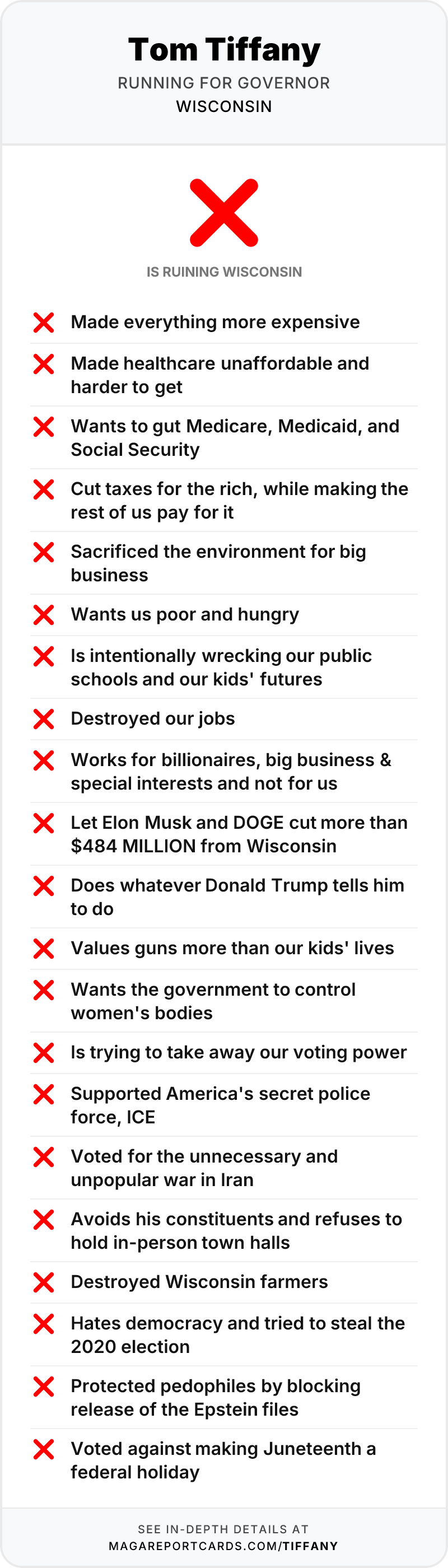
Tom Tiffany voted for the bill that left them to expire. He is now running for governor of Wisconsin, and this week he defended the part of it that hasn't even taken effect yet.
What he said this week
Asked by CBS 58 about Medicaid work requirements, Tiffany sent a statement on August 18:
"We must preserve Medicaid for our most vulnerable while promoting responsibility among those who are able to work."
He said nearly 80% of Wisconsin voters supported welfare work requirements in a 2023 referendum, and described his vote as being for "a common-sense requirement that able-bodied, childless adults work, volunteer, or participate in job training for at least 20 hours per week, with exceptions for vulnerable populations."
Set aside for a moment whether that requirement is reasonable. Notice what the answer does: it moves the conversation to a rule that starts in January 2027, and away from the thing that already happened in January 2026.
Because the 45,000 Wisconsinites who lost marketplace coverage this year did not lose it to a work requirement. They lost it because their premiums went up when the enhanced subsidies expired — and Republicans, repeatedly, declined to extend them.
What it looked like in DeForest
Macy Buhler owns the Yahara River Learning Center, a childcare center in DeForest. She can't afford to provide health insurance to her teachers directly, so she gives them a stipend to buy their own coverage on HealthCare.gov.
When premiums jumped, she doubled the stipend for 2026 — a $40,000 increase in that one line item.
It wasn't enough.
"I've lost some staff and closed a classroom because they can no longer afford to be an early childhood educator, a teacher."
She told CBS 58 she's looking at $150,000–$175,000 in added costs over the next year that would land "on the backs of working parents," and that she has already reduced how many children she takes in because she can't keep staff.
At a press conference on Tuesday, Buhler put it directly:
"Early childhood teachers deserve real access to healthcare and medication, not a Congress who makes it impossible for them to afford both. Tom Tiffany voted for this bill. We cannot trust him with our healthcare."
That is one small business, in one Wisconsin village. A closed classroom means families who can't find childcare, and teachers who left a profession they trained for.
The doctors in his own district
Dr. Kristen Dall-Winther owns a medical practice in Wisconsin's 7th Congressional District. Tiffany has been her representative since 2020.
"I see first hand what happens when patients struggle to afford care, when rural hospitals are under financial pressure, and when people put off seeing a doctor because they are worried about what it will cost. Tom Tiffany has repeatedly voted for policies that make those problems worse."
She cited forecasts that the bill could eventually cost more than 250,000 Wisconsin residents their health coverage.
Dr. Sophie Kramer, a Madison internist, described what that does in an exam room:
"I treat patients with chronic diseases like diabetes, cancer, heart disease, hypertension — and those don't disappear when someone loses insurance, they just become harder to manage."
What Tiffany promised at the time
Here is the part that should follow Tiffany through this campaign.
After the bill passed in July 2025, he issued a statement praising it for "providing tax cuts for seniors, parents, workers and small businesses." In the same statement, he said he would:
"remain committed to protecting Social Security, Medicare, and Medicaid for our seniors and the most vulnerable, while rooting out waste and curbing the reckless spending that threatens future generations."
He said that about a bill projected to cut $900 billion to $1 trillion from Medicaid over ten years. Rep. Mark Pocan put the healthcare total at $1.1 trillion and called it "the biggest cut we've ever seen in this country."
You cannot promise to protect Medicaid in the press release announcing your vote to cut it by a trillion dollars. Those are two different positions, issued the same afternoon.
Gov. Tony Evers, responding this week, was blunt about the subsidies:
"Congressional Republicans' refusal to extend the tax credits caused healthcare coverage costs to skyrocket, pricing families in Wisconsin and across the country out of having coverage at all."
The pattern for a man who wants to be governor
We wrote in July that Wisconsin was still paying for Tom Tiffany's "Big Beautiful Bill" vote, when the harm was still a projection and protesters parked a decommissioned ambulance outside state GOP headquarters to make the point.
The ambulance was a metaphor. The 45,000 people are not.
And this is how Tiffany tends to handle a record that has become inconvenient. When his position on abortion stopped polling well for a statewide race, he erased his support for a national ban from his website. He has also attacked his opponent over data centers while taking $5,000 from the only registered lobbyist for Wisconsin's data center coalition.
The through-line is a candidate who wants the policy and not the responsibility for it.
What's still coming
The Medicaid changes Tiffany calls common-sense don't start until January 2027 — after the election he's running in.
Nancy Higgs, a self-employed interior designer who switched to BadgerCare when her income dropped, told the Wisconsin Examiner she doesn't know yet what will happen to her coverage.
That's the honest summary of where Wisconsin stands. Forty-five thousand people have already lost coverage. Hundreds of thousands more are waiting to find out, and the man asking to run the state is campaigning on the vote that put them there.
Wisconsin deserves a governor who counts the people losing coverage, not the referendum results.
Sources
- Advocates say Tiffany's vote for 2025 Medicaid cuts bodes ill for healthcare — Erik Gunn, Wisconsin Examiner, August 19, 2026. Photo by Erik Gunn/Wisconsin Examiner.
- Small businesses raise healthcare concerns; Tiffany defends Medicaid work requirements — Meredith Hackler, CBS 58, August 18, 2026.
- How Has ACA Marketplace Enrollment Changed Across States in 2026? — KFF, July 28, 2026.