On December 18, 2025, President Trump signed the annual defense bill into law. It runs to hundreds of pages of shipbuilding, pay raises, and weapons programs.
Buried at Section 1068 is something else entirely.
The law now orders the Government Accountability Office — the federal government's audit arm — to comb through Pentagon records from 1945 to 1972 looking for proof that the U.S. military turned ticks into biological weapons. The text is right there in Public Law 119-60: the Comptroller General must review "the use of ticks as hosts or delivery mechanisms for biological warfare agents," including experiments involving two orders of bacteria, Spirochaetales and Rickettsiales. The auditors have to check classified files. They have two years to report back.
The provision even names specific Fort Detrick documents by their catalog numbers.
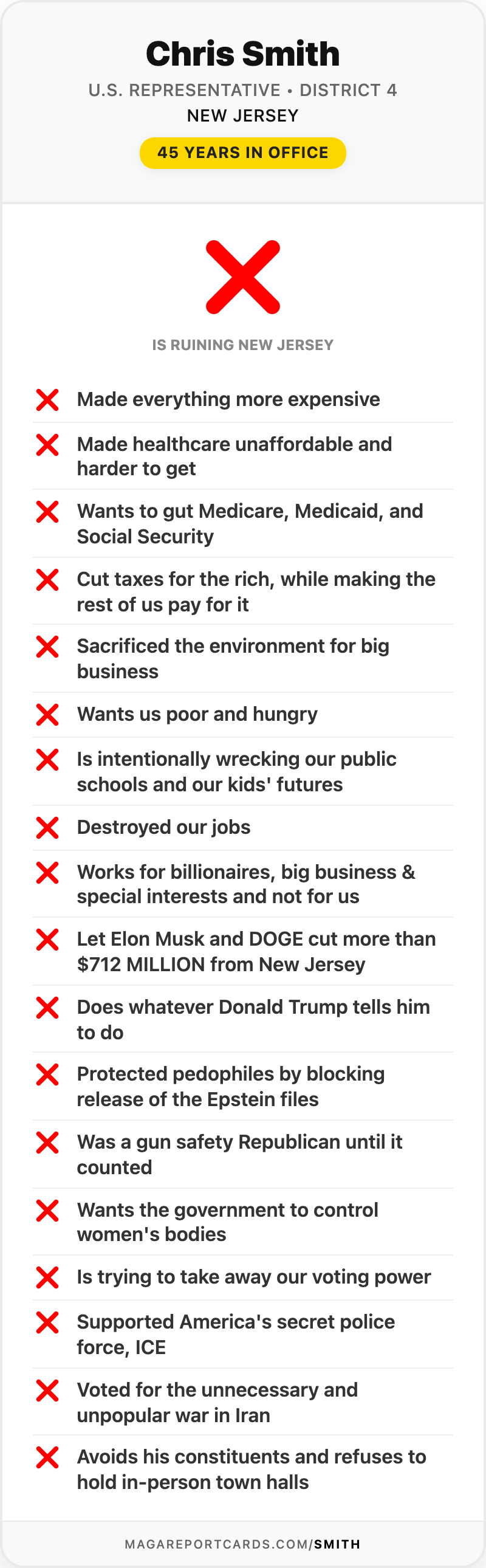
That language belongs to Chris Smith, who has represented New Jersey's 4th District since 1981. He has been trying to get it into law since 2019. Stars and Stripes reports that he put forward similar amendments in 2019 and 2021, and that each passed the House and died in the Senate. On the third attempt, it stuck.
What the theory actually claims
Smith's interest traces back to a book. He has said he was inspired by Bitten: The Secret History of Lyme Disease and Biological Weapons, by science writer Kris Newby, which argues that Cold War bioweapons researchers experimented on ticks and that something got loose — seeding the Lyme disease epidemic in the Northeast.
When Smith first brought the idea to the House floor on July 11, 2019, he told colleagues that "for years, books and articles have been written suggesting that significant research had been done at U.S. Government facilities, including Fort Detrick and Plum Island, to turn ticks and other insects into bioweapons." His question for the Pentagon was direct: "Was there any accidental release anywhere or at any time of any of the diseased ticks?"
The House passed it on a voice vote.
Scientists who study the disease say it doesn't hold up
Reporters took the theory to people who study Lyme for a living. It did not go well.
Richard Ostfeld, a disease ecologist at the Cary Institute of Ecosystem Studies, told VICE News that "both the tick and the bacterium that causes Lyme disease are ancient creatures," and that "there is strong scientific evidence that the present-day forms of the [Lyme disease] bacterium diverged from a common ancestor at least 60,000 years ago." A 5,300-year-old mummy found in the Alps carried traces of it.
Phil Baker, then executive director of the American Lyme Disease Foundation, added two more problems. There is evidence Lyme was in North America before Columbus. And Lyme is a lousy weapon — it usually causes fatigue and flu-like symptoms, not death.
Ostfeld also pointed out that the geography is wrong. Lyme shows up across Europe, Western Asia, and the Mediterranean. "The notion that Lyme was created on Plum Island doesn't represent the real geographic distribution of the disease in recent decades," he said.
His warning about the cost was the sharpest part:
"What gets neglected is scientific research in tick control, which would prevent people from getting sick in the first place."
That is the real problem here. Lyme disease in New Jersey is not imaginary. Roughly 476,000 new cases are diagnosed nationwide every year, according to the Global Lyme Alliance, and people who get it late can be sick for years. Smith co-chairs the Congressional Lyme and Tick-Borne Disease Caucus. He has a real platform, a real disease, and real suffering constituents.
He spent that platform buying a two-year records hunt through Cold War filing cabinets. When his 2019 version passed, VICE News reported it came with $1 million in new CDC Lyme research money — next to a CDC Lyme budget that was then about $11 million. The conspiracy audit got the headlines. The research got the rounding error.
Smith's own framing is that the truth will lead somewhere useful. "The hundreds of thousands of New Jerseyans suffering from Lyme disease — in addition to the millions across the United States — deserve to know the truth about the origins of their illness," he said in a statement this January. At a Lyme disease discussion hosted by the Department of Health and Human Services a month earlier, he put it more bluntly: "GAO will be fully empowered to leave no stone unturned."
Every stone except the ones the scientists keep pointing at.
We have seen this movie before
Smith is not alone in this. There is a whole cohort of House Republicans who have discovered that a congressional letterhead makes an excellent conspiracy-hunting tool.
Eric Burlison runs a UFO investigation from his seat on the House Oversight Committee — the subcommittee he actually chairs handles economic growth and regulatory affairs — and he flew to Mexico City to look at "alien" mummies and has toured a classified military base. Anna Paulina Luna chaired Congress's first MKUltra hearing in 49 years and turned it into a session about USAID and Anthony Fauci — so thoroughly that Mike Evans of the National Security Archive, the group that spends its days prying real government secrets loose, said the hearing "didn't break any new ground".
The pattern is always the same. A real historical wrong gets used as a doorway into something unprovable, the hearing or the audit generates a news cycle, and the actual constituents get nothing.
The other test: 27 names on a piece of paper
If you want to understand how Smith's office thinks, there is an older document worth looking at.
In 2015, a Capitol Hill staffer sent POLITICO New Jersey a section of Smith's college internship application. It asked student applicants to mark a plus, a minus, or a zero next to 27 different personalities, organizations and political issues — indicating whether they agreed, disagreed, or had no opinion.
The list included Rachel Maddow. Pope Francis. Planned Parenthood. The National Right to Life Committee. John Kerry. The NRA. The National Endowment for the Arts. PETA. The Sierra Club. The Cato Institute. Gun control. The Susan B. Anthony List. The Autism Society of America.
Undergraduates. Applying for an internship in a congressional office.
Ross K. Baker, a political science professor at Rutgers, told POLITICO he had a student — one of Smith's own constituents — thinking about applying, and that he would now talk him out of it:
"I just don't think that kids, undergraduates, ought to be subjected to what is obviously an ideological test. … There's something about this that's really, really troubling."
Baker's point wasn't that a congressman can't look for interested interns. It was the mechanism. Ask a student whether they care about foreign policy or the refugee crisis, he said, and you learn something useful. Tie it to a list of organizations, and a pattern of plus signs next to Planned Parenthood and EMILY's List will flag the applicant — and, he suspected, sink the application.
Brigid Harrison of Montclair State University put the problem plainly: "If you're assigning pluses or minuses, it is giving the appearance that you need to agree with a certain position." Even if nobody ever used it as a litmus test, how is a 20-year-old supposed to read it?
Smith's spokesman said the form "helps students identify interests and provides an opportunity to demonstrate awareness of issues at the federal level." POLITICO asked a simple follow-up — did the office actually make hiring decisions based on the answers? — and got no response.
Other New Jersey members, Republican and Democrat alike, managed to ask applicants what interested them without handing them a scorecard.
What his district actually needed
Here is the part that ties it together.
Smith has not held a public in-person town hall since 1992. When constituents rallied outside Toms River Town Hall in March 2025 demanding one, his own staff could only recall that 1992 event. Thirty-four years.
In that same stretch, he voted for the health care cuts in Trump's budget bill twice — Yea on May 22, 2025, and Aye again on July 3. The Joint Economic Committee's House minority staff estimates that 18,636 people in his district lose Medicaid coverage by 2034, and another 16,900 lose Affordable Care Act coverage — 35,536 in all.
So the ledger for New Jersey's 4th District looks like this. Thirty-five thousand neighbors losing health insurance: no town hall, no explanation. A Cold War tick theory that disease researchers say is not supported by the evidence: three attempts across six years, and now a line in federal law commanding a two-year audit with access to classified files.
Forty-five years in Congress buys a lot of leverage. This is what he chose to spend it on.
We deserve better.
Sources
- Congress calls on GAO to look for origin of Lyme disease in Cold War military programs — Rose L. Thayer, Stars and Stripes, January 23, 2026. Photo: Graham Snodgrass/U.S. Army Public Health Center.
- Chris Smith's intern applicants rate Rachel Maddow, NRA, the pope — Matt Friedman, POLITICO New Jersey, October 8, 2015.