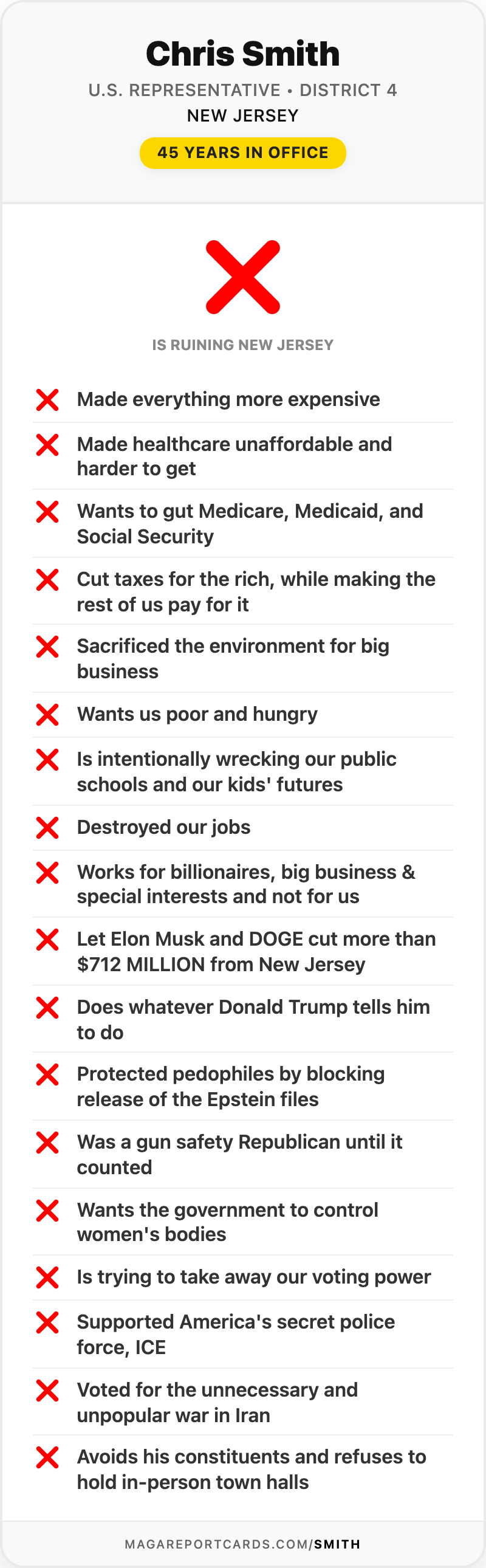
Go to the website of Giffords — the gun safety organization founded by former Rep. Gabby Giffords, who was shot in the head at a constituent event in 2011 — and you can still read their endorsement of a New Jersey Republican.
"Congressman Smith's voting record reveals his tireless commitment to enacting bipartisan gun safety legislation. He was an original cosponsor of H.R. 8, the 2019 House-passed universal background checks bill."
That was 2020. The Republican is Chris Smith, who has represented New Jersey's 4th District since 1981.
Here is the thing worth knowing about that endorsement: every word of it was true when they wrote it. Smith really was one of the very few Republicans who broke with the gun lobby, and he did it when it cost him something. That's what makes this post different from the usual story about a politician who never cared in the first place.
Then it stopped. Not with a speech, not with a press release explaining a change of heart. It just stopped, and nobody outside the district noticed.
The record Giffords was praising was real
This part is not spin, and it deserves to be said plainly.
December 2017. The House voted on national concealed-carry reciprocity — a bill that would have forced New Jersey to honor carry permits issued by states with far weaker screening. It passed 231–198. Only 14 Republicans in the entire House voted no, and Smith was one of them.
January 2019. Smith signed on as an original cosponsor of H.R. 8, the Bipartisan Background Checks Act, on January 8 — five days into the new Congress.
February 27, 2019. H.R. 8 came to the floor. Smith voted yes. Eight Republicans did.
March 1, 2021. New Congress, same bill. Smith signed on as an original cosponsor again.
March 11, 2021. He voted yes again. Again, eight Republicans.
Giffords endorsed him in 2018 and again in 2020. Defending both endorsements that fall, while campaigning for a New Jersey Democrat, Mark Kelly — Giffords's husband, now a U.S. senator — put it simply: "We're a bipartisan organization and both those guys have supported our legislation and have opposed the legislation of the National Rifle Association."
That's the record. Everything in it stops on March 11, 2021.
Fifteen months later, the no votes started
The gap between Smith's last gun safety vote and his first stretch of votes against it is fifteen months. Then, in a single summer, he voted against every bill the House put in front of him that would have restricted a gun.
June 8, 2022. Two weeks after a gunman killed 19 children and two teachers in Uvalde, the House passed the Protecting Our Kids Act — raising the purchase age for semi-automatic rifles to 21 and banning large-capacity magazines. Five Republicans voted yes. Smith voted no.
June 24, 2022. The Bipartisan Safer Communities Act — the first significant federal gun law in nearly thirty years, negotiated by senators of both parties, signed by the president. It cleared the House with 14 Republican votes (the bill rode on S. 2938, which is why the clerk's page still carries the courthouse-naming description it started life as). Fourteen Republicans said yes. Smith was not one of them.
Read those two numbers together. In 2017 Smith was one of 14 Republicans willing to defy the gun lobby. In 2022 there were again 14 Republicans willing to defy the gun lobby — and this time he was on the other side of the line.
July 29, 2022. The Assault Weapons Ban, 217–213. Two Republicans voted yes. Smith voted no, one of 208 Republicans against it.
June 13, 2023. He voted to overturn the ATF's pistol-brace rule — a resolution that would have restored the ability to turn a pistol into what functions as a short-barreled rifle without registering it.
July 2025. He voted for Trump's budget bill, which cut the federal transfer and manufacturing tax on gun silencers and short-barreled rifles from $200 to $0. That ninety-two-year-old deterrent hit zero on January 1, 2026.
The bill he wrote his name on twice, now missing his name
The cleanest measure of the change isn't a vote at all. It's a signature he stopped giving.
The background-check bill Giffords specifically credited him for has been reintroduced in every Congress since. Smith has not cosponsored it once:
- 118th Congress (2023), H.R. 715 — introduced by a Republican, Brian Fitzpatrick of Pennsylvania, and picked up 209 cosponsors, every single one a Democrat. The two-time original cosponsor stayed off it.
- 119th Congress (2025), H.R. 18 — 214 cosponsors, and this time two Republicans did sign: Brian Fitzpatrick of Pennsylvania and Mike Lawler of New York.
That second one matters most. The excuse that a Republican simply can't put his name on this bill anymore collapses the moment two Republicans do. Smith knows the bill — he helped write his name onto the top of it twice. He has served in the House for 45 years and does not need to be told how a cosponsor sheet works. He just doesn't sign it.
To be fair about where he actually stands: Smith has not flipped all the way. He is not a cosponsor of H.R. 38, the concealed-carry reciprocity bill he voted against in 2017 — the current version has 189 cosponsors and he isn't among them. That bill is now so aggressive that the nation's largest police union came out against it, warning that it strips officers of the power to verify whether someone carrying a gun is legally allowed to.
So this isn't a conversion. It's an abdication. He didn't join the other side; he stopped showing up on his own.
What it costs New Jersey
New Jersey has one of the lowest gun death rates in the country — 4.0 deaths per 100,000 people. That is not luck or geography. It is the direct result of laws the state fought to pass, and it is exactly what national concealed-carry reciprocity would override: a federal law forcing New Jersey to accept permits from states that require no class, no live-fire test, and no sheriff's sign-off.
Smith understood that in 2017. He said so with a vote that put him in a group of 14 in a chamber of 433.
His constituents cannot ask him what changed. Asked in 2025 when he had last held a town hall, his own staff could recall only one, in 1992 — thirty-four years ago, a drought so complete that voters in NJ-04 built a website just to ask where he is. There is no forum in the district where someone whose family survived a shooting can stand up and ask the man who once voted with them why he stopped.
A record you abandon isn't a record
Most Republicans in Congress have never done a single thing for gun safety, so there's nothing for them to walk away from. Smith is a harder case in the way that Brian Mast is a harder case — Mast begged Trump to pause AR-15 sales after Parkland and then voted against the gun bills that followed, including the assault weapons ban he'd demanded. Both men had standing. Both spent it.
The difference with Smith is the paperwork. Giffords, an organization founded by a woman who was shot in the head while meeting constituents, publicly staked its bipartisan credibility on him — twice — and the endorsement page praising his "tireless commitment" is still live on their website today, five years and a full reversal later.
Chris Smith proved he was capable of casting the hard vote. He did it in 2017, in 2019, and in 2021. Then in 2022 he stopped, and he has not signed the bill that made him an exception in the first place since.
Voters in New Jersey's 4th District aren't being asked to believe he could never stand up to the gun lobby. They have the receipts showing he could. They're being asked why he quit.
Source
Giffords, Chris Smith endorsement (2020), and Insider NJ, Smith Scores Gabby Giffords Organization Endorsement (July 17, 2020). Vote records from the Office of the Clerk of the U.S. House and cosponsor lists from Congress.gov. Photo: official House portrait via Wikimedia Commons.