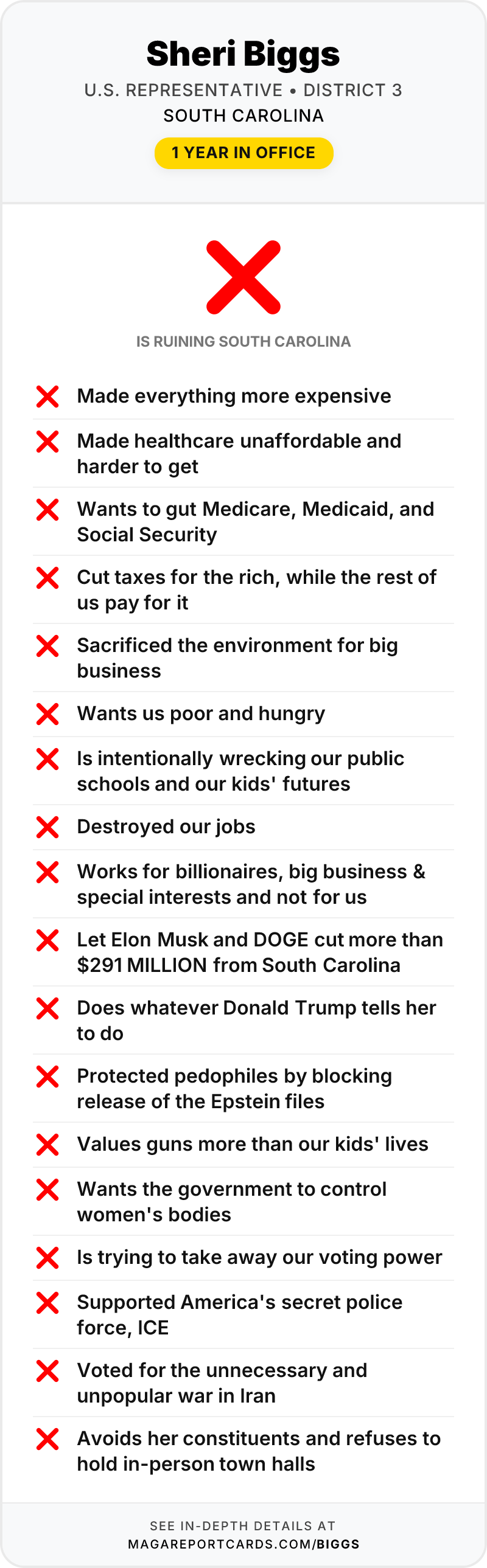
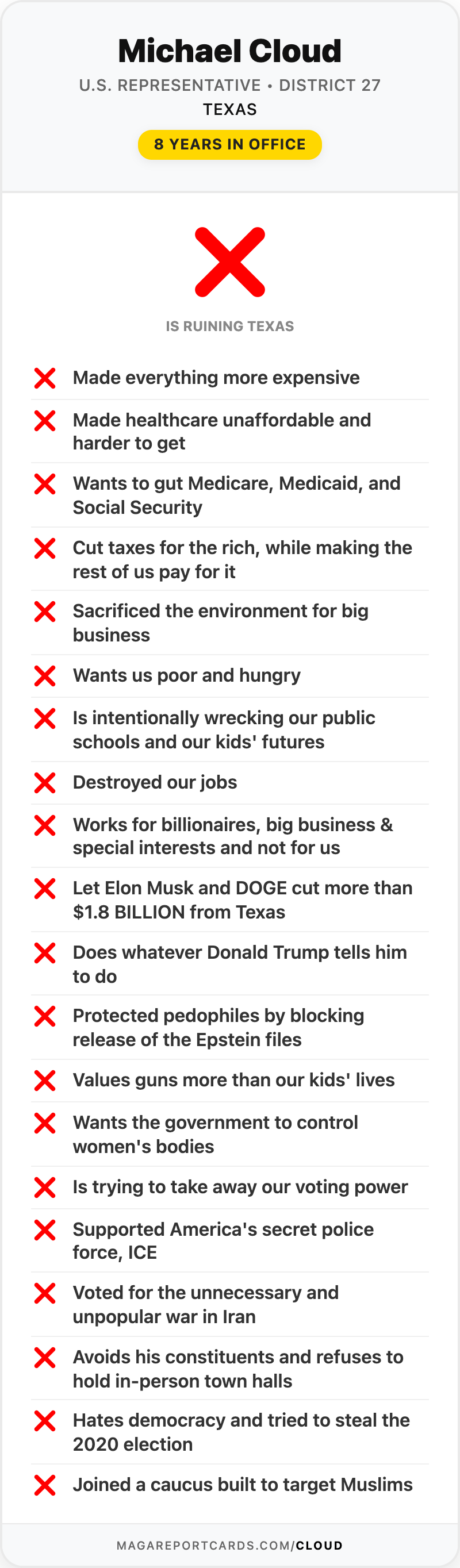
Two days after the 2026 midterms, Sheri Biggs, the Republican congresswoman from South Carolina's 3rd District, introduced a bill she calls the Don't Flush Babies Act. Its one cosponsor is Michael Cloud, the Republican from Texas's 27th District.
The bill goes after the abortion pill, mifepristone. It wouldn't ban the pill outright. It would bury it — and the women who take it — in rules designed to shame them, scare their doctors, and make the pill harder to get.
What the bill would do
Here is what's in it, in plain words.
A picture on every box. Every package of an abortion pill would have to carry a warning — "DO NOT FLUSH THE FETUS OR SOLID MEDICAL WASTE GENERATED BY USE OF THIS DRUG" — next to a picture of a 10-week fetus "that displays the head, arms, and legs," beside a picture of a toilet, inside a red circle with a slash through it. Without that label, the drug would count as "misbranded" under federal drug law — the category for drugs that can't legally be sold.
A "catch kit" for every patient. Any provider who prescribes or hands out the pill would have to give the patient a kit with two brightly colored biohazard containers — one labeled "Human Fetal Remains," one labeled "Solid Medical Waste" — plus instructions for collecting what comes out of her body during the abortion.
A trip back to the clinic. The instructions have to tell the woman to bring it all back to an abortion provider in person. The bill says it "may not be returned to an abortion provider by mail." The paperwork has to list the nearest facility that will take it and how far away it is from her home. The provider then has to arrange a burial or cremation.
Prison for the doctor. Anyone who prescribes or dispenses the pill without handing over the catch kit and the paperwork could be sent to prison for up to five years, fined $20,000 to $150,000, or both — for each offense.
The bill says it doesn't change any federal or state rules for emergency medical care.
Who this hurts
Think about what this asks of a woman taking an abortion pill at home, early in a pregnancy.
Under this bill, the kit she's handed tells her to collect the tissue her body passes in a biohazard container and bring it back to a provider in person — a clinic that may be hours away — because mailing it is forbidden. It tells her doctor that forgetting one piece of paper could mean five years in prison. Every one of those steps is a reason for a doctor to stop prescribing and a reason for a woman to give up.
That's the point. Supporters of bills like this say they're about dignity and the environment. The bill's own "findings" claim that flushing "may cause pipe blockages, plumbing damage, and environmental contamination." It cites no study.
The plumbing claim has no science behind it
Biggs and Cloud have been down this road before. In June, both of them signed a letter asking the EPA to treat mifepristone as a possible drinking-water contaminant — part of a group of 16 Republicans with report cards on this site, as we reported in September.
Environmental health experts have said over and over that there is no scientific evidence that abortion medication harms the environment or people. Mifepristone is usually taken once, by a small share of people, while drugs tens of millions of Americans take every day reach wastewater in far bigger amounts.
The same reporting found the "catch kit" idea isn't new. It's one of a set of state bills, nine in seven states in 2025 according to the Guttmacher Institute, that tie abortion pills to water pollution. Anna Bernstein, a policy adviser at the Guttmacher Institute, called the push "part of a broader effort to restrict access to medication abortion."
The Don't Flush Babies Act takes that state-level idea national, and adds prison time.
The timing
Biggs introduced the bill on November 5, 2026 — two days after voters handed Democrats the House. Democrats take control of the House in January. But the bill tells you exactly what Biggs and Cloud want to do with abortion the next time they have the votes: not just restrict it, but make every woman who uses a pill go through a humiliating process and make every doctor who prescribes one risk years in prison.
Both of them won re-election last week. That means the people of South Carolina's 3rd District and Texas's 27th District will have this bill's authors representing them for two more years.
The bill, in short
Sheri Biggs's Don't Flush Babies Act, cosponsored by Michael Cloud, would require every abortion pill to carry a picture of a fetus and a toilet, force providers to give patients biohazard "catch kits" with instructions to bring the remains back to a clinic in person, never by mail, and send any provider who skips the kit to prison for up to five years with fines up to $150,000 per offense. The bill's claim that flushing damages plumbing and the environment comes with no evidence, and environmental health experts say there is none. Both members also signed the June letter asking the EPA to treat the abortion pill as a water contaminant.
Source
This post is based on the text of H.R. 10954, the Don't Flush Babies Act, introduced November 5, 2026, with its sponsor and cosponsor listed on Congress.gov, and a summary first published by Quiver Quantitative.