For almost three years, Sarah Sanders has been trying to take direct control of Arkansas's prisons away from the independent board that runs them. For almost three years, the courts have told her no.
So she tried a shortcut. She replaced the board members who had sued her with her own people. Then the state's lawyers offered that new board a deal: agree that the laws the court had struck down were constitutional after all. Her new majority said yes.
On Friday, a judge threw the deal out. In an eight-page ruling, Pulaski County Circuit Judge Patti James called it "the first step down the slippery slope towards the degradation of our great democracy," "an unjustifiable attempt to usurp the power of the people" and "an attempt to undermine this court and authority of the judiciary."
The power grab
Arkansas's prison system answers to the Board of Corrections, and the courts have ruled that Amendment 33 to the state constitution keeps it that way.
In 2023, the Legislature passed two laws, Act 185 and Act 659, that handed day-to-day control of the corrections system to the governor. The prisons secretary would now serve "at the pleasure of the Governor" instead of the board. The heads of the prison and parole divisions would answer to that secretary.
It didn't take long for that to blow up. Sanders's secretary, Joe Profiri, wanted to add hundreds of beds to prisons that were already short of staff, and suggested he could do it on his own. The board stopped him over security and staffing concerns, suspended him, and fired him in January 2024. It had already sued Sanders and Profiri in December 2023.
The courts kept saying no
The board kept winning:
- January 2024: Judge James blocked the state from enforcing the two laws.
- June 2025: The Arkansas Supreme Court, in a 5–2 decision, refused to lift that order.
- October 2025: James made the order permanent, ruling that both laws were unconstitutional. By the Arkansas Times' count, that was at least the fourth time in this case that a court had sided with corrections officials and against Sanders.
The state appealed again. Then it changed the question in the lawsuit — by changing who was on the other side of it.
She replaced the people suing her
As board members' terms ran out, Sanders appointed replacements. In December 2025 she named two more, giving her appointees a majority of four on the seven-member board. One of them was Jamie Barker, her own former deputy chief of staff, who had left her office and become a lobbyist. The four made him chairman at the board's January meeting.
His appointment barely survived the Arkansas Senate, with eight Republicans voting no. Republican Sen. Bryan King called him a "political profiteer." Brand-new Republican Sen. Brad Simon said his voters were worried about "politics interfering with the governing boards of our state agencies and institutions," and that the appointment "validates those concerns."
Right around then, Attorney General Tim Griffin, whose office represents the state in the case, brought the new board a settlement. It required the board to say Acts 185 and 659 are not unconstitutional — the opposite of what the court had ruled. Sanders's majority accepted it in March. The state dropped its appeal and asked the Supreme Court either to overturn James or to send the case back so she could approve the deal.
In other words, the board that had sued the governor was now run by the governor's appointees — and it agreed she should win.
The judge's answer: "If only it were that easy"
The Supreme Court sent the case back to James. At a September 2 hearing, the state argued she had no choice but to erase her own ruling and sign off on the deal.
Two people fought it: board member Lee Watson and former board chairman Benny Magness. James had let them join the case because they still believed the laws were unconstitutional.
James sided with them. Nothing in the law had changed, she wrote, and two parties can't make a court ruling disappear by agreeing with each other:
"In their joint motion, the parties declare this matter moot because they simply agreed it is. If only it were that easy."
She called the state's claim that she had no discretion "a final effort to convince this court to yield to the parties' will." And she asked what would happen if the trick worked: could any state agency or board just "assemble and agree that specific statutes are constitutional or unconstitutional?" Granting it, she wrote, "would result in preposterous and absurd consequences."
Her October 2025 ruling stands. The two laws are still unconstitutional.
This is how she governs
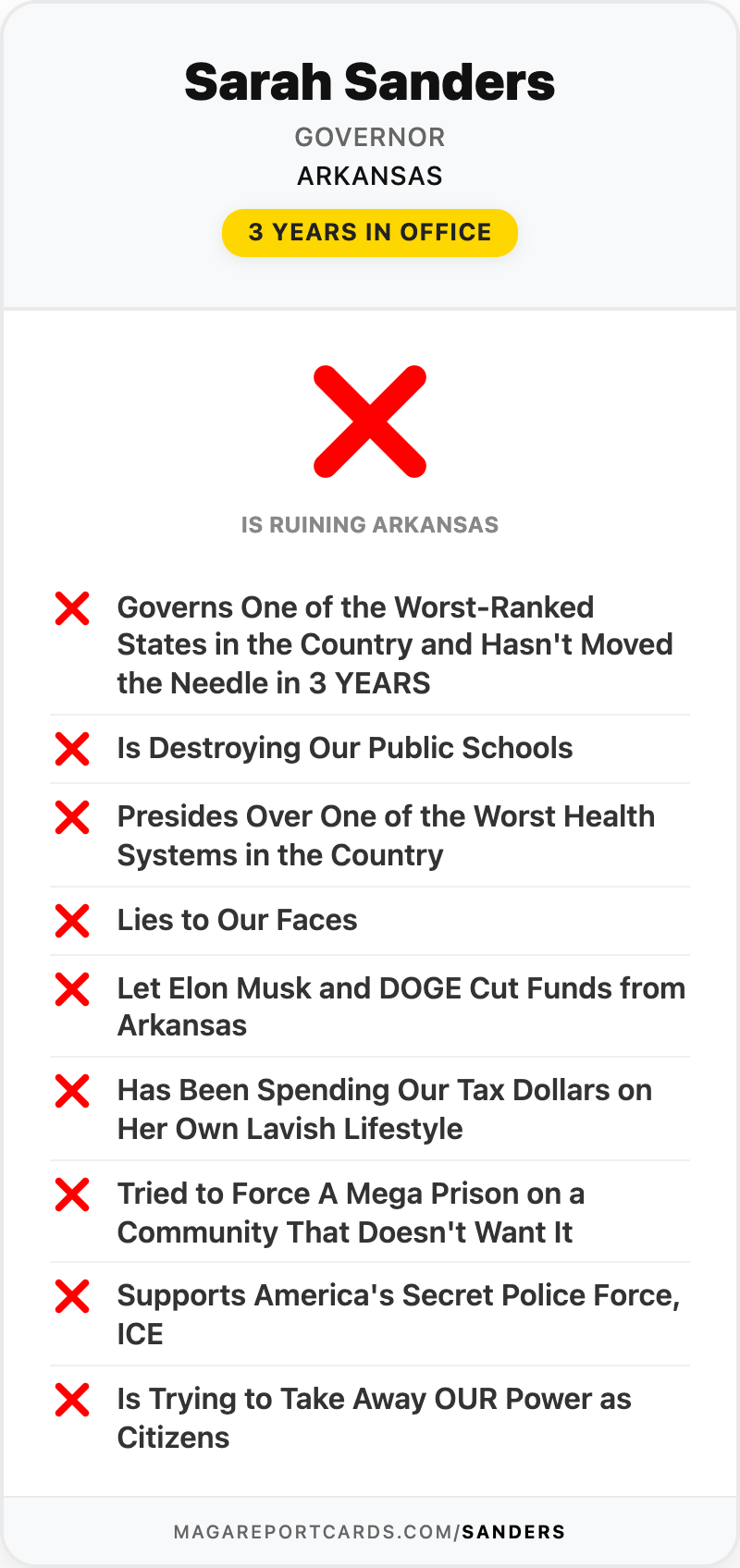
This isn't the first time Sanders has answered a loss by going after the people who beat her. When Republican senators blocked her $750 million mega-prison five times, she recruited primary challengers against two of them and lost both races.
The pattern is the same here. The board said no to more beds in understaffed prisons. The courts said the board was in charge. So Sanders swapped out the board and tried to have her own appointees settle the case in her favor.
The short version
Sarah Sanders signed two laws that took Arkansas's prisons out of the independent board's hands. Courts ruled against her at least four times, including the state Supreme Court. So she filled the board with her own appointees, led by her former deputy chief of staff, and they signed a deal declaring the laws constitutional. On September 25, Judge Patti James rejected it as "an unjustifiable attempt to usurp the power of the people," and the laws stay struck down.
Source
Judge rejects collusive settlement agreement between Sanders and corrections officials — Arkansas Times, September 25, 2026.