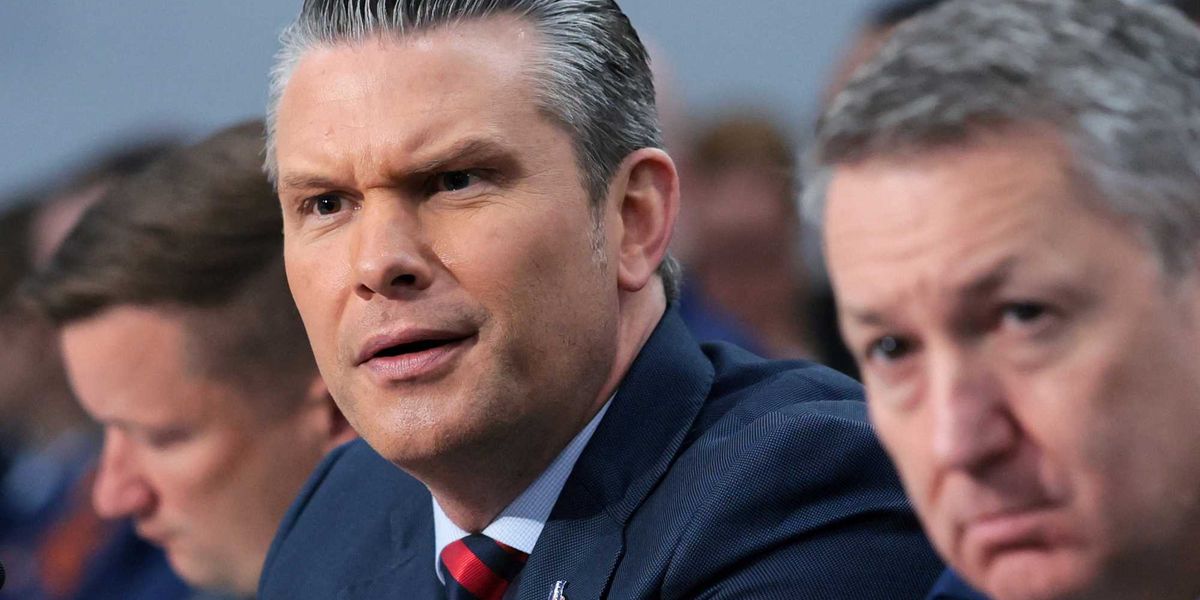
On April 22, 2026, state officials in Sioux Falls picked up ceremonial shovels and broke ground on the most expensive state-funded building project in South Dakota history — a 1,500-bed men's prison with a $650 million price tag.
The men in charge of it spent the ceremony making an argument that would have sounded radical in the state a few years ago. Corrections Secretary Nick Lamb told the crowd the new facility would lay the groundwork for a modern, rehabilitative approach to public safety. The old penitentiary, which predates statehood, was designed for an era when inmates were warehoused rather than helped to readjust to society.
"We have to do better" in South Dakota. "We have to get better at rehabilitation, and this facility will help us do that."
That is the whole idea behind the First Step Act — the federal prison and sentencing law that passed Congress in December 2018 and that President Trump signed into law. Give people in prison programs that work, let them earn their way to an earlier release, and fewer of them come back.
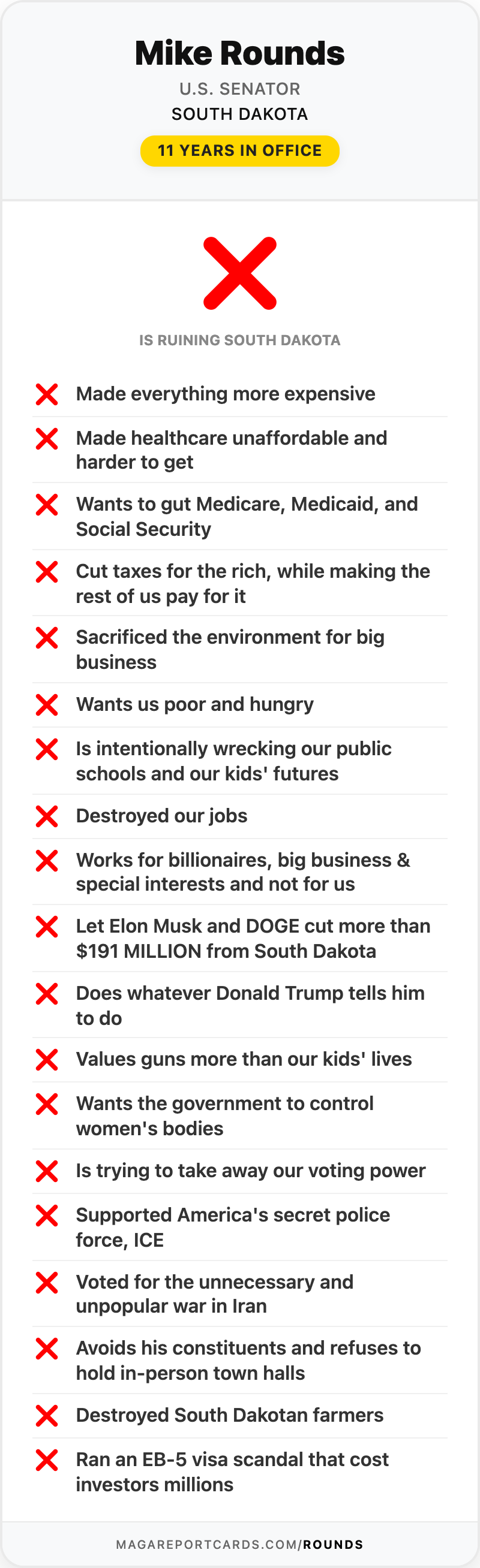
Mike Rounds voted against it.
One of twelve
The First Step Act cleared the Senate on December 18, 2018 by a vote of 87 to 12. Eighty-seven senators from both parties said yes. Twelve said no.
Rounds was one of the twelve. So were John Barrasso, Tom Cotton, Mike Enzi, John Kennedy, Jon Kyl, Lisa Murkowski, Jim Risch, Marco Rubio, Ben Sasse, Richard Shelby and Dan Sullivan. That is the entire company he kept on a bill the sitting Republican president had personally pushed and would sign three days later.
What he said at the time
The day after the vote, Rounds put out a statement explaining himself. The language is worth reading closely, because almost every piece of it has since been tested against reality.
"I support the intent of criminal justice reform, particularly for nonviolent offenders, but the First Step Act fails to adequately protect South Dakota families from violent criminals who should remain behind bars."
"We can't be soft on crime when we're facing a serious drug epidemic across our state and nation."
"Without the support of our attorney general and local law enforcement officials — who will be the ones dealing with dangerous criminals released early from the federal prison system — I could not in good conscience vote in favor of legislation that poses a threat to public safety."
Three claims: the law would free violent criminals, it was soft on drugs, and law enforcement was against it.
He was right about the list. He was wrong about "walk free."
Start with the violent criminals, because this is the part Rounds got right and it is worth saying so. His statement came with a list — "Types of crimes that will now be eligible for early release" — and each line carried a statute number: bank robbery by force or violence, assaulting a law enforcement officer, assault with a dangerous weapon, coercing a child to engage in prostitution or any sexual activity, hate crimes.
Check the list against the law and it holds up. The First Step Act's exclusion is not a category. It is a list of 68 enumerated provisions of federal law, written into the bill, and the line falls in places a summary won't show you. It bars assaulting a federal officer "using a deadly or dangerous weapon or inflicting bodily injury" — 18 U.S.C. § 111(b) — but not § 111(a), the subsection Rounds cited. It bars bank robbery resulting in death, § 2113(e), but not bank robbery by force, § 2113(c). Hate crimes under § 249 are not on the list at all, and neither is § 2422(b), coercing a child into sexual activity. Every offense on his list really is missing from the statute.
What he got wrong is the rest of his own sentence: "Allowing violent criminals to walk free." Nobody walks free. Time credits are applied toward prerelease custody or supervised release — home confinement under "24-hour electronic monitoring," or a halfway house. And before the Bureau of Prisons moves anyone, 18 U.S.C. § 3624(g) requires that the person have been scored "a minimum or low risk to recidivate" on their last two reassessments — or that a warden sign off that they "would not be a danger to society" and are "unlikely to recidivate."
So the argument was never whether the bill had guardrails. It was where to draw the line, and whether a risk score can be trusted. Those are real questions — and eight years on, there is an answer to them.
Now the law enforcement part. Rounds said he couldn't vote yes "without the support of our attorney general and local law enforcement officials." South Dakota Attorney General Marty Jackley did raise concerns, and Rounds' release names ten national organizations that opposed the bill. But the Fraternal Order of Police, which represents more than 330,000 officers, endorsed it — and so did the National District Attorneys Association. FOP national president Chuck Canterbury said the bill would "make our streets and neighborhoods safer".
Law enforcement wasn't against it. Law enforcement was split, and Rounds counted one side.
And then the results came in
The Council on Criminal Justice went back and checked what happened to the people released under the law. Roughly 30,000 people came home under its provisions between 2020 and 2022. Their recidivism rate was 12.4% — compared to an estimated 19.8% for people in similar situations released before the law existed. That is an estimated 37% lower rate, though the Council cautions that its findings "should not be interpreted as an impact assessment of the FSA."
Fewer crimes. Fewer victims. Fewer prison beds needed. That is the bill Rounds said "poses a threat to public safety."
Meanwhile, in South Dakota
Here is why this is not an old vote about a distant federal agency.
South Dakota incarcerates 812 people out of every 100,000 — a higher share of its own residents than any independent democratic country on earth. Roughly 8,200 South Dakotans are behind bars.
And the state is losing ground. In December 2025, the Department of Corrections released its annual report: half of everyone released from a South Dakota prison is back within three years. That is the highest rate in at least eight years, and seven points worse than the year before. Among Native Americans it's 59%. Among Native American women it's 66%. Native people make up 39% of the state prison population.
That is the population the new $650 million building is being sized for.
The $2.7 million South Dakota wouldn't spend
The new prison came with a promise. To win over skeptical legislators, Gov. Larry Rhoden created a Correctional Rehabilitation Task Force. Sioux Falls Mayor Paul TenHaken agreed to host the prison in his city, and in offering that support he pleaded with the state to fund rehabilitation programs alongside it.
Then the 2026 legislative session happened. House Bill 1086 would have given the Department of Corrections $2.7 million over five years for leadership training aimed at cutting repeat offenses. It got through the Joint Committee on Appropriations 10-6. It died on the House floor 42-23, short of the two-thirds needed for spending bills. Lawmakers cited cost and doubts about whether it would work.
At the groundbreaking, TenHaken said lawmakers "unfortunately" shot the money down, and repeated what he hears inside the penitentiary walls:
"They talk less about the building — and I know we need the facility — but we talk a lot about the need for programs."
$650 million for the building. Not $2.7 million for the programs. That is the same instinct Rounds acted on in 2018, scaled down to a state legislature.
About that drug epidemic
Rounds' loudest line was the drug one — we can't be soft on crime "when we're facing a serious drug epidemic."
In 2024, 91% of male inmates and 97% of female inmates in South Dakota prisons had a substance abuse problem. Treatment is the drug policy. Everything else is storage.
So look at what Rounds has actually done about paying for that treatment. Medicaid is the single largest payer of behavioral health services in the country, and 21% of Medicaid enrollees have a substance use disorder. Rounds voted for Trump's budget bill in July 2025 — every Senate Republican did except Susan Collins, Rand Paul and Thom Tillis — and KFF projects that the law's Medicaid changes will leave about 9,000 more South Dakotans uninsured by 2034, with the state losing $931 million in federal funding for the program over ten years.
You cannot call addiction an emergency and then vote to take away the thing that pays to treat it.
Tough on crime, depending on the crime
There's a pattern here that goes well beyond one senator. Republicans in Congress have been perfectly willing to write new prison time into law — when the defendant is the right kind of defendant. Jason Smith, who chairs the House's tax committee, buried a provision doubling the maximum prison sentence to 10 years for leaking someone's tax return on page 1,081 of Trump's budget bill. That's the punishment reserved for exposing what billionaires pay in taxes.
And at the other end, the mercy has been flowing freely — to the connected. A convicted fraudster from the Jack Abramoff scandal gave $2,600 to a Republican congressman's PAC and was pardoned by Trump three days later.
Harsher sentences for leaking a tax return. Pardons for donors. And a no vote on the one law that measurably reduced the number of people cycling back into federal prison.
He's on the ballot
Rounds won his primary on June 2, 2026 and faces voters again on November 3, running for a third term.
South Dakota now has a $650 million prison going up, the highest recidivism rate it has recorded in at least eight years, and a corrections secretary standing in a construction site saying "we have to do better." Eight years ago, Rounds had the chance to vote for a law that did better — a bipartisan one, endorsed by the country's largest police union, signed by the Republican president whose agenda he votes for.
Eighty-seven senators figured it out. He was one of twelve who didn't.
Source
Cost savings and improved outcomes emphasized at men's prison groundbreaking — South Dakota Searchlight, April 22, 2026. Photo by John Hult/South Dakota Searchlight.