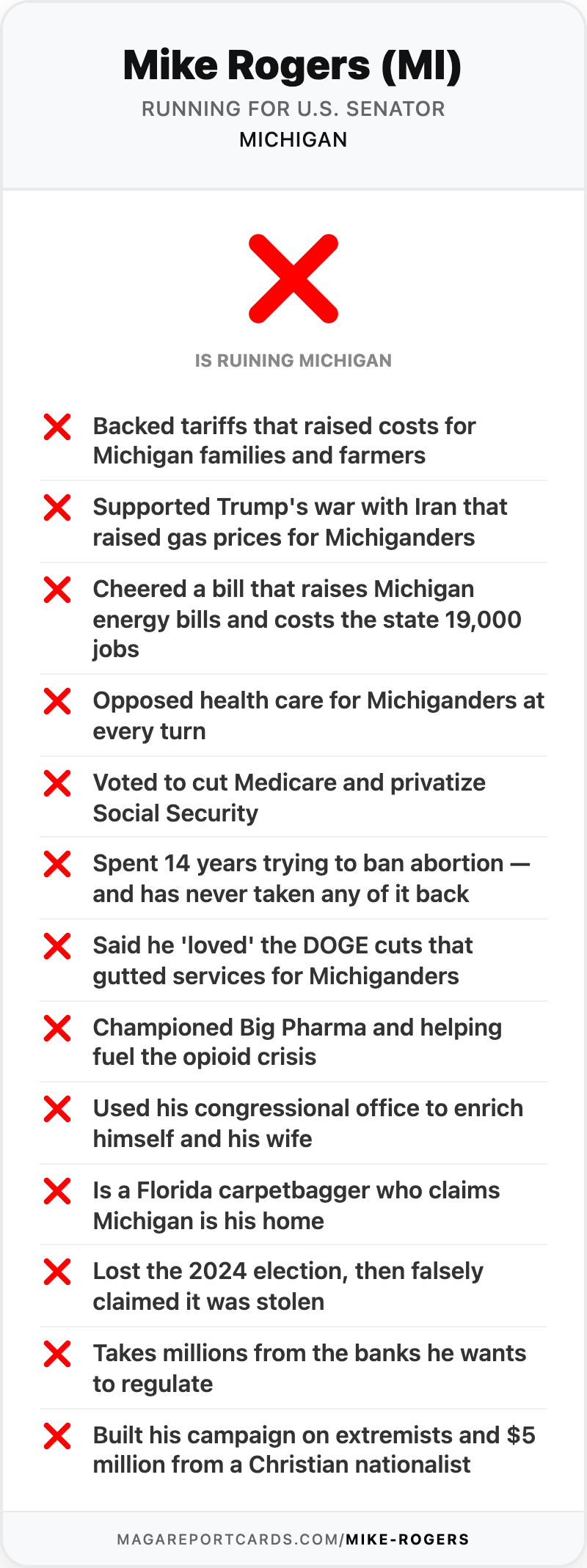
There is a process in Michigan for a candidate who thinks an election was stolen from him. You can request a recount. You can file a lawsuit. Both cost money and both put you in front of a judge who will ask what evidence you have.
Mike Rogers (MI), the Republican running for Michigan's open U.S. Senate seat, did neither one.
The spokeswoman for the Michigan Secretary of State told The New York Times this week that he never formally raised concerns about the 2024 results — no recount request, no court challenge. She described the state's elections as "safe, secure."
What he did instead was tell rooms full of Republicans that a van carrying ballots in Detroit "swung the election" on him. And when the president said the same thing out loud, Rogers put it in a fundraising appeal.
That's the whole story. A claim serious enough to raise money on, but not serious enough to take to a judge.
He knew better, and he said so in writing
This is the part that separates Rogers from most of the people saying these things.
He didn't stumble into 2020 confused. He was a CNN commentator with fourteen years in Congress behind him, including four as chairman of the House Intelligence Committee — a job whose entire purpose is telling the difference between evidence and noise.
And he used it. On January 5, 2021 — the day before the Capitol was attacked — he published a column in the Washington Post arguing that the election was over and Republicans should get back to governing. He wrote that Trump sounded "more gangster than presidential" leaning on Georgia's top election official to overturn a race Trump had lost, and he called that election free and fair. We've written before about what he put in that op-ed and what he says now.
He kept going after that. He said Trump's efforts to undermine the results were cause for concern and alarm. On Trump's responsibility for January 6, he said: "You're damn right you had responsibility for this." In 2022, while sniffing around a presidential run of his own, he called the tactics "clearly destructive" and said Trump's time had passed.
Then he decided he wanted the Senate seat.
The moment he stopped answering
The pivot has a date on it.
In June 2024, the Detroit Free Press editorial board asked Rogers a question with one true answer: did Joe Biden win the 2020 election?
He didn't answer. Asked again, he said this instead:
"Having an argument about is or isn't the guy who has been president for four years — my argument is it's been pretty much a disaster."
The board endorsed Justin Amash over him and wrote that his transactional approach to politics, his ideological inconsistency, and his obeisance to Trump made him a poor fit for the seat.
Notice the technique, because he uses it every time. He does not say the election was stolen. He declines to say it wasn't, and lets the audience fill in the rest. Two months after that interview he won the primary. Then he lost the general to Elissa Slotkin by 19,006 votes — while Trump carried Michigan on the exact same ballots.
No recount. No lawsuit. A fundraising appeal.
A year after conceding without a word about fraud, Rogers started telling Republican audiences about the van.
Christopher Thomas, who ran Michigan's elections for more than three decades and now advises Detroit's election officials, told the Times that Rogers "knows better" — that no one stole the election from him in 2024, and no one stole 2020 from Trump either. Thomas has said before that a morning batch of drop-box and Election Day registration ballots showing up the next morning wouldn't be unusual, and that Republicans had a full complement of challengers watching Detroit's count in 2024.
Even Rogers' own supporters can't keep the story straight. Linda Lee Tarver, a Republican activist who is serving on his campaign's coalition of religious leaders and who backed the 2020 effort to overturn Michigan's results, told the Times she didn't blame Rogers for opposing those efforts six years ago: "He didn't have all the information."
That is the kindest possible reading, and it still says the man who chaired the House Intelligence Committee was the last person in the room to figure out what was going on.
Here is what he has never done, in the two years since: produce a name, a document, a sworn complaint, or a filing. His campaign didn't give the Times any evidence either. His spokeswoman changed the subject to Democrats undermining faith in elections.
What he's actually promising to do about it
This is where it stops being a grievance and starts being a policy.
When Rogers campaigned with Trump in Michigan last month, he told the crowd that if he's elected to the Senate he would help pass the president's voting legislation: nationwide voter ID, a documentary proof-of-citizenship requirement to register, and new limits on voting by mail.
Every piece of that has a cost, and it doesn't land on the people committing imaginary fraud.
- Proof of citizenship. The SAVE Act would require documentary proof to register to vote. More than 21 million Americans of voting age don't have ready access to it. Married women whose current name doesn't match their birth certificate get swept in too. We broke that bill down here.
- Limits on mail voting. Trump has already tried this by executive order, and two courts blocked it, pointing out that the Constitution gives states — not presidents — the power to run elections.
- The fraud it's meant to stop. Trump's primetime claim that hundreds of thousands of noncitizens are registered to vote didn't hold up. We went through the numbers: noncitizen voting is already illegal and already vanishingly rare, and Republicans spent years breaking the one federal tool that could have measured it.
Rogers isn't proposing to fix a problem he documented. He's proposing to change the rules over a story he told.
Trump says it for him, and Rogers cashes it
The president has now claimed Rogers' 2024 loss was rigged at least three separate times.
At the Detroit Economic Club on January 13, standing in the city Rogers blames, Trump said it directly: "I'll be honest with you, Mike. They rigged the election on you. Mine was too big to rig. You won, I'm telling you, you won." Rogers posted the remarks on X and worked them into a fund-raising appeal.
He said it again on stage with Rogers in Michigan last month. And this past Friday, in an interview with Punchbowl News, he said it once more: "I happen to think he won." Asked to explain, he added, "No, no, I think it was a rigged deal. I think they rigged him out of it."
Trump won Michigan by 1.4 points on the same day Rogers lost it by 0.3. For the theory to work, the fraud had to be precise enough to steal a Senate seat and leave the presidential race alone.
That kind of arithmetic doesn't seem to trouble Michigan Republicans. At the same rally, John James told the crowd Trump had won Michigan "three times" — a state Trump lost in 2020 by more than 154,000 votes.
Two campaigns, running at the same time
Rogers is not actually betting on election denial to win in November. He's betting it gets him through the base while he sells something else to everyone else.
On Friday he posted a video aimed straight at Democrats — housing, education, taxes. "You have a home with us," he said.
Fred Upton, the former Michigan Republican congressman who served with Rogers and still calls him a friend, described the trajectory bluntly: "Now he's toeing the MAGA line." Upton also predicted the swerve back to the middle is coming, because that's what winning a swing state takes — voters, he said, will see "the old" Rogers again.
He has reason to think so. Epic-MRA polling in June put Trump's job approval in Michigan at 33%, with 63% disapproving — the lowest of either of his terms in the state.
So which Rogers shows up on the ballot? Michigan voters have already seen the pattern this month. Days after winning the primary, he claimed his Democratic opponent "believes America deserved 9/11" — words spoken by a Twitch streamer in 2019, not by Abdul El-Sayed, who had said the opposite on Fox News. PolitiFact rated it Pants on Fire, their worst rating.
There's a simple test for whether someone believes an election was stolen: they go to court. Rogers went to a donor list.
Source
Michigan Senate Candidate, a Former Trump Critic, Shifts Toward Election Skepticism — Beth Reinhard, The New York Times, August 9, 2026. Photo: Brittany Greeson for The New York Times.