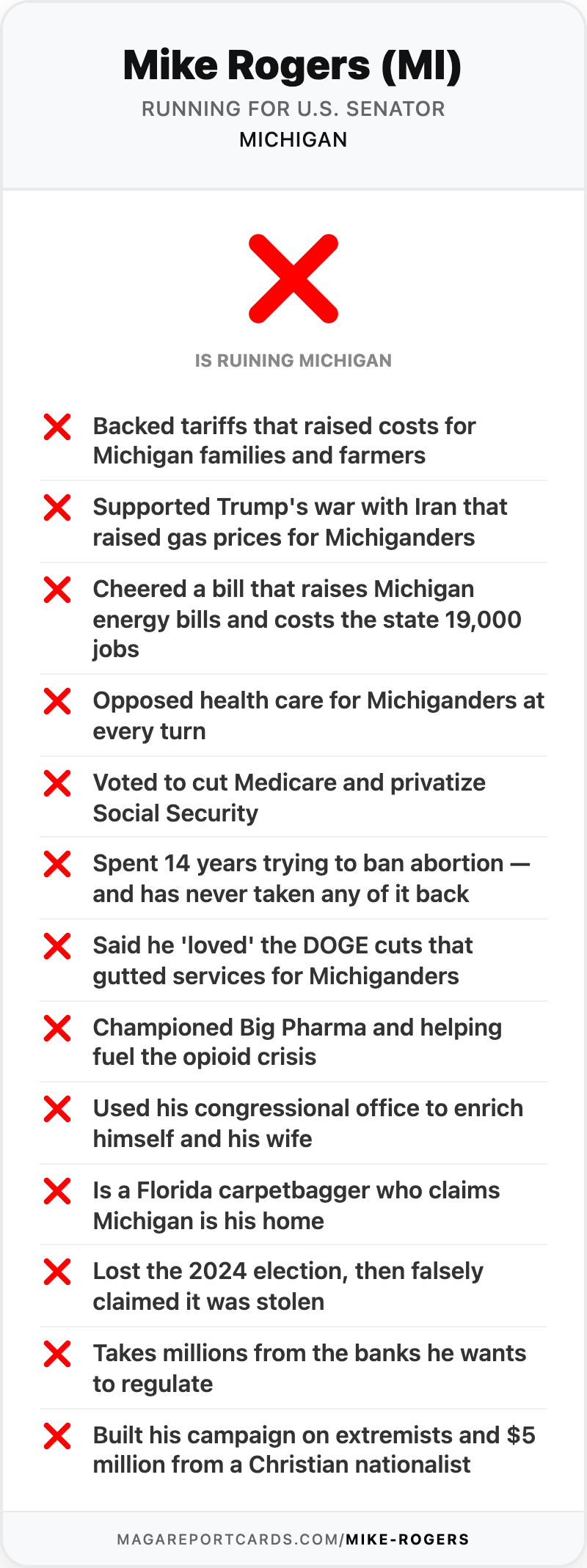
The day after Michigan's primary, Mike Rogers (MI) decided the first thing voters should hear about his opponent was a comment his opponent never made.
"Never in a million years did I think that I would be running against someone who believes America deserved 9/11," Rogers said in a statement. PolitiFact rated it Pants on Fire — their worst rating. The quote came from a Twitch streamer named Hasan Piker, in 2019, and Piker took it back two days later. Abdul El-Sayed never said it. We wrote about that one already.
When it was pointed out that El-Sayed hadn't said it, the Rogers campaign shifted the goalposts to a purity test:
"Abdul was asked point blank if he'd disavow Hasan Piker's comments, and he wouldn't do it. That tells you everything you need to know."
So that's the Rogers standard. You are responsible for what people connected to you say. If you won't disavow it, that tells us everything.
Fine. Let's apply it to him.
"Good, I'm glad he's dead"
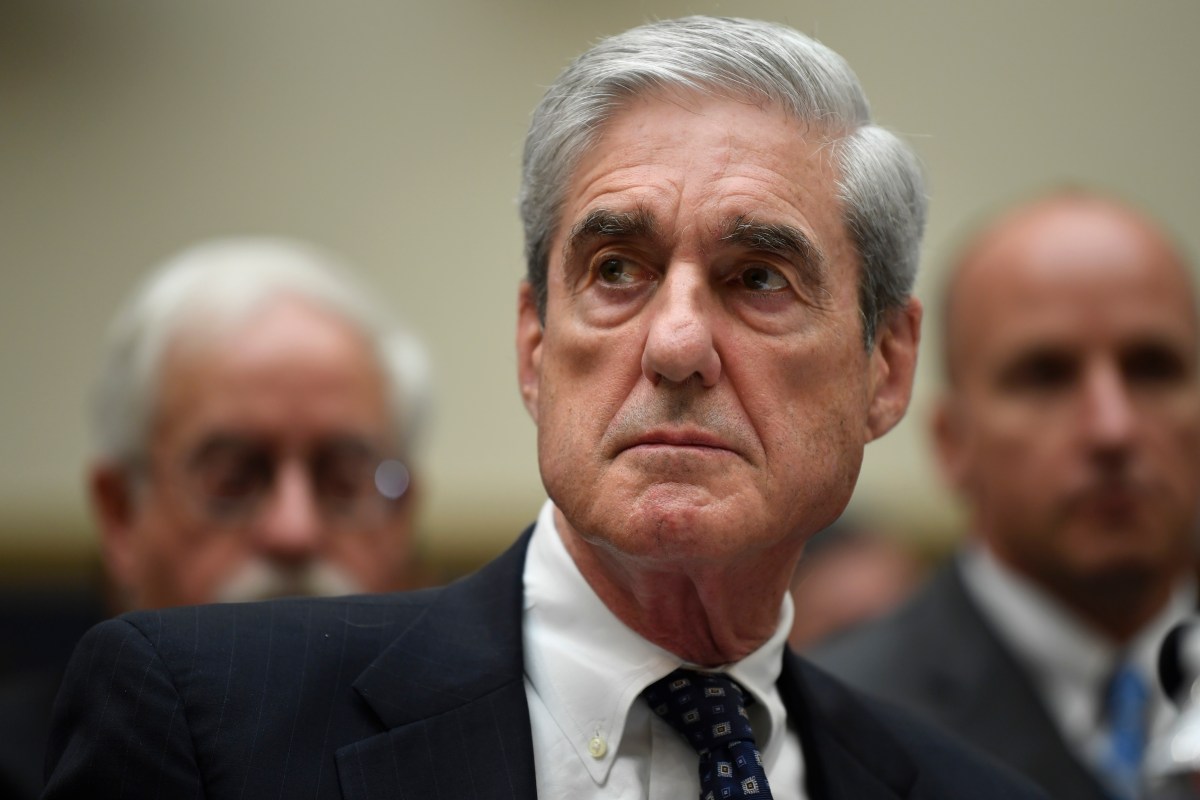
Robert Mueller died on a Friday night in March 2026. He was 81. He was a Marine who earned a Bronze Star and a Purple Heart in Vietnam. As a federal prosecutor he built cases against the mob boss John Gotti and the Panamanian dictator Manuel Noriega. He ran the FBI from 2001 to 2013 — the second-longest-serving director in the bureau's history — and he rebuilt it after 9/11, moving 2,000 agents into national security work and turning the FBI's top job from solving crimes into stopping attacks.
The next afternoon, the President of the United States posted this on Truth Social:
"Robert Mueller just died. Good, I'm glad he's dead. He can no longer hurt innocent people!"
That is the whole post. Not a criticism of Mueller's investigation. Not a policy disagreement. A man died and the president said he was glad.
Some Republicans did answer for it. Rep. Don Bacon of Nebraska, who is retiring this year, called it "clearly wrong and unchristian behavior" and added that "the vast majority of Americans want better." Fox News analyst Brit Hume wrote that this is "the kind of stuff Trump does that makes people not just oppose him but hate him. There was no need to say anything."
Rogers said nothing. We looked. There is no public statement from him about it, and no sign any reporter has put the question to him.
And then there was Rob Reiner
This was not a one-off.
In December 2025, the director Rob Reiner and his wife Michele were found dead in their Los Angeles home. Police investigated the deaths as a homicide and took the couple's son into custody.
The next morning, Trump posted that Reiner had "passed away, together with his wife, Michele, reportedly due to the anger he caused others through his massive, unyielding, and incurable affliction with a mind crippling disease known as TRUMP DERANGEMENT SYNDROME, sometimes referred to as TDS." He said Reiner was "known to have driven people CRAZY" and described his "obvious paranoia." Then he ended with "May Rob and Michele rest in peace!"
Two people were killed in their house, and the president suggested they had it coming because they didn't like him.
The timing made it worse. Conservatives had spent that weekend saying the right would never celebrate a political opponent's killing, drawing a contrast with reactions to Charlie Kirk's murder three months earlier. Then Trump posted.
Rep. Marjorie Taylor Greene — a Trump ally — said flatly: "This is a family tragedy, not about politics or political enemies."
Rep. Thomas Massie of Kentucky went further, and he named exactly what we're describing here:
"I guess my elected GOP colleagues, the VP, and White House staff will just ignore it because they're afraid? I challenge anyone to defend it."
Massie issued that challenge in December. Rogers has not taken him up on it.
Rogers isn't a bystander here. He knew Mueller's work.
This is the part that should sting.
Before Congress, Rogers was an FBI special agent in the Chicago field office, working organized crime and public corruption. He then spent fourteen years in the House, and from 2011 to 2015 he chaired the House Intelligence Committee — the panel that oversees the intelligence side of the FBI.
Mueller ran the bureau for twelve of Rogers's fourteen years in the House.
And Rogers didn't just tolerate him. On May 12, 2011, Chairman Rogers put out a press release under his own name titled "Chairman Rogers Supports Term Extension for FBI Director Robert Mueller." Obama wanted Mueller to stay two years past his ten-year term. Rogers, the Republican chairman, publicly backed it.
Two years after that, when Mueller was finally stepping down, the FBI Agents Association asked Obama to make Rogers the next director. Rogers was thrilled:
"I am honored to have the confidence of the men and women of the FBI's Special Agent community, and am humbled by their endorsement of me to lead the Bureau."
So when Rogers stays quiet about "I'm glad he's dead," he isn't staying quiet about a stranger. He is staying quiet about a man whose term he publicly backed extending, at an agency he served in, in a job he wanted for himself.
The 9/11 problem
Here's where the two halves of this meet.
Rogers opened his general election campaign by invoking 9/11 against his opponent — falsely. He didn't stop at the statement, either. His campaign posted a video that same day, captioned "I spent my life hunting terrorists. I never in a million years thought I’d hear the words, ‘America deserved 9/11.’" It was part of a broader Republican push we've been tracking.
Robert Mueller is the person who remade American counterterrorism after 9/11. So Rogers is willing to put 9/11 in a campaign video, and unwilling to say one word when the president of his own party celebrates the death of the man who spent twelve years trying to prevent the next attack.
That's not a gotcha. That's the same week's news.
And El-Sayed, for his part, actually answered. He said on Fox News, "Of course I don't think 9/11 was justified." He called Piker's 2019 line "a dumb statement" on Meet the Press. He was asked, on camera, repeatedly, and he answered. That is the disavowal Rogers said never happened.
Why Rogers won't say anything
Because he can't afford to.
Trump endorsed him — "He is one of the best candidates we have anywhere," Trump said. Rogers needs that endorsement, and he needs Trump's voters, and he has already shown us what he'll trade for them.
In 2021, Rogers wrote that Trump's attempt to overturn the 2020 election was "behavior... seen in Third World dictatorships, not the leading democracy in the world." Today he tells Republican audiences that a van full of ballots stole his own 2024 race, with no evidence at all. We laid that reversal out here. A man who will abandon his own words about democracy is not going to risk a Truth Social post about a dead FBI director.
The pattern is the point. Rogers demands accountability in exactly one direction. His opponent must answer for a streamer's seven-year-old comment. Rogers doesn't have to answer for the sitting president who endorsed him — a man who put both of these things in writing, under his own name, in the last eight months.
Michigan reporters have Rogers in front of them constantly between now and November. It's one question:
Do you disavow the president's comments about Robert Mueller and Rob Reiner?
If he won't answer it, then by his own campaign's standard, that tells us everything we need to know.
Sources
- In Michigan Senate race, Mike Rogers falsely ties Abdul El-Sayed to Twitch streamer's 9/11 comments — PolitiFact, August 7, 2026
- Trump reacts to Robert Mueller death: 'I'm glad' — The Hill, March 21, 2026
- Trump says Rob Reiner's death caused by "Trump derangement syndrome" — Axios, December 15, 2025
- GOP Lawmaker Criticizes Trump's Reaction to Robert Mueller's Death — Newsweek
Photo: Robert Mueller testifies before the House Judiciary Committee, July 24, 2019. AP Photo.