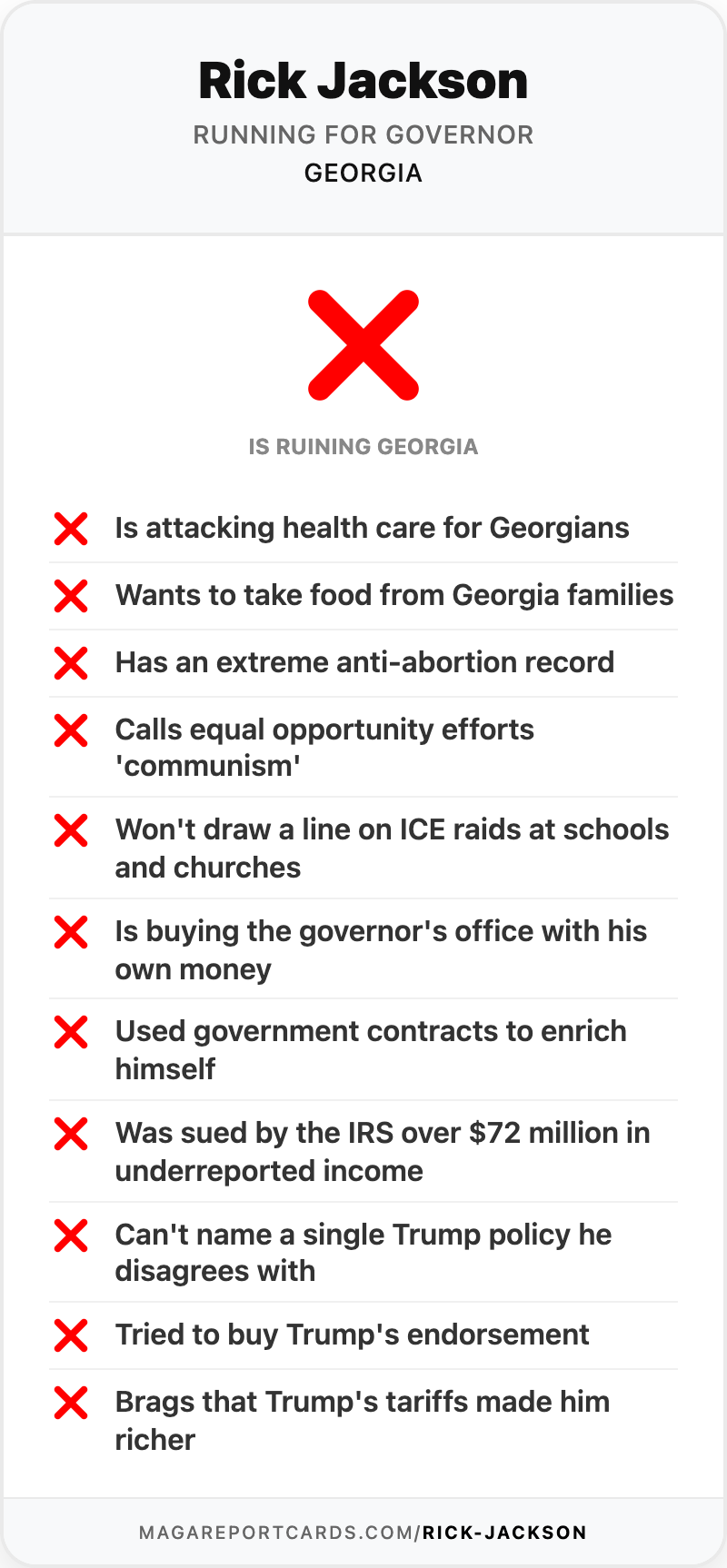
Rick Jackson is the Republican nominee for governor of Georgia. He made his fortune in healthcare staffing.
At an event in Buckhead on August 20, he explained his approach to Georgians who have no health insurance.
"You need to understand: Not having insurance in Georgia does not mean you don't have healthcare. There's a huge difference. Some people equate it. That is not true."
And on Medicaid:
"What I'm going to be doing is helping each of these people get off of Medicaid."
What he's actually describing
There is one thing that makes Jackson's first claim technically true. A federal law requires hospital emergency rooms to treat and stabilize anyone who comes in, regardless of whether they can pay.
That's it. That's the entire healthcare system he is describing.
State Rep. Michelle Au — a Democrat from Johns Creek who is also a practicing anesthesiologist — responded on X:
"That is not 'healthcare' in the sense that most people think of it. That is battlefield triage."
Au pointed out what an emergency room is not required to do: cancer screenings, annual physicals, ongoing maintenance, or preventive care.
An ER will stop you from dying today. It will not catch your tumor at stage one. It will not adjust your blood pressure medication. It will not keep your diabetes from taking your foot.
Leah Chan of the Georgia Budget and Policy Institute put the cost in plain terms: "When you're unable to take care of manageable health conditions, and to prevent sickness or injury, you are paying more down the line for more costly acute care, both as an individual and then we as a society."
That's the part that should matter to every Georgia taxpayer, insured or not. Treating a condition after it has turned acute costs more than managing it early — that is Chan's point — and the bill doesn't disappear. It lands on hospitals, as uncompensated care.
"Get off of Medicaid"
Jackson says he supports what he calls "intelligent Medicaid expansion." Asked what that means, he described it this way:
"That's what I'm going to be doing is helping each one of these people to get off of Medicaid. If they get onto commercial insurance that's a first stop of success for them so they can grow their career."
Georgia is one of a small number of states that has never expanded Medicaid under the Affordable Care Act. That decision is why the state has a "coverage gap" — people who earn too much to qualify for Georgia's very limited Medicaid, and too little to get much help buying a plan on their own.
Jackson's answer to that gap is that people in it should move onto commercial insurance so they can "grow their career." He did not say how someone whose job does not offer coverage is supposed to buy it.
And it's about to get worse
Georgia isn't holding steady on coverage. It's losing ground.
An estimated 150,000 Georgians will lose health coverage under Trump's budget bill, 32,000 of them losing Medicaid specifically. If the enhanced ACA premium tax credits are also allowed to expire, a Georgia-specific analysis projects that 492,000 Georgians will lose coverage and become uninsured by 2034.
Those are the people Jackson is telling to use the emergency room.
His website says two words about healthcare
Jackson's campaign site promises to "transform healthcare."
That is the whole healthcare policy. There is nothing else on it.
For a candidate whose entire public identity is that he is a healthcare businessman, that is a remarkable amount of nothing — and it isn't the first time. At the Georgia Chamber's annual luncheon in August, he told counties a data center could wipe out their property taxes while personally invested in one, and rejected Medicaid expansion in the same speech.
The staffing business that made him a billionaire has its own record with the people who actually deliver care. A company he owns paid $3 million to settle claims it trapped more than 5,000 immigrant workers in contracts they couldn't leave, with allegations it threatened to report nurses to immigration authorities if they tried to quit — while his campaign ran ads promising immigrants who break the law would be "deported or departed."
What we know
Rick Jackson, a healthcare billionaire running to govern Georgia, told an audience that not having insurance "does not mean you don't have healthcare," and that his plan is to help people get off Medicaid. The only thing backing that claim is a federal law requiring emergency rooms to stabilize patients — no screenings, no checkups, no chronic care. A physician in the state legislature called it battlefield triage. Georgia has never expanded Medicaid, 492,000 Georgians are projected to lose coverage and become uninsured by 2034, and Jackson's campaign website's entire healthcare policy is the phrase "transform healthcare."
Source
Jackson campaign website promises to "transform healthcare," but nominee shuns Medicaid expansion — Doug Richards, 11Alive, August 24, 2026.