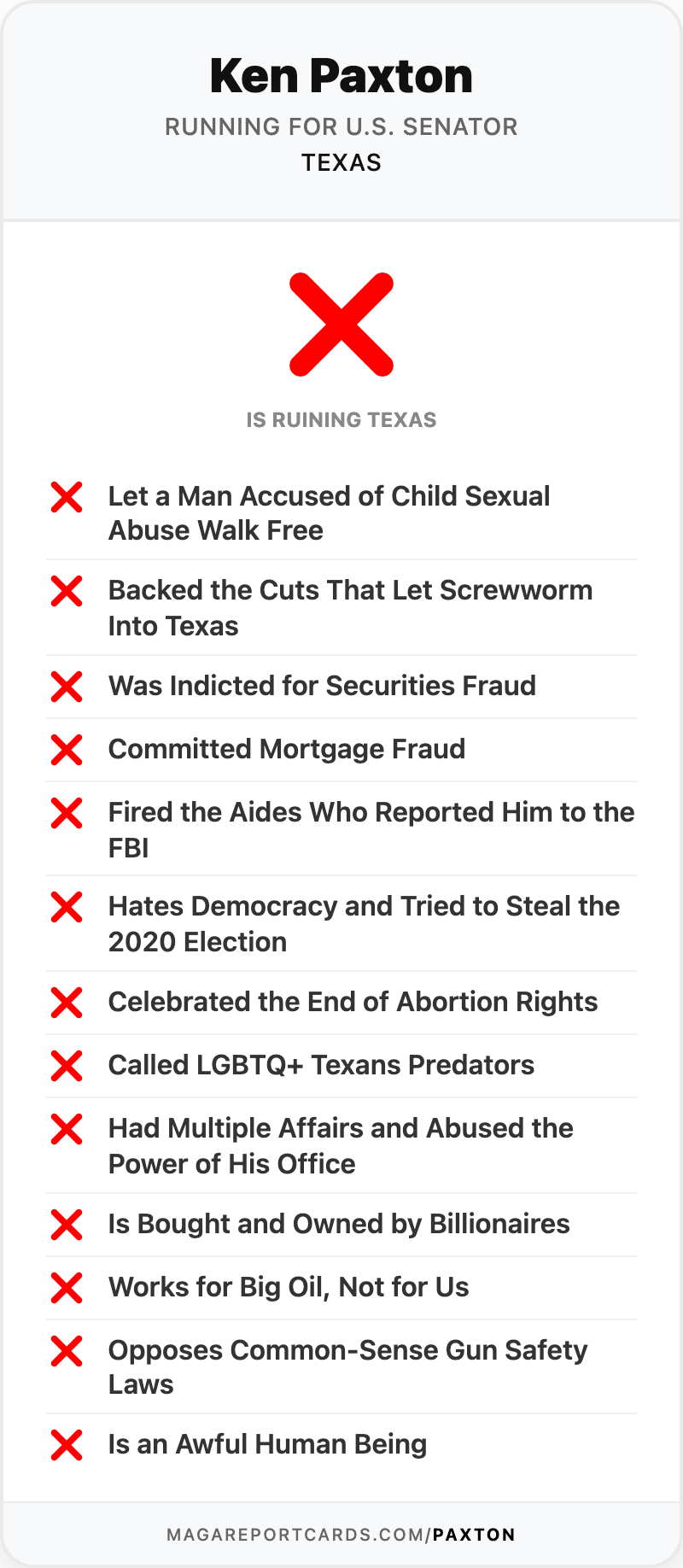
Ken Paxton has spent a decade making sure Texans never hear him answer questions about his money under oath. Now one of those answers is out.
On October 9, 2026, The New York Times published a leaked deposition that Ken Paxton gave in December 2014 to lawyers for the U.S. Securities and Exchange Commission. He had just been elected attorney general. The SEC was investigating whether he had secretly been paid to steer investors into a McKinney tech startup called Servergy. The Times says it confirmed the transcript is real.
It shows a man who accepted 100,000 shares in that company for free in place of a $100,000 check, said he couldn't find the stock certificates, and answered the government's questions with "I don't remember" or "I don't recall" more than 200 times.
The free stock
Paxton told the SEC lawyers that he met Servergy's founder, Bill Mapp, at a Dairy Queen in McKinney to hand him a $100,000 check for an investment. Mapp wouldn't take it, Paxton said, and gave him 100,000 shares instead.
His explanation, under oath: Mapp told him, "God doesn't want me to take your money."
The government's lawyers asked why a founder who was busy hunting for investors would give shares away to Paxton for nothing. Paxton answered, "It was not logical," then added that "Bill is a spiritual person." He said he never asked a lawyer whether it was appropriate to accept them. The shares later grew to be worth $200,000, according to Mapp's emails described in the deposition.
Paxton did list the shares on his state ethics filings — but as stock he held, not as a gift. Andrew Cates, an expert in Texas ethics law, told the Times that Paxton may have broken state rules by not disclosing that the shares were a gift.
"I'm so busy"
Asked where the certificates were, Paxton said he didn't know. He said he was too busy taking his daughter on college visits and getting ready to be attorney general. "I don't always keep track of this kind of stuff," he said.
He described a hands-off way of investing that grew his fortune while he was a state lawmaker: a member of his legislative staff would screen investment pitches, and he'd run ideas past Byron Cook, then a Republican in the Texas House, and other businessmen. At the time he had money in more than two dozen businesses, with $50,000 to $175,000 in each of the handful he discussed, and one investment that returned $250,000.
When the lawyers showed him his own tax return — which, they said, reported $100,000 from Servergy for "legal services" — Paxton pointed them to his wife, Angela. "My wife actually does them," he said.
Byron Cook, the lawmaker whose advice Paxton said he relied on, later accused him of steering Cook and others into Servergy without telling them he'd been paid.
How it ended: no trial, no conviction, no answers
That accusation became part of a 2015 state indictment on three felony counts. Paxton dragged the case out for nearly nine years. In 2024 he took a deal: community service, ethics classes and restitution to the investors, in exchange for prosecutors dropping the charges — with no admission of wrongdoing. The Times reports the restitution to Cook and another investor came to about $300,000.
The SEC's civil case went away too. A federal judge threw it out, ruling Paxton had no legal duty to tell investors he'd received something of value from Servergy's founder. That is a ruling about what the law required him to disclose — not a finding that he wasn't paid.
Nick Maddux, a senior adviser to Paxton, responded to the deposition by calling it "a 12-year-old deposition about a case that ended without a conviction, handed to the press by a political opponent." He did not dispute anything Paxton said in it.
He's still keeping his testimony sealed
The Times notes Paxton has been questioned under oath at least three times in the past decade, and none of those depositions were public until now.
Two more are still locked away. As we reported in August, Paxton sat for depositions in 2019 and 2022 in a separate securities fraud dispute, and his opponent's campaign is trying to get them unsealed while a lawyer for Paxton's wealth manager fights to keep them hidden.
Meanwhile his fortune keeps growing. The Times puts it at up to $23 million, including mutual funds, 15 properties in six states and a cell tower — the same tower the Times found sits on the campus of a hospital whose board he served on. On his federal disclosure, ProPublica and the Texas Tribune found he reported no rental income from homes that were listed for rent.
What the deposition shows
Under oath in 2014, Ken Paxton said he accepted 100,000 free shares in a company he brought investors into, without asking a lawyer whether he should, and couldn't say where the certificates were. He answered "I don't remember" or "I don't recall" more than 200 times, and when asked about $100,000 his tax return attributed to the company, he pointed to his wife. The criminal case built on the same deal ended in 2024 with about $300,000 in restitution and no trial.
Source
Inside Ken Paxton's Private Testimony About His Money — Lauren McGaughy, The New York Times, October 9, 2026