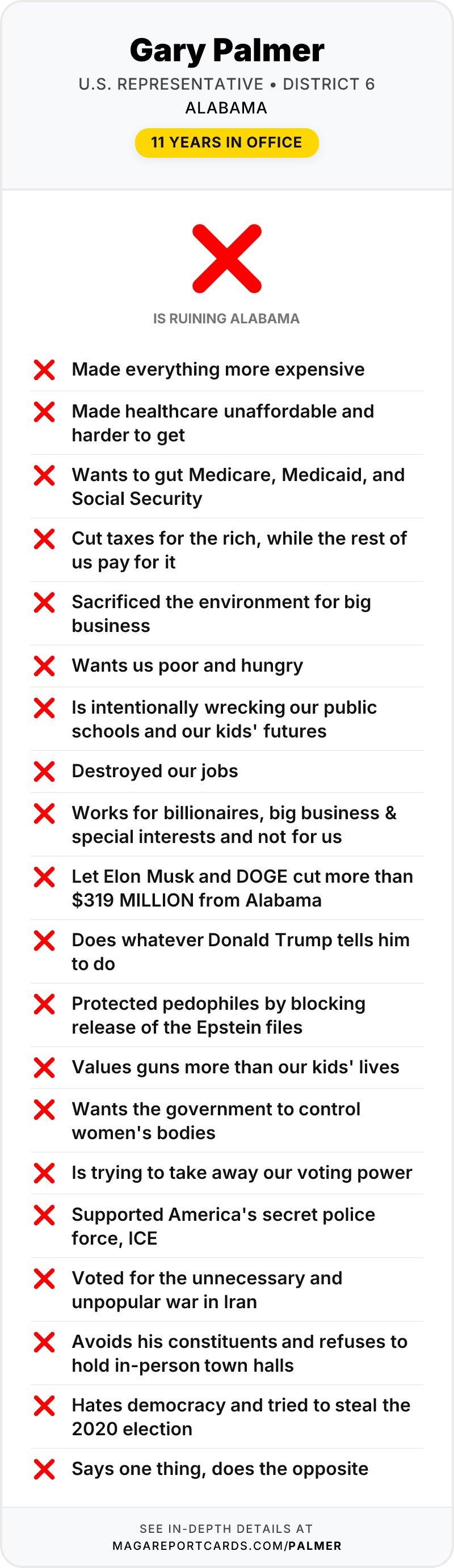
On Tuesday, August 11, 2026, Republican voters in Alabama's 6th Congressional District decide whether to send Gary Palmer back to Washington for a seventh term.
Twelve years ago, he told them he'd only take five.
What he promised
Palmer was first elected in 2014. That year he signed a pledge with U.S. Term Limits, a nonpartisan group, committing to cosponsor legislation capping House members at three terms and senators at two. As the Alabama Reflector reported, that pledge didn't require him to limit himself — but separately, on his own, he told voters he would serve no more than five terms.
Five terms is ten years. He's been there eleven, and he's asking for two more.
He does not dispute any of this. Asked about it in March 2023, as AL.com documented, Palmer said plainly: "I own that. I said I would serve only five terms."
The explanation
Here is where it gets unusual.
Palmer told Alabama Today that he made the five-term pledge at a candidate forum after another candidate did, and that he made it without much thought:
"I didn't pray about it. Sometimes you get ahead of God."
He said he intended to keep the promise right up until early March 2023, when he prayed to God "for clarity" about whether to run again. His account of what came back:
"I need to change my mind, so I am going to run again. God still has a plan for me. I need to change my mind, so I am going to run again. I know I am going to have detractors. I know people are going to question. I would rather not have it."
So the promise was made without praying, and the decision to break it came with praying. That's the structure of the story: the commitment to voters was the hasty thing, and staying in office was the considered thing.
That was for term six. He is now running for term seven.
He won't answer questions about it
The Alabama Reflector tried to talk to him. From their July 29, 2026 story:
"More than a dozen attempts were made to interview Palmer, including via email, since July 14. As of Tuesday afternoon, Palmer's campaign had not responded to questions."
His campaign also did not respond when the paper sought comment on his challenger's criticism of his record, or when it sought comment on the term-limit promise specifically.
This is a pattern, not a scheduling problem. Palmer has said he won't hold a town hall, either. Town-hall crowds, he said, "are not constituents, most of them. They bring in paid agitators." His office offers a monthly coffee event in Washington called Pastries with Palmer, not a forum where everyone hears the question and the answer.
Eleven years in office, and a man who won't take questions from a reporter or from a room.
Who's actually running against him
Case Dixon is 26, a physical therapist assistant from Hueytown, and a first-time candidate. He raised about $25,000 through June 30 — roughly a third of it his own money, according to FEC filings.
Palmer raised more than $1 million and spent nearly $988,000 over the same period, according to FEC filings. About half of it came from PACs.
Which is the real answer to the term-limits question. An eleven-year incumbent on the Energy and Commerce Committee has a donor base that a physical therapist assistant does not. Palmer's own funders include the PACs of Drummond Company, an Alabama coal company ($33,000), Alabama Power's employees, Regions Financial ($39,000) and Koch, Inc. ($35,000) — most of them industries his committee writes the rules for. Since 2020, less than 1% of his money has come from small grassroots donors.
That machine is what a term limit would have interrupted. It's also the thing his 2014 self said he wanted to interrupt.
In May, Palmer beat Dixon with 81% of the vote. Then roughly 76,000 ballots in that race were thrown out — voided when Alabama had to run a special election after the U.S. Supreme Court let the state use a 2023 congressional map that had earlier been struck down as racially discriminatory. So they're doing it again on August 11.
The bigger pattern
The broken pledge isn't the only time Palmer's words and his votes have pointed opposite directions.
In 2021 he put out a celebration of the $369 million for Birmingham's Northern Beltline that his legislation had put into the federal infrastructure law — leaving out that he had voted against the law that paid for it. It's the same move we've documented across the party: every Republican in Congress voted against the American Rescue Plan, then put out press releases bragging about the money it sent home.
And "I'm not one of the insiders" is a durable Republican campaign line that tends not to survive contact with the record. In Iowa, Joe Mitchell campaigns against a system that "works for insiders and lobbyists" — after founding and leading a real estate trade group that spent nearly $75,000 lobbying the Iowa Legislature.
What this asks of voters
Nobody has to think term limits are a good idea. Plenty of people don't.
But Palmer wasn't drafted into this. He stood in front of Alabama voters in 2014, told them ten years was enough, signed a pledge with a term-limits group, and then decided — twelve years later, after raising a million dollars and with a coal company and a power company on his donor list — that the plan had changed.
He can explain that to voters. The Reflector gave him more than a dozen chances starting July 14, and he didn't take one.
We deserve better.
Source
Longtime U.S. Rep. Gary Palmer faces first-time candidate in August special primary — Anna Barrett, Alabama Reflector, July 29, 2026. Graphic: Anna Barrett/Alabama Reflector. Palmer's 2023 comments were first reported by Alabama Today and documented by Howard Koplowitz of AL.com (linked above).