More than 300,000 Missourians signed a petition to put their state's new congressional map to a public vote. On Thursday, September 3, 2026, the Missouri Supreme Court ruled unanimously that they are entitled to that vote — and that because the referendum qualified, the 2025 map never legally took effect. November's election has to be run under the old lines.
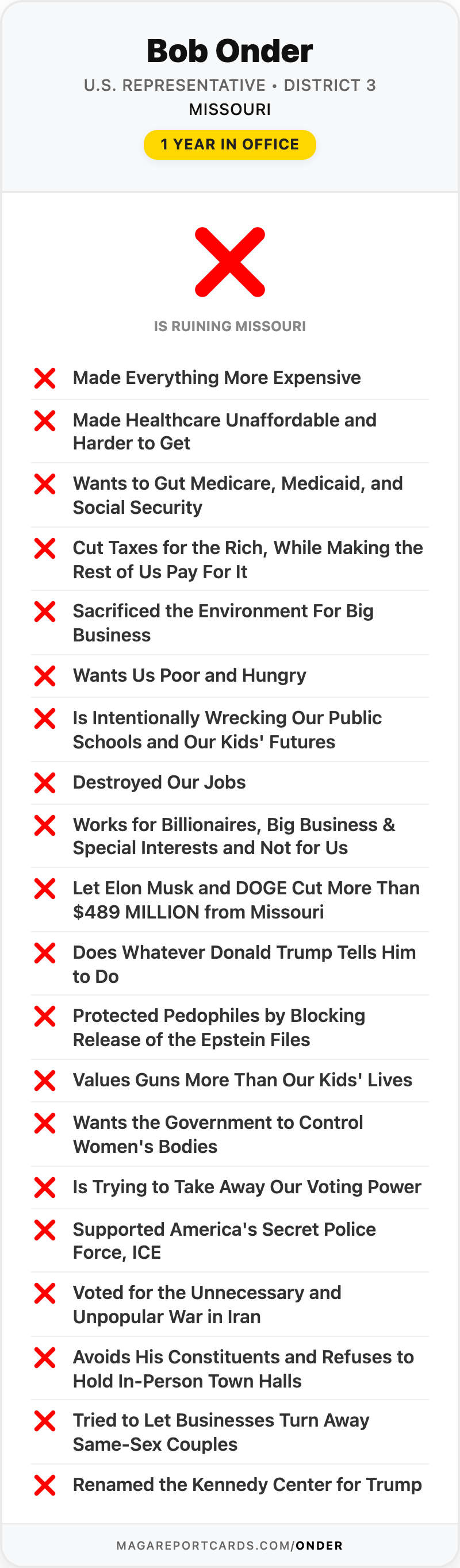
The next day, Bob Onder sued in federal court to take that away.
Onder, state Senator Rick Brattin and two Missouri voters filed suit on Friday, September 4 against Secretary of State Denny Hoskins in the U.S. District Court for the Eastern District of Missouri, ABC 17 News reported. They want November's election held under the 2025 map instead. Their lawyer, Marc Ellinger, argues that letting Missourians vote on their own congressional districts violates the U.S. Constitution's elections clause and the 14th Amendment's guarantee of equal protection.
The state's attorney general, Catherine Hanaway, filed a separate emergency appeal at the U.S. Supreme Court asking Justice Brett Kavanaugh to put the state court ruling on hold.
He is the man who asked for this map
This is not a bystander objecting to chaos. Onder had been pushing for a seven-Republican-seat map since 2022, when he was a state senator, and was one of four Missouri Republicans in the U.S. House who backed the 2025 redraw.
In August 2025 he told St. Louis Public Radio that the legislature should redraw the lines mid-decade:
"We are a Republican state. Republicans have supermajorities in the Missouri House and the Missouri Senate. Republicans hold all of our statewide elected offices, including, of course, governor. And I believe that we should pass a congressional map that reflects the values of the state of Missouri."
Asked whether the plan might backfire, he said the arithmetic was simple: "we have seats that have wide enough margins that I think it's pretty straightforward math to draw seven very safe Republican seats."
He got what he asked for. The 2025 map moved all of St. Charles County into his 3rd District — a long-running goal for Republicans there. We wrote about the redraw and the four Missouri Republicans who backed it in August.
Now the state's highest court has said Missourians get to vote on the same map, and Onder is in federal court arguing they should not.
The argument he is making
The case rests on the idea that Onder and Brattin are the ones being harmed. Brattin, who is running in the 5th District currently held by Democrat Emanuel Cleaver, put it this way:
"When you put in all this blood, sweat, tears, the time, all of this campaigning, yeah, it's really disenfranchising when you've done all that, and those people have believed in you and trusted you and cast their vote for you, to then say they're going to go to the ballot box and be voting in a completely different district."
Read that again with the actual sequence in mind. Republicans redrew the districts in 2025 to move voters between them. Citizens gathered 300,000 signatures to object. A unanimous court said the objection was valid and the old lines still stand. And the word for the inconvenience of campaigning in the wrong district, according to the candidate who lobbied for the redraw, is "disenfranchising."
Onder's brief makes the same move on behalf of two voters, Pat Thomas and Debra Havens, who say they are harmed because they must now "educate themselves about new candidates and issues."
Whose delay caused the mess
Missouri's own Supreme Court has already assigned responsibility for the confusion, and it did not point at the people who signed the petition.
People Not Politicians turned in more than 300,000 signatures in December 2025. Hoskins had the authority to rule the petition unconstitutional the moment it landed, and he had already made exactly that argument in federal court that same month. Instead he sent hundreds of thousands of signatures out for verification — asking local election officials to check every single one rather than use the random sample state law allows, which pushed the deadline from February to the end of July.
Then, at about 4 p.m. on August 4, 2026, roughly an hour before his legal deadline and while voters were casting primary ballots, Hoskins declared the referendum unconstitutional.
Judge Ginger Gooch, writing for the court, said in a footnote that his complaints about cost and confusion were "particularly misplaced given the secretary's delay created the confusion, expense, and practical difficulties of which he complains" — a sequence the Missouri Independent's Jason Hancock laid out in a commentary piece. All but two of the judges on that court were appointed by Republican governors, and the ruling was unanimous.
The pattern in one state
Missourians voted to expand Medicaid in 2020. They put abortion rights in the state constitution in 2024. They approved a minimum wage increase and paid sick leave the same year, and the legislature repealed the sick leave.
On August 4, 2026, they rejected Amendment 4 — which would have let a single congressional district veto future citizen initiatives — by 80 percent to 20.
The referendum on the gerrymander is the next thing they are supposed to get to vote on. Onder is asking a federal court to make sure it does not count this year.
What the record shows
Bob Onder publicly lobbied Missouri's legislature to redraw its congressional map mid-decade, said the goal was seven safe Republican seats, and ended up with all of St. Charles County in his own district. When 300,000 Missourians forced a referendum on that map and a unanimous state Supreme Court ruled they were entitled to it, Onder went to federal court on September 4, 2026 to have November's election run under the map anyway. The harm he alleges is that he campaigned in the wrong districts.
Source
Congressional candidates Onder, Brattin seek to overturn Missouri Supreme Court map decision by Alison Patton, ABC 17 News, September 5, 2026.