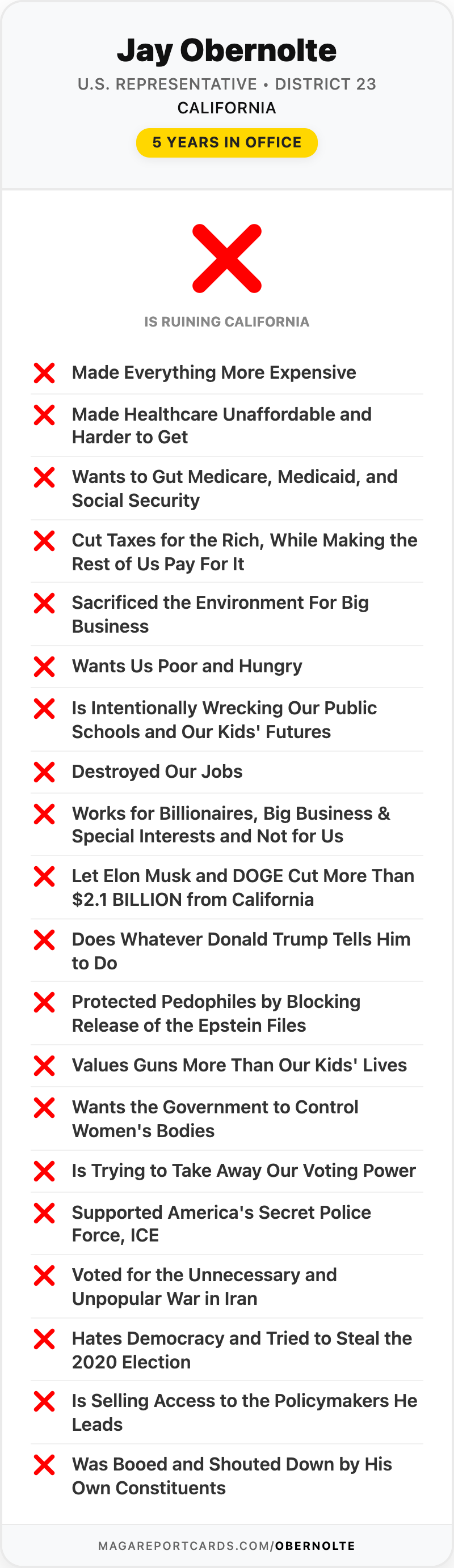
Jay Obernolte is the most powerful voice on artificial intelligence in the House of Representatives.
He chairs the Science Committee's Subcommittee on Research and Technology. He chaired the House's bipartisan AI Task Force. He sits on Energy and Commerce, including its Communications and Technology subcommittee. In April 2026 his colleagues elected him chair of the House Republican Policy Committee, a leadership job. He is, by his own office's description, "the only serving member of Congress with a graduate-level degree in AI."
He is also the author of the bill that would decide how — and whether — America regulates the most powerful AI systems ever built.
And in October 2025, an AI conference company and a venture capital fund launched a nonprofit that sells AI startups access to people exactly like him. Obernolte helped launch it.
What the AI Coalition Sells
The group is called the AI Coalition. HumanX, which runs a large AI industry conference, and the venture fund Humanrace Capital tapped Obernolte to launch it, Axios reported.
Here is how the coalition describes itself, in its own words:
"the first nonprofit specifically designed to provide early-stage AI companies, from pre-seed through Series B, with meaningful access to policymakers and influence over the regulations that will define the next decade of innovation"
Read that phrase again — not "a voice," not "education." Meaningful access to policymakers and influence over the regulations.
It is to be registered as both a 501(c)(3) and a 501(c)(6), HumanX CEO Stefan Weitz told Axios, so it can do education and lobbying. Membership runs $1,750 to $3,500 a month. The plan includes Washington fly-ins, collective advocacy, and business development events, according to an AI policy newsletter's account of the launch.
That's up to $42,000 a year, from a pre-seed startup, for access.
Obernolte's stated reason is sympathetic on its face: at AI hearings on Capitol Hill, he said, the voices of smaller companies and entrepreneurs were missing. That's a real problem. Big AI firms have armies of lobbyists and small ones don't.
But look at what the fix actually is. The problem is that access to Congress is bought. The solution on offer is a cheaper subscription to the same thing — sold with the endorsement of the congressman writing the rules.
If access to your own government has a monthly price, the answer isn't a discount tier. It's that access shouldn't have a price.
The Regulations He's Selling Influence Over
This isn't abstract. Nine months after the coalition launched, Obernolte introduced the bill.
On July 23, 2026, he introduced the FRONTIER Act (H.R. 9925) with five original cosponsors, among them Rep. Lori Trahan — the first serious attempt at a federal framework for frontier AI. It requires the biggest developers to publish risk frameworks, hire outside auditors, and report safety incidents to the Commerce Department.
Then there's Section 9. In the bill's own text:
"Except as provided in subsection (c), no State or political subdivision of a State may adopt or enforce any law, regulation, order, or other requirement that imposes new substantive obligations on artificial intelligence developers with respect to any Covered Subject Area."
The "Covered Subject Areas" are frontier AI risk transparency, third-party auditing and independent verification, and incident reporting. Those are precisely the three things states have started regulating.
Subsection (c) leaves states four lanes: generally applicable laws that don't target developers, rules on how AI is used or deployed, rules protecting minors, and rules on what state governments themselves buy. What it does not leave them is any power to put a safety obligation on the companies building the models.
There is no sunset date in Section 9, or anywhere else in the bill. As written, that preemption is permanent.
It Would Override His Own State
Obernolte represents California's 23rd District. California passed the country's first frontier AI safety law.
Governor Newsom signed SB 53 on September 29, 2025. It requires large frontier developers to publish a safety framework, sets up a channel for companies and the public to report critical safety incidents to the state's Office of Emergency Services, and protects whistleblowers who disclose significant health and safety risks. Noncompliance carries a civil penalty enforceable by California's attorney general.
Transparency. Incident reporting. Those are two of the three Covered Subject Areas his bill takes away from states.
So the congressman from California wrote a bill that would preempt the core of the AI safety law California just passed — and helped launch a group that charges AI companies a monthly fee for "influence over the regulations."
Who Already Funds Him
Obernolte doesn't need the coalition to hear from AI money. It's already in his campaign account.
At the top of his contributor list sits Anthropic PBC — not the company, whose PAC has given him nothing, but its employees and their households, at $71,862 on OpenSecrets' current count — alongside the venture firm Andreessen Horowitz. The PACs of Google, SpaceX, Comcast, AT&T, and Charter are writing him checks too — companies regulated by the committees he sits on.
Only 4% of his money comes from small grassroots donors. Sixty-nine percent comes from PACs, super PACs and large donors, and he ranks #361 out of 440 House members in grassroots funding.
He is not a congressman who has to go looking for the tech industry's opinion. It arrives.
The Rest of Us Don't Get a Subscription
Here's what the $3,500-a-month tier buys that Obernolte's actual constituents don't get.
In February 2025, about 200 people packed the Yucca Valley Community Center to ask him about DOGE firing staff at Joshua Tree National Park. He defended the cuts, said of Elon Musk that "I'm very glad there is someone looking at all of the waste," and the room shouted him down. His office's response afterward was to tell the paper that many in the crowd "were from outside the district and attended with the intent to disrupt rather than engage in a productive conversation," and to call the event an "anomaly."
That's the difference. A pre-seed AI startup in another state pays a monthly fee and gets a fly-in. A grandmother in Twentynine Palms gets a night in a community center and a press statement calling her an outside agitator.
We've seen what the AI industry's money buys when it's spent directly: in Texas, the AI and crypto industries spent $2.1 million electing Carlos De La Cruz — twice what his own campaign raised. And we've seen what preemption does downstream: in Pennsylvania, all ten of the state's Republicans in the U.S. House voted for a ten-year ban on states writing AI rules while their constituents absorbed the electricity costs of the data centers.
Obernolte is further upstream than any of them. He's the one drafting the language.
What We Deserve
None of this requires believing Obernolte is corrupt in a criminal sense. There's no allegation that he broke a law.
The problem is the arrangement itself, and it's simple enough to state in one sentence: the member of Congress writing the country's AI rules lent his name to a business that sells companies influence over those rules, by the month.
He is also, by his own office's description, "a video game developer and business owner" — still in the industry he regulates.
When a lawmaker's name becomes part of a product other people sell, the public is entitled to ask who he works for. AI is going to reshape jobs, elections, schools, and safety in the High Desert the same as everywhere else. The people who live there are not pre-seed through Series B. They can't buy a tier.
They just get to vote.
Sources
Benton Institute for Broadband & Society summarizing Axios, "AI startups find a D.C. advocate in Rep. Obernolte" (October 2025), and the text of the FRONTIER Act, H.R. 9925 (introduced July 23, 2026).