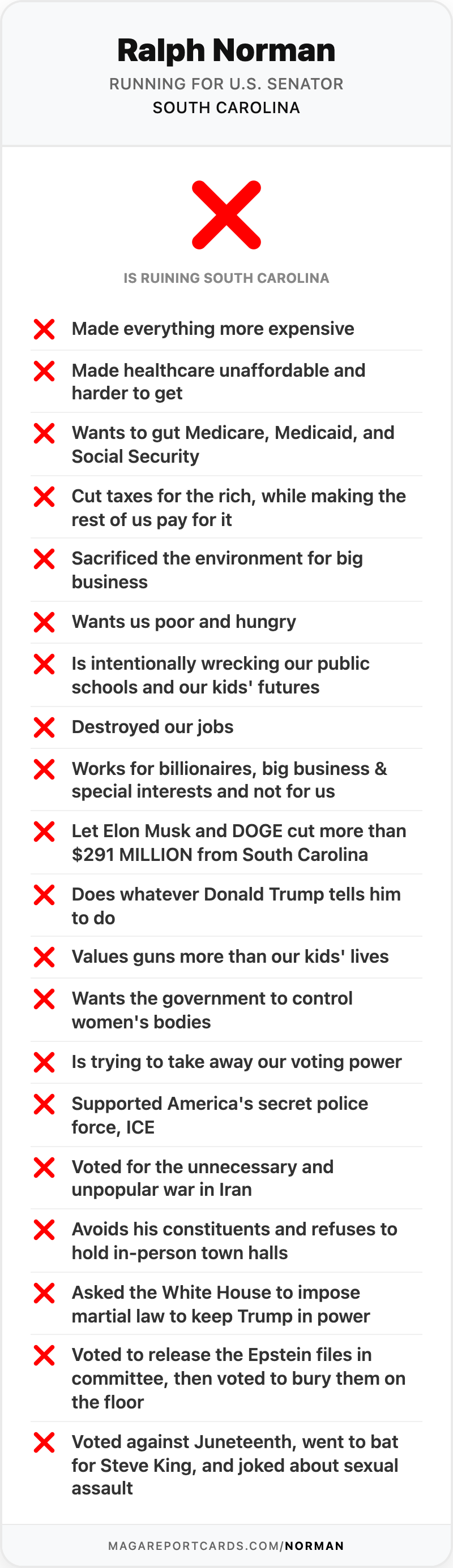
South Carolina Republicans vote on Tuesday, August 11, to pick a nominee for Lindsey Graham's Senate seat. One of the names on that ballot is Ralph Norman, who has spent nine years representing South Carolina's 5th District and now wants a promotion to the other chamber.
So it is worth looking at what he did with the power he already had — specifically, the power to hold the executive branch accountable.
Because there was a stretch in 2021 when Norman used that power constantly. And then he stopped.
Four of the highest officials in the country, in 45 days
Between August 10 and September 24, 2021 — a span of 45 days — Norman put his name on five separate resolutions to impeach four different senior officials of the Biden administration.
- August 10: He signed on as an original cosponsor of Andy Biggs's resolution to impeach Homeland Security Secretary Alejandro Mayorkas, one of eleven members who joined it the day it was filed.
- August 27: He introduced his own resolution to impeach Secretary of State Antony Blinken. More on that below.
- September 7: He signed Marjorie Taylor Greene's resolution to impeach President Biden over the withdrawal from Afghanistan — one of only seven cosponsors it ever attracted.
- September 24: He signed a second Biden impeachment resolution, this one from Lauren Boebert, as an original cosponsor.
- September 24: The same day, he signed Boebert's resolution to impeach Vice President Kamala Harris.
That last one deserves a moment. The Harris resolution drew exactly two cosponsors in the entire 435-member House. Norman was the first of them — the only member willing to put his name on it the day it was filed. The other was Bob Good of Virginia, four days later. Nobody else in Congress would touch it.
The President. The Vice President. The Secretary of State. The Secretary of Homeland Security. In a month and a half.
The one he wrote himself
The cut section of Norman's record described him as putting his name on the Blinken impeachment. That undersells it. H.Res. 608 was his. He introduced it on August 27, 2021 — "Mr. Norman (for himself and Mr. Harris)," as the resolution reads — and fourteen other Republicans eventually signed on.
It is worth reading, because in it Norman wrote down his own standard for what gets a cabinet official removed from office.
Article I accuses Blinken of "a reckless abandonment of our Nation's interests, security, and values" in the Afghanistan withdrawal, and of "ignoring critical intelligence."
But it is Article II that matters now. Article II is not about Afghanistan policy at all. It is about secrecy. Norman's resolution charges Blinken with:
"the provision of false information to the Congress and American citizens"
and with violating
"his statutory duty to keep the Committee on Foreign Relations of the Senate and the Committee on Foreign Affairs of the House of Representatives fully and currently informed"
Norman wrote an impeachment article arguing that a senior official who withholds information from Congress and the public has committed a high crime. He put it in the Congressional Record under his own name.
Hold onto that.
Then his own party won
In January 2025 Norman's own party took the White House. Norman's record from that point forward is the test of whether any of the above was about oversight — or about the party of the person being investigated.
On the Epstein files, he voted both ways in less than a day. On the night of July 14, 2025, in the Rules Committee, Norman was the only Republican to cross over and vote with the panel's Democrats for an amendment forcing the Justice Department to publish the Epstein files. He told Axios: "The public's been asking for it. I think there are files. All of a sudden not to have files is a little strange."
The next day on the House floor, he voted with leadership to block that same effort. It carried 211 to 210. Had he voted the way he had voted the night before, it would have failed.
He then declined to sign the discharge petition that would have forced the release, and on September 2, 2025 told Politico he hadn't read it. Asked whether he had a position on the effort he had voted for seven weeks earlier, he said: "Not yet."
He found a position on November 18, 2025 — two days after Trump publicly said Republicans should vote to release the files. Norman voted yes, along with every member who voted but one, 427 to 1.
The man who wrote that hiding information from Congress and the public is an impeachable offense voted to block a vote on releasing the Epstein files on a one-vote margin — after voting the opposite way in committee the night before — and then waited four months for permission to change his mind in public.
On war, he voted four times to avoid voting. Norman impeached a Secretary of State over the conduct of a military withdrawal. When American forces went into a war with Iran that Congress never authorized, he voted against resolutions ordering those forces out on March 5, April 16, May 14 and July 23, 2026. Two came down to nothing: April failed 213–214, and May failed on a 212–212 tie. Either would have passed had he switched. The July resolution passed anyway, 214 to 208, over the objections of 185 Republicans we track. Norman was on the losing side of that one.
He explained himself on his official website under the headline "NO to War Powers Resolution": "Biden backed down. Trump took action... America is safer when our enemies know we mean business."
That is the whole argument, in his own words. The standard is not the conduct. The standard is who is doing it.
And on Congress's own money, he voted to give it away. On June 12, 2025, Norman voted for the Rescissions Act of 2025, which in the version the House passed that day would have cancelled $9.4 billion Congress had already approved for foreign aid and public broadcasting. It passed by two votes. He voted for it again in July. A member who spent 2021 filing articles of impeachment over executive overreach voted to cancel, at the White House's request, money Congress had already appropriated.
This is not new for him
Norman had already shown what he does when the accountability points at his own side. He voted against the independent, bipartisan commission to investigate January 6, and then against the select committee created after that commission was blocked. He voted against awarding the Congressional Gold Medal to the police officers who defended the Capitol — one of only 21 members of the House to do so.
And eleven days after the Capitol was attacked, he texted the White House chief of staff: "Our LAST HOPE is invoking Marshall Law!!"
Seven months later he was filing impeachment articles about other people's disregard for the Constitution.
He is not alone in the pattern. Scott Franklin called for a bipartisan investigation of January 6 and then voted against one. Greg Steube filed articles of impeachment against a federal judge who had already died. Impeachment has become a press release with a bill number on it.
What he's asking for on Tuesday
A Senate term is six years. The Senate is the body that actually holds impeachment trials — the chamber Norman's own resolution said Blinken's articles should be "exhibited to."
Norman has told us exactly how he would use that power. He spent 45 days in 2021 aiming it at four officials of a party he opposed, including one resolution so thin that only one other member in the entire House would sign it. Then he spent the years since voting to bury an investigation, to stay in an unauthorized war, and to cancel, at the White House's request, spending Congress had already passed.
The standard he wrote down was that officials who keep Congress and the public in the dark should be removed from office. He should be held to it.
We deserve better.
Sources
- H.Res. 608 (117th Congress) — full text of Norman's articles of impeachment against Secretary of State Antony Blinken
- H.Res. 679 — Impeaching Kamala Devi Harris, cosponsors (Norman the only original cosponsor; two total)
- H.Res. 582 — Impeaching Alejandro Mayorkas, cosponsors
- H.Res. 598 — Impeaching Joseph R. Biden, cosponsors
- H.Res. 680 — Impeaching Joseph Robinette Biden, Jr., cosponsors