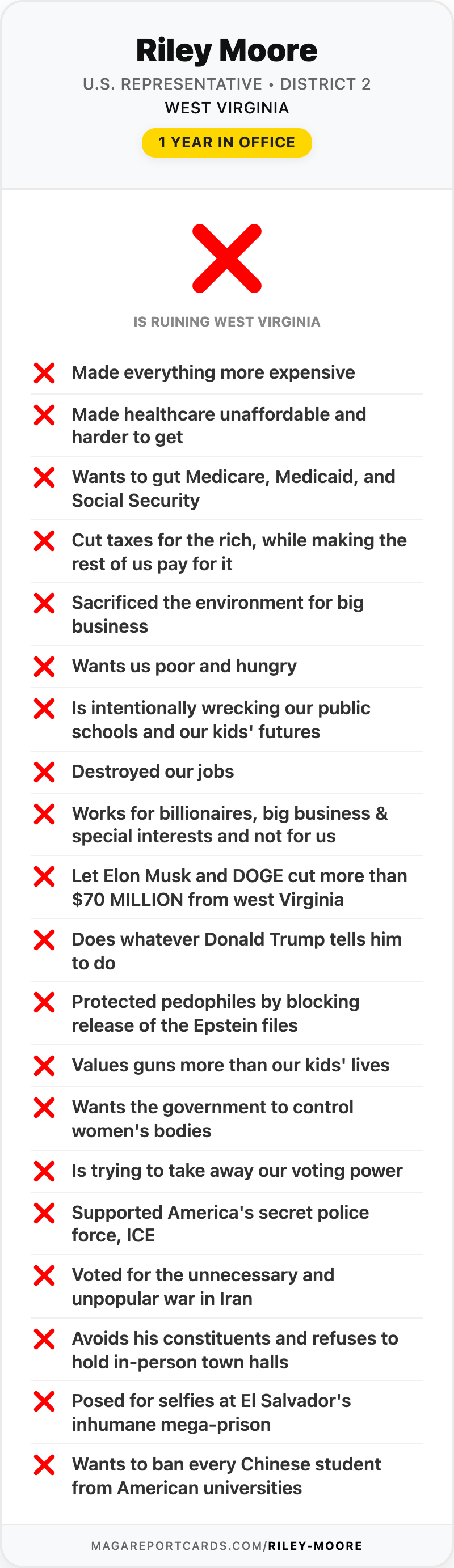
Riley Moore has built a political identity on being tough about foreign influence. He wrote a bill to bar every Chinese citizen from getting an American student visa. He calls the H-1B program "a scam." He introduced something called the DEPORT Act.
Before all of that, from 2013 to 2017, he was a vice president at the Podesta Group — a Washington lobbying firm — and he worked on the client team for the European Centre for a Modern Ukraine.
That name won't mean much on its own. It should.
What the ECFMU actually was
The European Centre for a Modern Ukraine presented itself as a Brussels-based think tank promoting Ukraine's ties with Europe.
It wasn't one. As WV MetroNews reported in 2017, federal prosecutors alleged in the Paul Manafort indictment that the ECFMU — while presenting itself as a think tank — actually operated under the direction of the Ukrainian government, and was funded through offshore accounts connected to Manafort and his associates.
The ECFMU was formed to represent Viktor Yanukovych — the Ukrainian president whose Party of Regions was the pro-Moscow party in Ukrainian politics, and who was driven from office in 2014 and took refuge in Russia.
So the client wasn't a think tank. It was a vehicle for a Kremlin-aligned foreign government to influence Washington without registering as what it was — which is the conduct the Foreign Agents Registration Act exists to prevent, and which is why the Podesta Group ended up inside the Mueller investigation.
Riley Moore was on that account. The Podesta Group's own lobbying disclosures name him as one of the lobbyists working it, in the first, second and fourth quarters of 2013.
What he says about it
Moore has never been accused of a crime in connection with any of this, and he was never identified as a person associated with the Manafort case. He has been consistent about his answer, and it is worth quoting exactly.
When Tony Podesta stepped down in October 2017 after the firm was linked to the Manafort indictment, Moore — then a West Virginia delegate — told WEPM News:
"It's hurtful and upsetting since I had no idea that this was going on."
And:
"I think it's terrible, and I think there's a lot of good people who are being dragged into this that don't have anything to do with it."
Take that at face value. Assume every word is true. He didn't know.
That is still a remarkable thing to be able to say about your own job.
The standard he applies to everyone else
Here is why "I had no idea" doesn't settle it.
In March 2025, Moore introduced the "Stop CCP VISAs Act". Despite the name, the bill would bar every citizen of China from receiving a U.S. student visa — not Communist Party members, not people with security-relevant backgrounds. Every one. A 19-year-old from Chengdu who has never heard of the Party's foreign influence operations is barred on the theory that she might be a vector for them, whether she knows it or not.
Chinese American groups including the Committee of 100 and Asian Americans Advancing Justice condemned it as discriminatory, warning that it treats every Chinese student as a suspect on the basis of nationality alone.
Notice the asymmetry. For a Chinese student, not knowing about a foreign government's influence operation is no defense — the mere possibility of being used is enough to bar her from the country. For Riley Moore, being a registered lobbyist on an actual foreign influence operation’s account, at a firm that later dissolved over it, is fully answered by "I had no idea that this was going on."
One standard for a college kid he'll never meet. Another for himself.
Why it matters now
Moore now sits on the House Appropriations Committee, which controls federal money, and he has spent his first term positioning himself as a hardliner on who gets to come to America and who gets to work here.
The relevant question isn't whether a 33-year-old lobbyist should have known who was really paying the bills at his client. It's what someone who lived through that experience learned from it.
What he appears to have learned is that when the person who didn't know is him, ignorance is a complete defense — and when the person who didn't know is a foreign student, ignorance is irrelevant.
It is not a secret. It is in the public record, it was reported in West Virginia at the time, and Moore answered questions about it nine years ago. It's just not the part of the résumé that leads — the story West Virginia voters hear — the one on his own House biography — starts with welder, then delegate, then treasurer, then congressman.
Source
Hans Fogle, "Moore says he had 'no idea' what was happening at Podesta Group", WV MetroNews, October 31, 2017.