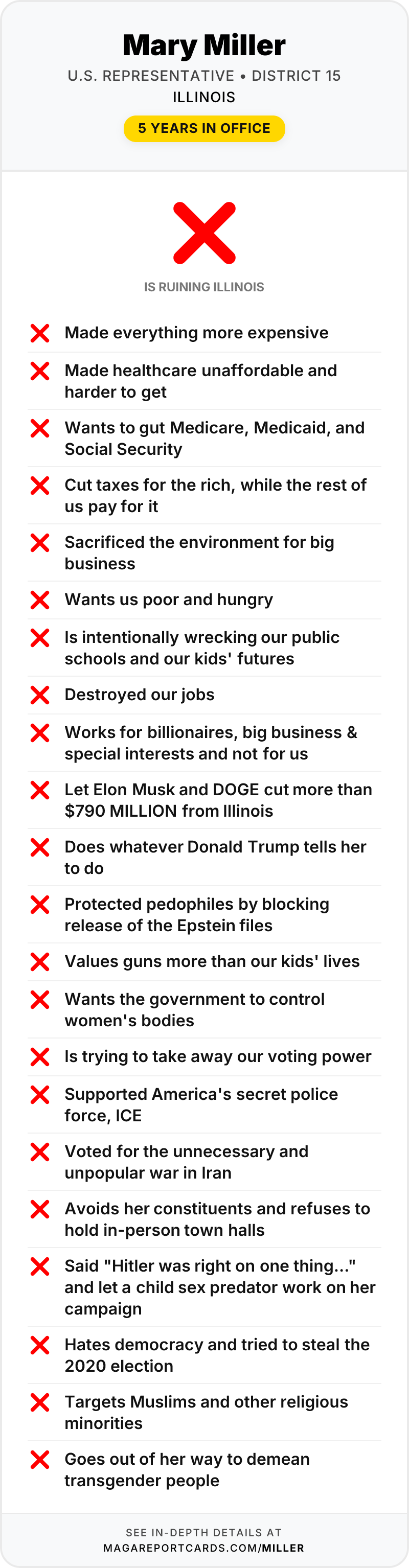
On February 26, 2026, Mary Miller introduced a bill about child care fraud. You can read the whole thing in about thirty seconds.
It was called the No Funds for Repeat Child Care Violations Act. Its entire operative content was one amendment to the Child Care and Development Block Grant Act: strike the words "Secretary may" and insert "Secretary shall."
That's it. The provision it changed lets the HHS Secretary pile extra sanctions — up to cutting a state off from the program — on top of the penalties for a state found out of compliance. It turned that discretionary power into a mandatory one.
On June 3, the House passed it 217 to 207. By then the bill had grown from a single operative section to nine, picked up a new short title — the Stop Child Care Scams Act of 2026 — and started carrying something the February version didn't have anywhere in it.
What got added
Compare the bill as introduced with the version the House sent to the Senate. Section 5 of the passed version is new, and it does two things:
First, it cuts the improper payment threshold in half. Under current rules, a state has to file a corrective action plan when its improper payment rate goes over 10%. The bill drops that trigger to 5 percent and writes it into permanent law.
Second — and this is the part worth reading twice — it adds this:
"If for each of 2 consecutive fiscal years the improper payment rate of a State determined under this section is more 5 percent, then such State shall be ineligible to receive funds under this subchapter" — unless the state satisfies the Secretary of Health and Human Services that it will fix things.
A state goes over 5% two years in a row, and every low-income family in that state can lose its child care assistance, unless one Cabinet secretary decides otherwise.
If that mechanism sounds familiar, it's because we've written about it before. It is, essentially, the CRACKDOWN Act that Glenn Grothman introduced the very same day — same 5% threshold, same two-consecutive-years trigger, same "shall be ineligible" language, same escape hatch through the HHS Secretary.
Grothman's standalone bill cleared committee and never got a floor vote. Miller's bill is the one that carried the idea onto the House floor and over to the Senate.
"Improper payment" is not the same thing as fraud
This is the load-bearing point, and it isn't a matter of opinion. The Government Accountability Office has said it flatly, and Democrats on the House Education and Workforce Committee quoted it in their minority views in the committee's report on Miller's own bill: while all fraudulent payments are improper, not all improper payments are due to fraud.
An improper payment is any payment made in the wrong amount, to the wrong recipient, or for a service that didn't qualify. In practice a huge share of them are documentation problems — a missing form, a late eligibility recertification, a payment that was actually too small.
Miller's public case for the bill is about scams. Miller has cited an estimated $600 million a year in improper payments across federal child care programs, and the bill's fraud sections are genuinely aimed at fraud: they require the HHS Secretary to investigate it, and to permanently bar any provider found to have committed it after all appeals are exhausted.
You can argue about whether permanent debarment with no discretion is the right call. But at least those sections punish the people who did something wrong.
Section 5 doesn't. Section 5 punishes a state's error rate — and the people it takes the money from are the families, not the bureaucrats who filed the paperwork wrong.
What that would mean in Illinois
In Miller's own state, more than 36,000 children age five and under get their child care paid for through this program, according to the First Five Years Fund. That's 16% of the kids who qualify — the other 84% are already going without.
Child care in Illinois runs about $19,807 a year. Families who get the subsidy pay an average of $335 a month instead.
Now imagine Illinois posts a 5.2% improper payment rate two years running. Under Section 5, unless one federal official is satisfied with the state's promises, the funding stops — for all 36,000 of those kids at once. Their parents' options are to quit a job or find $1,651 a month.
That's the mechanism. Not a fine on the state agency. Not a clawback of the misspent money — which, incidentally, federal law already allows, along with three-year on-site reviews of every state and mandatory independent audits.
The vote
The final tally on June 3 was 217 to 207. Republicans voted 212 to 0 in favor. Democrats voted 207 to 4 against, and one independent voted yes. Miller voted yes on her own bill.
An almost perfectly party-line vote is worth noticing on a bill whose supporters describe it as common-sense anti-fraud housekeeping. When 207 members of one party vote against stopping fraud, it's usually because the bill in front of them does something else too.
It's now with the Senate Committee on Health, Education, Labor, and Pensions.
The pattern
Miller sits on the House Education and Workforce Committee, which moved eight of these bills at once in early March. She's a member of the House Freedom Caucus. And she has built a record of writing bills that take something away and naming them after the thing they threaten.
She demanded Congress lock in every DOGE cut permanently — "Every DOGE cut targets waste, fraud, and abuse. Congress MUST codify them quickly. What's the holdup?!" — and was one of only eight cosponsors of the bill to write DOGE into federal law.
Child care assistance for 36,000 Illinois kids is not waste, fraud, or abuse. It's the thing that lets their parents go to work.
We deserve better.
Source
House passes Mary Miller bill targeting child care fraud — WSIU, June 5, 2026. Bill text and roll call: H.R. 7726 and Roll Call 198. Photo: official House portrait, via Wikimedia Commons.