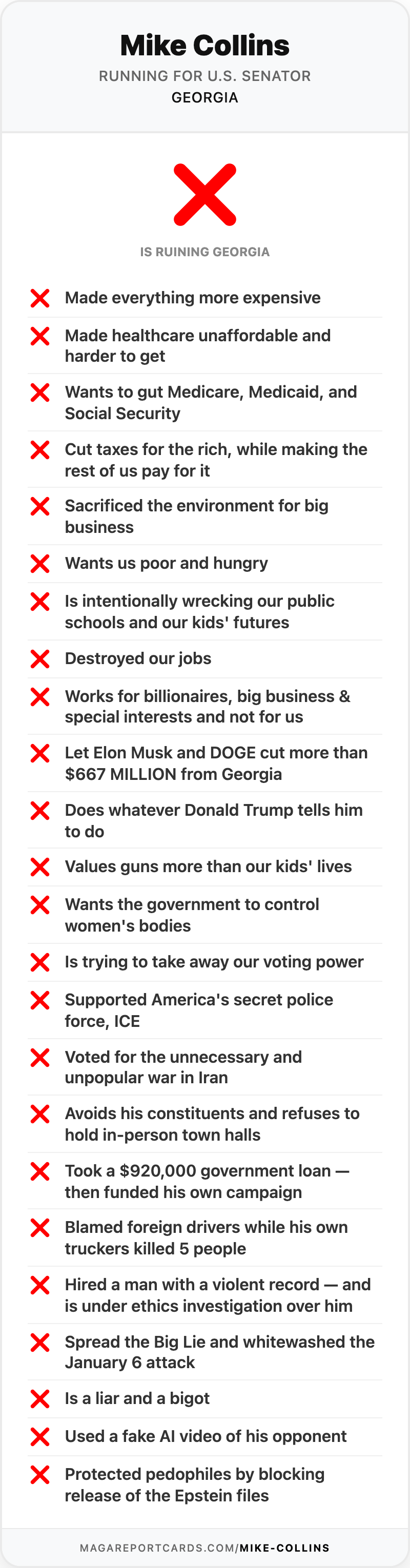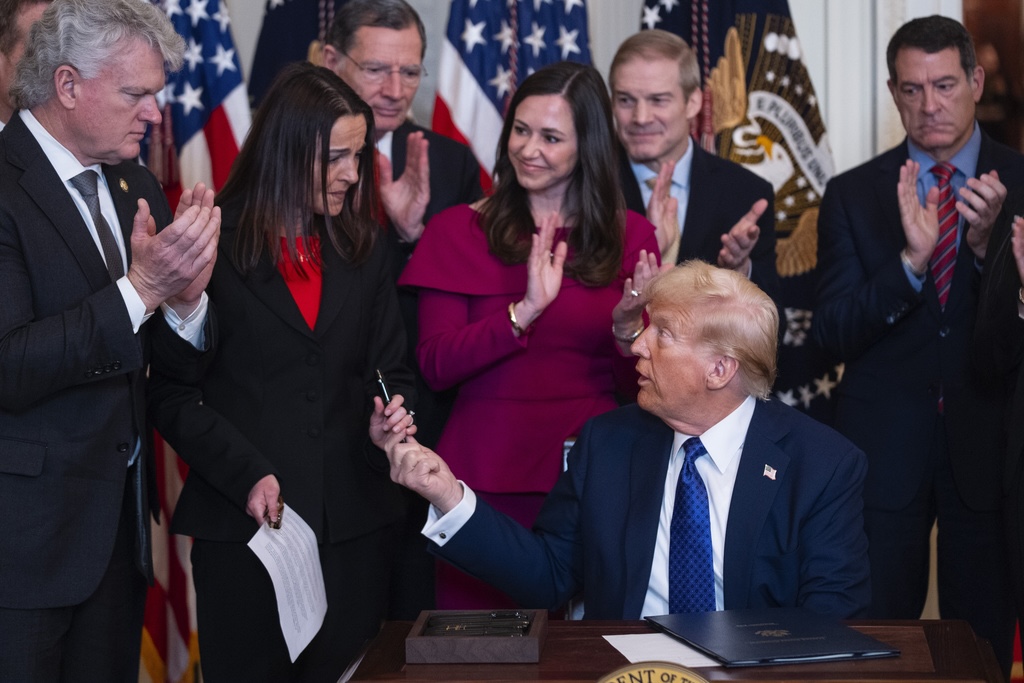
Mike Collins is the author of the Laken Riley Act. He introduced it in the House. He stood a few feet from Donald Trump when it was signed into law in January 2025. Nobody in Congress knows the history of that bill better than he does.
Which is what makes his July 21 post on X so hard to explain away.
"The socialist wing of the Democrat Party has taken over, and Jon Ossoff is leading the charge. He voted against the Laken Riley Act when he had the chance to save lives."
Jon Ossoff voted for the Laken Riley Act.
PolitiFact rated Collins's claim False on July 28.
The record isn't close
You don't have to take anyone's word for it. The Senate roll call is public.
On January 20, 2025 — Trump's first day back in office — the Senate took up S. 5, the Laken Riley Act. It passed 64 to 35. Ossoff was one of 12 Democrats who crossed over and voted yes. The official record lists him plainly: "Ossoff (D-GA) … Yea."
That's the bill Collins wrote. That's the vote on it. Ossoff voted for it.
What Collins is actually pointing at
Collins isn't inventing a vote out of thin air. He's swapping one vote for a different one and hoping nobody checks.
Here's the sequence:
- March 2024 — A week after Laken Riley's killing, Collins introduced the House version of the bill. The Republican-led House passed it 251–170.
- March 23, 2024 — With Democrats controlling the Senate, Republicans tried to force the issue by attaching a related amendment to a spending package. Ossoff, along with 50 other Democratic and independent senators, voted down a procedural measure that would have allowed that GOP amendment. That amendment was not the Laken Riley Act, and its text was different from the bill.
- January 20, 2025 — Republicans took the Senate, Collins reintroduced the bill, and it came up for a real vote. Ossoff voted yes. It passed 64–35.
So the thing Collins calls a vote "against the Laken Riley Act" was a procedural vote on a different measure, ten months before the actual bill ever reached the Senate floor. The Atlanta Journal-Constitution said the same thing in its July 24 analysis: "Collins is not making that distinction."
He knows better — he's said it correctly before
This is the part that turns a sloppy attack into a deliberate one.
PolitiFact notes that Collins has, on other occasions, described Ossoff's votes accurately — sometimes saying Ossoff eventually supported or "came around" on the bill. He's capable of stating it precisely. In the July 21 post, he simply left that out.
And he was told. Collins's post drew a community note on X — the platform's own crowd-sourced correction — reading: "Jon Ossoff voted Yes on the Laken Riley Act," with a link to the January 20, 2025 vote record.
Collins did not correct it. Instead, he shared a post from another user arguing that Ossoff only backed the bill once it was clear it would pass.
When PolitiFact asked about it, the Collins campaign declined to comment.
Why this matters more, not less, because it's his bill
There's a version of this story where a candidate garbles an opponent's voting record because congressional procedure is genuinely confusing. That's not this.
Collins is the bill's author. He introduced it, shepherded it, and got a signing ceremony out of it. He is the single member of Congress least able to claim he misunderstood which vote was which.
He's also using a murdered 22-year-old's name to do it. Laken Riley was an Augusta University nursing student found dead on the University of Georgia campus in February 2024. Her killer was sentenced to life without parole. Collins attached her name to a law and is now attaching it to a false claim about a colleague — one who, as Ossoff told Georgia radio station 95.5 WSB days after his vote, represented her:
"Laken Riley was my constituent, and her family are my constituents. And she never should have been killed. It was preventable."
A pattern of dodging the follow-up
Collins doesn't much like being asked to explain himself. When constituents in Georgia's 10th District wanted to press him on DOGE cuts and federal layoffs, more than 300 people showed up to a town hall in Athens — without him. He was invited. He didn't come. People wrote their questions on cards and mailed them to his office instead.
Same instinct here: make the claim, ignore the correction, decline to comment.
The bottom line
Mike Collins wants to be Georgia's next U.S. senator. He is running on a law he wrote — and he is misrepresenting the public, recorded vote of the senator he's trying to replace, on that very law, after being publicly corrected.
Georgians can look up the roll call in about thirty seconds. Collins is betting they won't. We deserve better.
Source
This post is based on the PolitiFact fact-check Mike Collins falsely says Jon Ossoff voted against the Laken Riley Act by Ben Brasch (Photo: AP), with the roll call verified against the official U.S. Senate vote record.