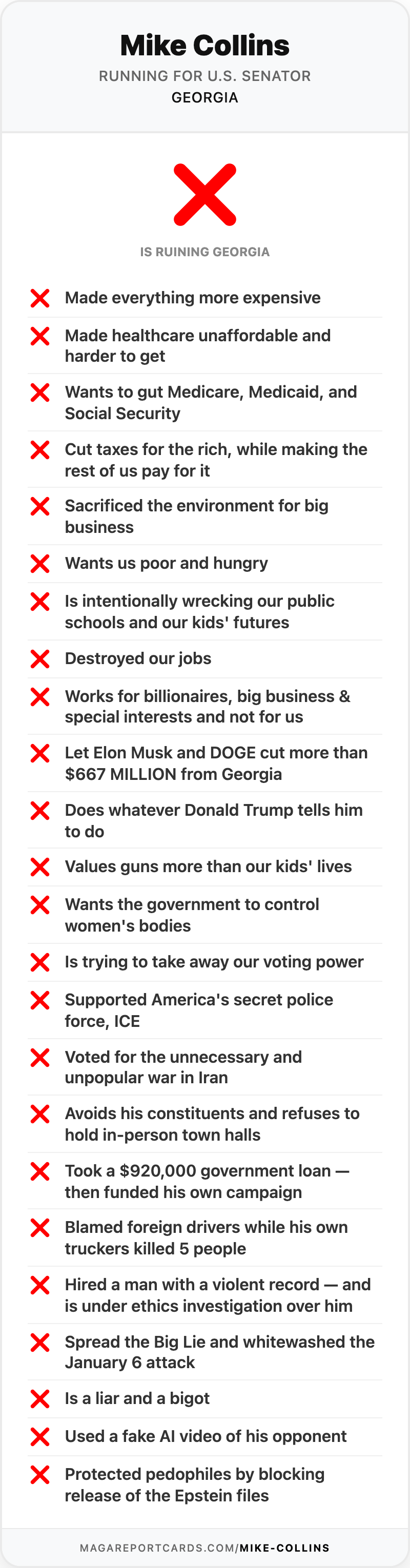
At a breakfast event in Savannah on August 11, a man convicted of two felonies for his part in the January 6 attack on the U.S. Capitol stood up, introduced himself as a "non-violent Jan. 6-er from here in Savannah" and asked Georgia's Republican Senate nominee whether he would back the compensation fund, or some other form of relief, for himself and for anyone else harmed by a "weaponized political system."
Mike Collins answered without hesitation.
"When the federal government harms you, then yes, they have a liability too. That's easy. Yes."
The exchange was recorded and posted by the man who asked it, Dominic Box, on the morning of August 11. It spread from there. The Lincoln Project put the video in front of a national audience within hours.
Let it be known, Georgia GOP Senate candidate @MikeCollinsGA proudly supports Trump's $1.8 billion "weaponization" slush fund for January 6th insurrectionists. When asked if he supports it Mike says "that's easy, yes".
— The Lincoln Project (@ProjectLincoln) August 11, 2026
Share this with a Georgia voter you know today. pic.twitter.com/ZtVrasvfKA
The next day his campaign attempted to clarify it. Spokesperson Meyer Siegfried said Collins "fully supports holding the government accountable when federal agencies abuse their power and believes Americans who've been wronged by their government ought to have a path to seek justice," and added: "He does not support a blank-check fund or automatic taxpayer-funded payouts to anyone simply because they were prosecuted for January 6."
Read that carefully, because of what it doesn't do. It doesn't dispute a word of what Collins said. It denies support for a fund — and the fund had been formally killed eight days before he spoke. The payouts that are actually moving don't come from a fund. They come from the Judgment Fund and from claims filed one at a time, which is the machinery laid out below, and which a "blank-check fund" denial leaves entirely intact.
Jon Ossoff, the senator whose seat Collins is running for, wanted more than a clarification. "Yesterday, we heard Congressman Mike Collins unacceptably and disgustingly call for taxpayer-funded payouts to the violent thugs who ransacked the United States Capitol to try to overturn the 2020 election," he said. "Congressman Collins needs to immediately come out and publicly retract his support for these taxpayer-funded payouts to violent insurrectionists." What he got instead was a campaign that rejected Ossoff's framing — not the words Collins said.
Two things about that answer are worth slowing down for. The first is who was asking. The second is that Collins called "easy" a question that has torn his own party apart for three months.
The man asking the question stands to get paid
Dominic Box is not a curious voter who wandered into a town hall. He is a Savannah man who was convicted in October 2024 on two felony counts of civil disorder and four misdemeanors for what he did at the Capitol. He waived his right to a jury trial, turned down a plea deal, and was found guilty by U.S. District Judge Colleen Kollar-Kotelly. Federal surveillance images placed him on the Capitol's east stairs; he entered through the Senate wing door.
"Civil disorder" — the felony he was convicted of twice — is the federal crime of acting "to obstruct, impede, or interfere with any fireman or law enforcement officer lawfully engaged in the lawful performance of his official duties incident to and during the commission of a civil disorder." It carries up to five years in prison.
He remains proud of it. In an August 2024 update, he wrote: "To this day, I remain fully confident and proud of my decision to attend the events of that day…" His X biography today reads "Guerrilla Journalist" and "J6 Survivor." In his own post about the Savannah exchange, he described himself in the third person as the "Savannah Insurrectionist."
So when Collins said the government "has a liability," he was saying it to a man who would personally collect. Box understood exactly what he had gotten. He called the moment "HISTORIC" and claimed Collins had become the first U.S. Senate candidate to go on the record backing payouts — his characterization, not a verified fact, but he was clear about what he thought he'd won: "Now the pressure is on every other candidate."
What Collins actually said yes to
The "liability" Collins was talking about is real money, and it comes with a story most Georgians haven't heard.
Trump sued the IRS for $10 billion over a 2019 leak of his tax information. He then settled that lawsuit — a lawsuit against the federal government — with officials he had appointed himself. In exchange for dropping the claim, the government created a $1.776 billion "anti-weaponization" fund, a number chosen to echo 1776. The settlement also handed Trump, his sons Don Jr. and Eric, and the Trump Organization immunity from tax audits and enforcement tied to that leaked information. A federal judge in Florida said in a July 13 order that the arrangement amounted to using the presidency to "manipulate" the courts. We laid the whole thing out when it blew up in Washington a week before Collins spoke.
Acting Attorney General Todd Blanche told Congress in June that the Justice Department was "not moving forward" with the fund, after Republicans balked and refused to vote on an unrelated ICE and Border Patrol funding bill until it was dealt with. Trump said that same week that he didn't know whether the fund was dead or just on hold, but called it "a beautiful thing" that he loved.
And killing the fund doesn't kill the payouts. The Justice Department still has the Judgment Fund — a bottomless pot of Treasury money for settling claims against the government, with no appropriation from Congress required. Associate Attorney General Stanley Woodward, the department's number three official, said publicly that he already had the authority "to settle any claim that is brought against the United States of America."
The line is forming. Roughly 400 pardoned January 6 participants are already seeking compensation from the federal government, most asking for $1 million to $10 million each. One Florida attorney told ABC News he has already filed claims for about 200 clients and expects to file for 200 more. The government has already paid just under $5 million to the family of Ashli Babbitt.
That's the bill Collins says Georgians have a "liability" for.
"That's easy" — except it wasn't easy for anyone else in his party
Here is the part that should stick with Georgia voters. Mike Collins is describing as obvious a question that Republicans in Washington have been fighting over since May.
- Sen. Thom Tillis of North Carolina called it "stupid on stilts," and Rep. Mike Flood of Nebraska said in the same reporting: "I do not think one penny of any fund should ever go to any January 6 insurrectionist that was in the Capitol on January 6, 2021."
- Sen. John Cornyn of Texas joined Tillis in refusing to advance Blanche's nomination for attorney general until the fund was formally ended in writing — stalling Trump's pick to run the Justice Department over exactly this question. The two of them got that order on August 3, 2026, eight days before Collins spoke in Savannah.
- Sen. Susan Collins of Maine spent a May 19 Justice Department budget hearing pressing Blanche on whether any of it was even legal, asking what "the legal basis for those decisions" would be and whether the claims would ever be publicly reported.
- On the Senate floor, Democrats tried to pass the No Rewards for January 6 Rioters Act by unanimous consent on May 21. Sen. Tommy Tuberville objected, and it went nowhere.
Senators in both parties spent three months treating this as one of the hardest questions in front of them — hard enough to stall an attorney general and jam up an immigration bill. A Republican Senate nominee looked at the same question and said it took no thought at all.
The people who don't get a check
More than 140 police officers were injured defending the Capitol on January 6. Former Capitol Police Sgt. Aquilino Gonell was dragged into the crowd by his shoulder straps and nearly suffocated, and still has shoulder and foot injuries. Metropolitan Police Officer Daniel Hodges was crushed between heavy doors and beaten in the head while calling for help.
Hodges is one of the officers suing the Trump administration to stop the fund, alongside former Capitol Police Officer Harry Dunn.
Former Capitol Police Officer Winston Pingeon, who was attacked and knocked to the ground that day, put it simply: "The pardons erased what little justice there was."
Nobody has proposed a fund for them.
Collins has been rewriting January 6 for years
None of this came out of nowhere. On the fourth anniversary of the attack, Collins posted that "thousands of peaceful grandmothers gathered in Washington, D.C., to take a self-guided, albeit unauthorized, tour of the U.S. Capitol building." He called the rioters "peaceful protestors" who had been "hunted down, arrested, held in solitary confinement, and treated unjustly."
His 2022 campaign ad had him running through debunked Georgia voter-fraud claims with an AR-15 before shooting a ballot drop box to pieces.
Saying the rioters deserve money is not a departure for him. It is the logical last step of a story he has been telling for four years: that nothing bad happened, and the only real victims were the people who did it.
He is not alone in the whitewashing. Rep. Pat Harrigan of North Carolina, a former Green Beret, called Trump's pardon of 1,500 January 6 defendants "leadership rooted in honesty and accountability". What Collins added in Savannah was the invoice.
Georgia has 42 people in this line
Federal prosecutors charged 42 Georgians in connection with the Capitol attack. Trump's clemency covered all of them.
If the payouts go forward at the numbers lawyers are asking for, a share of that money goes to Georgians — paid for by every other Georgian. Collins wants to represent all of them in the U.S. Senate. In Savannah, he told one of them, on camera, that the money should flow.
He didn't ask a follow-up question. He didn't distinguish between people who wandered in and people who beat police officers. He didn't mention the officers at all.
He said it was easy.
It isn't. And a senator who thinks it is has told us exactly who he plans to work for. We deserve better.
Source
Dominic Box, posted video and account of the exchange, X, August 11, 2026; video also circulated by The Lincoln Project. Reporting from the event and the reaction to it by Ross Williams, "'That's easy': Collins tells pardoned Jan. 6 defendant that government should pay wronged Americans," Georgia Recorder (August 12, 2026). Photo: official congressional portrait, 118th Congress, via Wikimedia Commons.