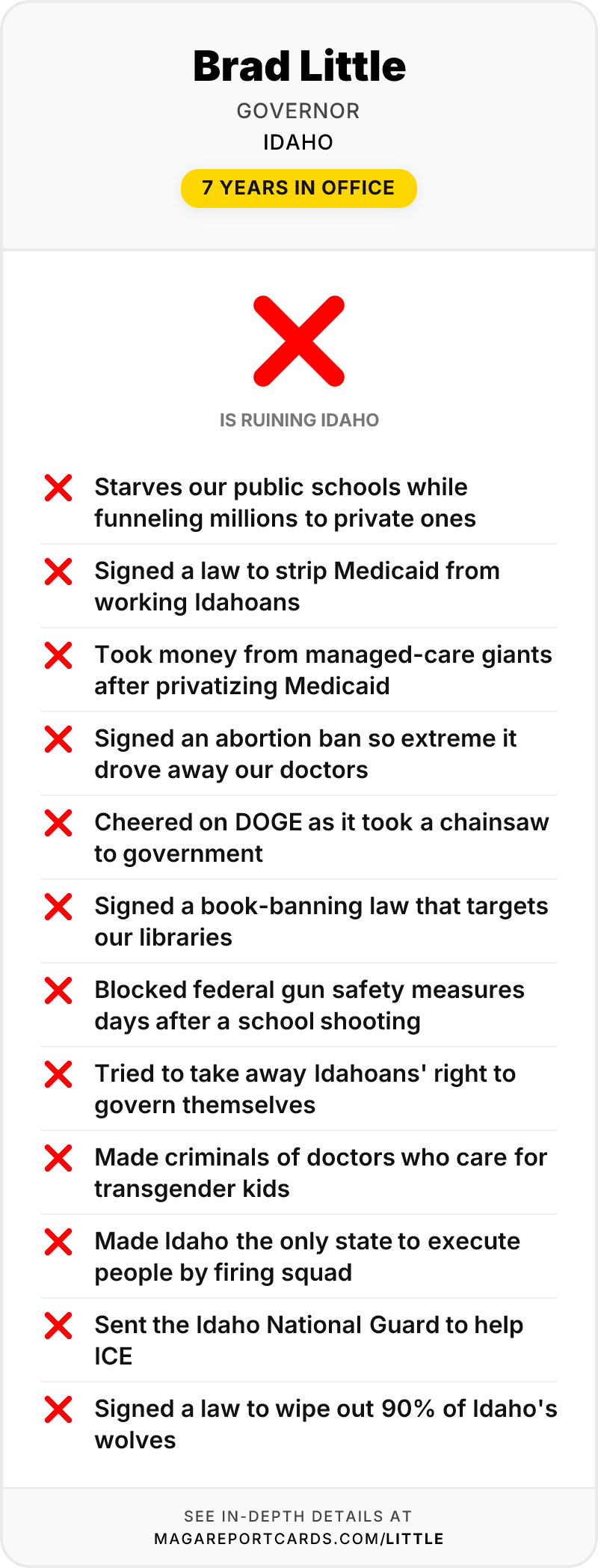
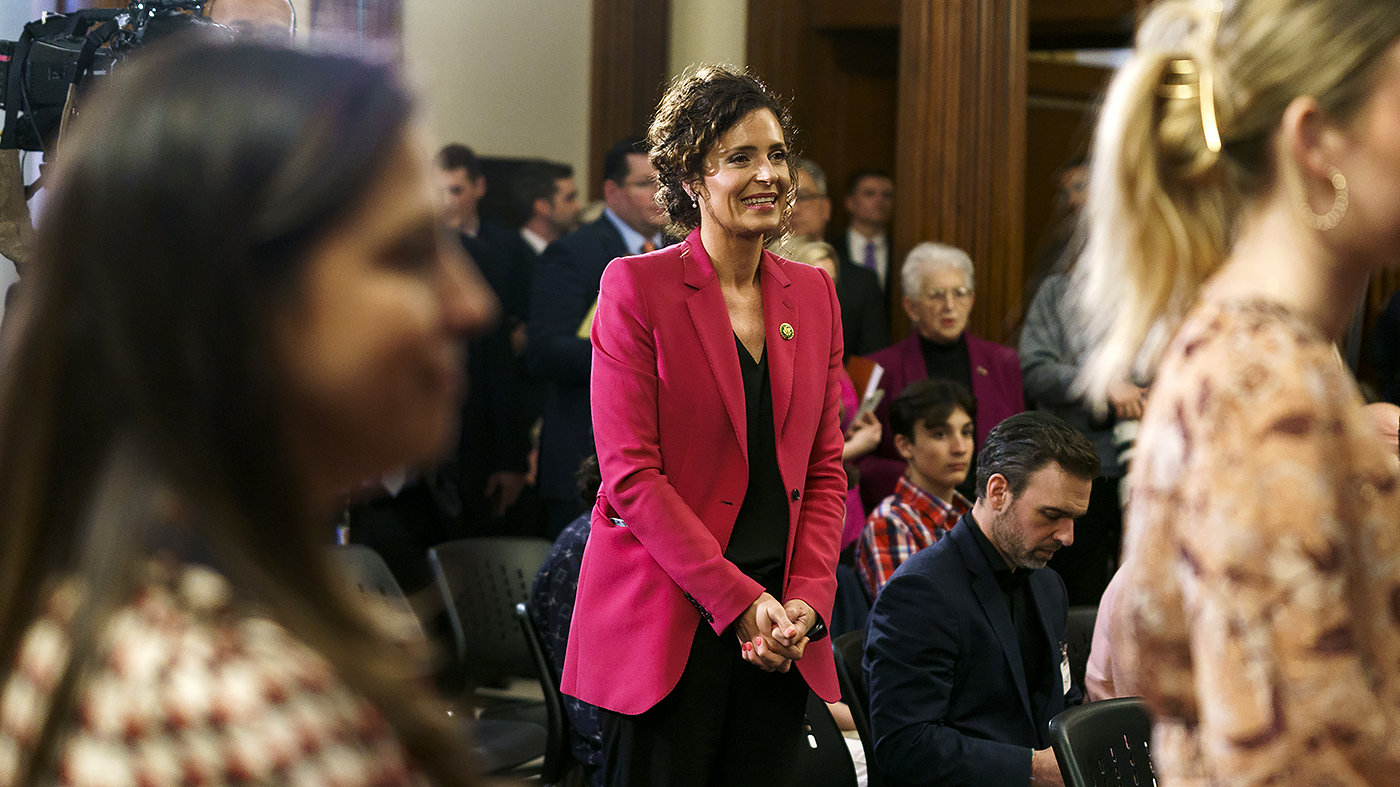
There are a lot of things Idaho could have criminalized this year. On March 31, 2026, Brad Little picked using the bathroom.
The law is House Bill 752. The Legislature's own one-line description of it reads:
"INDECENCY AND OBSCENITY – Adds to existing law to prohibit a person from entering a restroom or changing room of the opposite sex, to provide a penalty, and to provide exceptions."
The House passed it 54–15 on March 16. The Senate passed it 28–7 on March 27. Little signed it on March 31, and it became Session Law Chapter 263. It took effect on July 1, 2026.
What the penalty actually is
This is not a fine or a citation. Idaho Education News laid out the ladder: a first offense is a misdemeanor, and a second offense within five years is a felony punishable by up to five years in prison.
Up to five years in state prison. For which restroom door someone walked through.
Idaho has real problems. It spends less per student than any other state in America. It ranks 48th of 50 for public education. Brad Little's Legislature spent its 2026 session building a felony offense out of a bathroom.
The exception clause tells you everything
Every law has exceptions. Read this one — it's the part of House Bill 752 that carves out when entering the "wrong" restroom is allowed. As Boise State Public Radio reported, the statute permits it:
"when the person is in dire need of urinating or defecating and such facility is the only facility reasonably available at the time of the person's use"
Idaho lawmakers had to write the words "dire need of urinating or defecating" into the state code, and Brad Little had to sign them, because they wrote a law so sweeping that it needed an emergency-bathroom escape hatch to function at all.
That is not a serious public safety measure. That is a law written to make a point about a group of people, with escape hatches written in so it wouldn't be completely absurd in practice. The other exceptions — for custodial work, medical assistance, law enforcement, coaching, emergencies and more — exist for the same reason.
The second law: $100,000 fines for not reporting kids
House Bill 752 wasn't the only one Little signed. He also signed House Bill 822, which requires schools to notify parents within 72 hours if a student asks for help with "social transitioning" — including asking to be called by different pronouns, or asking to use a bathroom or join a sports team designated for the opposite sex.
Enforcement includes civil penalties of up to $100,000 against schools and health care providers that don't comply.
Think about what that does to a school counselor. A kid comes to them scared, in confidence, and asks to be called by a different name. Under this law, the school has 72 hours to report that request to the child's parents — or it faces a penalty of up to $100,000. The law does not ask the counselor what they think is safest for that particular kid. It sets a clock.
The bill's sponsor was Rep. Bruce Skaug of Nampa. The floor sponsor on the bathroom bill was Rep. Cornel Rasor of Sagle. But bills don't become law without a signature, and Brad Little signed both.
This is a pattern, not a session
Little didn't stumble into 2026. He's been building this record for six years.
- In 2020, he signed House Bill 500, barring transgender girls from girls' sports, and House Bill 509, which locked an "immutable" biological sex onto Idaho birth certificates so transgender Idahoans could never correct them.
- In 2023, he signed House Bill 71, making it a felony punishable by up to 10 years in prison for a doctor to provide gender-affirming care to a transgender minor. That ban became fully enforceable in June 2025 after a lawsuit against it was dismissed.
- In 2026, he added the bathroom felony and the school reporting mandate.
Doctors face a decade. Repeat "offenders" face five years. Schools face fines of up to $100,000. Every year the list of Idahoans exposed to criminal or financial penalty gets a little longer, and every year Brad Little signs.
Who this actually reaches
Transgender Idahoans are plainly the target. The law bars people from using the restroom that matches their gender identity, and it arrived alongside a second bill about transgender students in schools.
But here's the practical problem with a law like this. The statute makes it a crime to enter the restroom "of the opposite sex." Nobody checks a birth certificate at the door. In real life, the question of who belongs in a restroom gets settled by whoever is standing in it and decides someone looks wrong — and now that person has a criminal statute to point at.
That's not a hypothetical harm to one group. That's every Idahoan's next bathroom trip becoming something the state has an opinion about.
The choice he made
Brad Little is running for a third term in 2026. He is not a bystander to any of this. Idaho's governor holds a veto pen, and he has used it — in the same 2026 session he line-item vetoed a $478,600 cut to medical residencies, warning it would signal "that the state may not honor its commitments" during one of the worst physician shortages in the country.
So he knows how to say no. He knows how to tell his own party that a bill goes too far.
He just didn't do it here.
Brad Little had a pen, a veto, and a choice. He chose to make Idahoans criminals over a bathroom door. We deserve better.
Sources
- House Bill 752 (2026) — Idaho State Legislature: full text, vote tallies, and signing date
- Find out what passed and what didn't. A look back to the 2026 legislative session — Ryan Suppe and Kevin Richert, Idaho Education News, April 2026. Photo: Sean Dolan/Idaho EdNews.
- Idaho's 2026 legislative session closes. Here's what passed — Boise State Public Radio, April 5, 2026