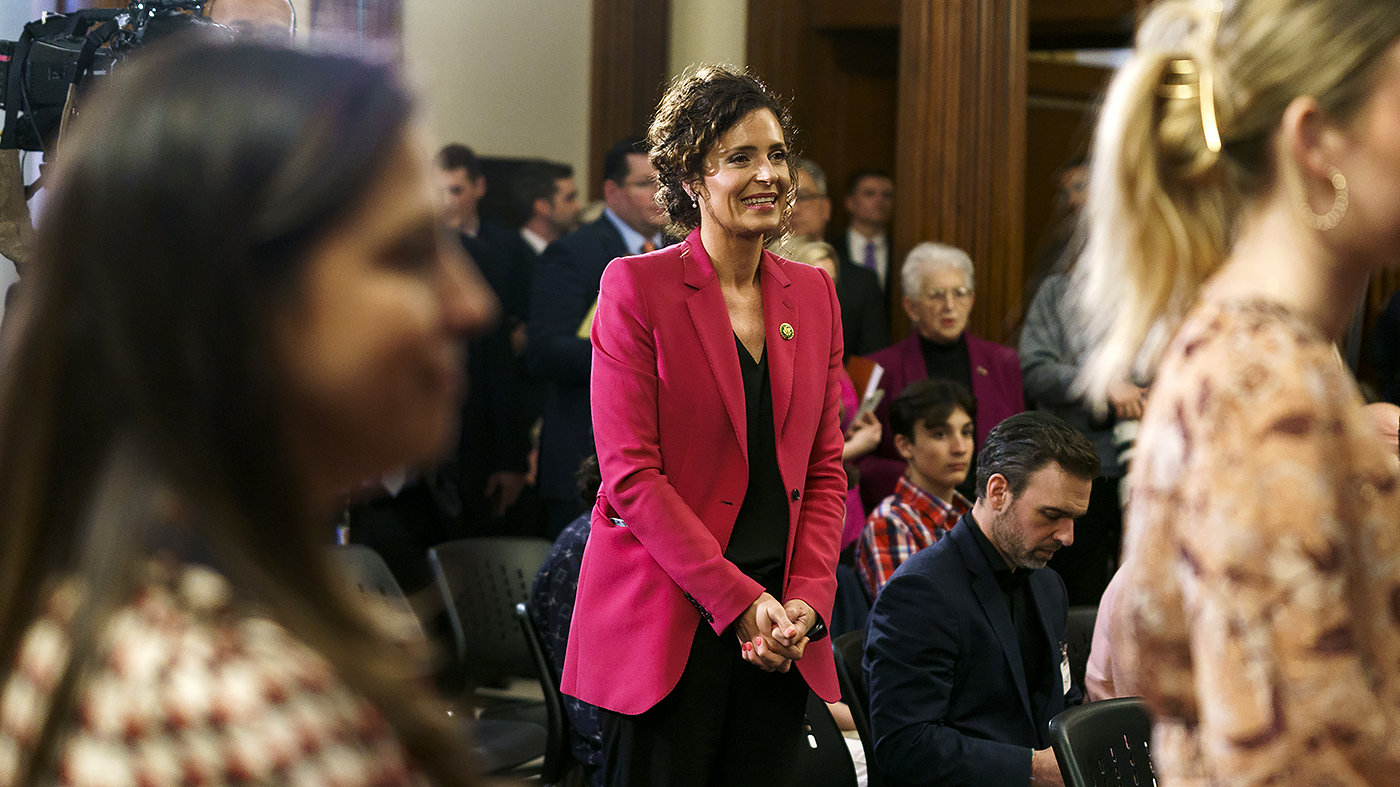
At a news conference on Monday, Andy Biggs — the congressman running to unseat Arizona Gov. Katie Hobbs — stood with his party's nominees for secretary of state and attorney general to promote Proposition 318, an anti-trans ballot measure.
He didn't sell it as a policy that solves a problem. He sold it as a winner.
"This is an 80-20 issue."
That's the pitch. Not that Arizona schools are in crisis. That the polling is good.
The Arizona Mirror's Gloria Rebecca Gomez reported the whole news conference, and the framing was consistent throughout: Republicans are betting this measure drives their voters to the polls in November.
The problem it claims to solve
Republican lawmakers gave Prop. 318 the short title "Protect Girls' Sports in Arizona Act." Here's the part they don't lead with:
Arizona law already forbids transgender girls from joining school sports teams that match their gender identity. That ban passed in 2022, before Hobbs was even elected.
So what does Prop. 318 add? Two things.
First, it extends the ban past schools into private youth recreational organizations — leagues like Little League Baseball. Not state programs. Not public schools. Neighborhood kids' leagues.
Second — and this is the part that isn't about sports at all — it requires schools and athletic associations to make sure bathrooms, locker rooms, shower rooms and other "private spaces" aren't used by anyone of the opposite biological sex. The restriction applies to facilities "integral to athletic engagement," language broad enough to pull in facilities used by teams and even members of the public visiting during sports events. Critics say it could be read to cover every bathroom in a school.
And it works through lawsuits. Schools and athletic associations face legal action if they get it wrong. Which means the safest thing a school can do is police the question aggressively — checking, challenging, and asking children to prove themselves.
The number that ends the argument
In the dozen or so years before Arizona's 2022 ban, the Arizona Interscholastic Association fielded about 12 requests from transgender students to play on teams matching their gender identity — and approved seven of them. Those are the district court's findings in the case that blocked the ban, quoted by the Ninth Circuit when it upheld that ruling in 2024. The record does not say how many of the seven were girls.
Roughly 170,000 students play school sports in Arizona each year.
That's the emergency. Seven students in twelve years, and the response is a constitutional-grade ballot measure that reaches into Little League and turns every school bathroom into a potential lawsuit.
LGBTQ advocates call it a solution to a problem that doesn't exist. The numbers make that hard to argue with.
Why it's on the ballot instead of in a bill
Biggs complained at the press conference that Republicans even had to go to voters at all — saying Hobbs had a chance to do this the easy way and didn't.
"She puts in jeopardy the opportunity for fair competitive athletics for women and it's really astounding."
That's a strange complaint, because it describes exactly how this is supposed to work. Hobbs has consistently vetoed anti-LGBTQ bills sent to her by the Republican legislature, including several that would have barred trans students from using school facilities matching their gender identity. That's a governor using a governor's power.
A large part of the reason Republicans wrote Prop. 318 as a ballot measure in the first place was to get around that veto.
It's worth being precise about Biggs's framing, too. The law banning trans girls from school sports already exists, and Hobbs never had the chance to veto it — it passed before she took office. Since then, Republicans haven't sent her further trans-athlete legislation. They've focused on school facilities. So the thing Biggs blames Hobbs for not doing is not quite the thing on the ballot.
The trap inside the measure
Here's the piece Arizona voters should understand before November.
If Prop. 318 passes, a future legislature essentially cannot undo it. The Arizona Constitution requires a three-fourths supermajority before lawmakers can change anything voters approved — and any change has to advance the measure's original intent, which rules out swapping in trans-inclusive policy.
The only other route is going back to the voters with a whole new ballot question.
Warren Petersen, the Republican nominee for attorney general, made the appeal plainly: he touted Prop. 318 as a long-term solution that can't be undone by future legislatures.
That is the actual design. Not to settle a policy question, but to lock one in past the reach of anyone Arizonans might elect later.
The ad is built on a video from another state
The "Yes on 318" campaign released an ad Monday built around a viral clip from a Massachusetts girls' basketball game, in which an allegedly trans player shoves an opponent while grabbing the ball. The voiceover asks Arizonans to protect "female spaces from those 'pretending' to be someone they're not."
When that clip went viral in 2024, LGBTQ advocates made a simple point: one athlete's bad sportsmanship is not a reason to condemn an entire group.
The campaign's website also hosts a page called "rational voices," collecting quotes against trans athletic participation from figures like Bill Maher, Caitlyn Jenner and Meghan McCain.
An out-of-state video clip and a celebrity quote page. That's the evidentiary base for a measure that would reach into Arizona's Little Leagues and school bathrooms.
What Biggs is actually running on
Biggs is running for governor with an anti-abortion record he has spent the campaign managing.
Prop. 318 fits neatly. It's a measure that does relatively little about school sports — those rules already exist — and a great deal about bathrooms, private leagues, lawsuits, and locking the whole thing beyond a future legislature's reach.
And Biggs's own stated reason for backing it wasn't any of that. It was the number: 80-20.
The people this actually lands on
Arizona's Democratic incumbents won narrowly last time — Attorney General Kris Mayes by 280 votes, Hobbs by two-thirds of a percentage point. Republicans think a wedge issue closes that gap.
So the strategy is legible. Find an issue that polls at 80-20, put it on the ballot, and let it pull your voters to the polls in a race you lost by 280 votes.
The cost of that strategy falls on the kids who wanted to play a sport, and on every student who now gets a school bathroom policed under threat of a lawsuit.
Mayes' campaign manager, Delaney Corcoran, put the political read plainly: "These attacks are designed to divide and distract Arizonans from the issues that matter most to Arizonans and their families."
Biggs told Arizona what this is when he called it an 80-20 issue. He was describing a turnout tool, not a problem in Arizona's schools. Voters should hold him to his own description.
Source
Top Republicans embrace anti-trans measure as a wedge in November races — Gloria Rebecca Gomez, Arizona Mirror, August 10, 2026. Photo by Bruce Bennett/Getty Images.