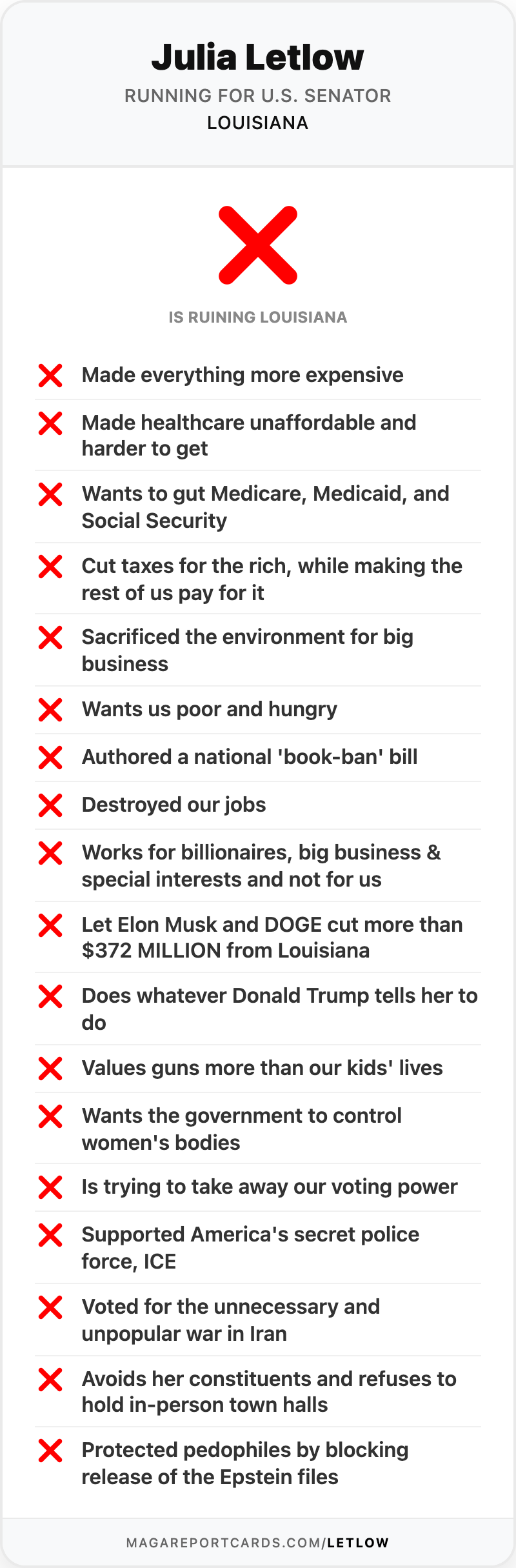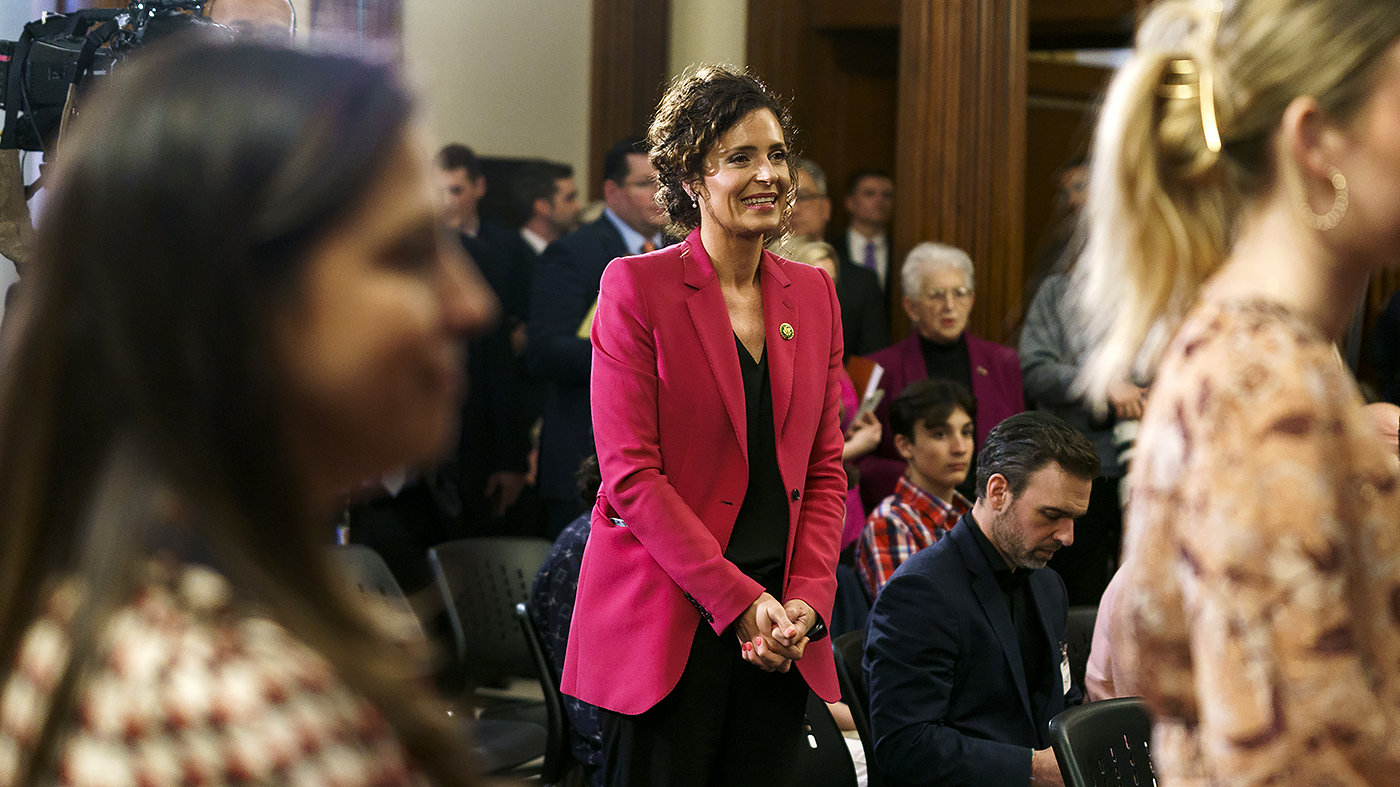
Julia Letlow is a former university administrator with a doctorate, and education is the thing she says she came to Congress to do. Her one signature piece of legislation is the Parents Bill of Rights Act, H.R. 5.
She introduced it in 2021, reintroduced it in 2023, and pushed it through the House on March 24, 2023 by 213 to 208 — every voting Democrat against, plus five Republicans. It went to the Senate and died there.
In June she won the Republican nomination for the Senate seat Bill Cassidy is losing. The general election is November 3.
What the bill actually says
Republicans spent the floor debate insisting the bill has nothing to do with banning books. Rep. Virginia Foxx, then the Education Committee chair, said so repeatedly. Rep. Chip Roy said on the floor that the bill is there "to just ensure that parents know what is in the libraries and what is in the curriculum. It does nothing more."
Here is the operative text, verbatim. It gives parents the right to receive:
"(i) a list of the books and other reading materials available in the library of their child's school; and (ii) inspect such books or other reading materials"
and separately requires that every school receiving federal Title I funds provide parents exactly that list and that opportunity.
Roy is right that the word "ban" doesn't appear. But the bill's opponents weren't arguing that it bans books. They were arguing that a federally mandated, parent-facing inventory of every book in every school library is the machinery a ban runs on. PEN America counted bans on 1,648 individual titles in school libraries and classrooms in the 2021–22 school year alone — removals, and removals pending review. Of those titles, 41% dealt with LGBTQ+ themes or characters and 40% had protagonists or prominent secondary characters of color.
Roy, for his part, didn't hide the ball on the floor: "Yes. Some local jurisdictions are removing certain books—absolutely, and God bless them for it—books about explicit sex acts."
The part about students
The bill does two separate things here. Elementary schools and middle schools that take Education Department money have to get parental consent before:
"(1) changing a minor child's gender markers, pronouns, or preferred name on any school form; or (2) allowing a child to change the child's sex-based accommodations, including locker rooms or bathrooms"
And every school in a district that takes Title I money — high schools included — has to notify parents whenever "a school employee or contractor acts to ... change a minor child's gender markers, pronouns, or preferred name." No form has to be involved, and no consent is asked for. In practice that means a school cannot call a student by the name that student asks to be called without the parents being told.
Rep. Mark Pocan, then chair of the Congressional Equality Caucus, said the effect would be to force "schools to forcibly out transgender students, even if it puts those youth in harm's way." Rep. Melanie Stansbury said the bill was "modeled after bills passed at the state level" that have censored teaching and endangered students.
And then the House added to it. Two amendments from Rep. Lauren Boebert were adopted before passage: one establishing a parental right to know whether the school allows transgender girls to play in girls' sports, and another establishing a parental right to know whether the school allows a transgender girl to use a bathroom or changing room matching her gender.
Those are now part of the bill Letlow authored.
What Letlow said about her own bill
On the House floor, she told her colleagues:
"This bill is not complex or complicated. Nor should it be partisan or polarizing, and contrary to what you may hear from my colleagues on the other side of the aisle, it is not an attack on our hard-working teachers, who will always be the heroes in my eyes."
"It is not an attempt to have Congress dictate their curriculum or determine the books in the library. Instead, this bill aims to bring more transparency and accountability to education."
Both halves of that can't hold at once. A bill that requires every school in every district taking federal Title I money to hand parents a list of its library holdings at the start of each school year is Congress reaching into what's in the library. That may be a defensible thing to do — reasonable people think parents should be able to see it — but it is not "not an attempt."
And a bill that is "not partisan or polarizing" doesn't pass with zero votes from the other party.
Why it matters now
Letlow's district is one of the poorest in the country. When she was first elected, nearly 30% of families with children in Louisiana's 5th were under the poverty line, and she told CNN that education "can be used as a catalyst to lift a region out of poverty."
That is the right diagnosis. It's the kind of thing a former university administrator in a poor rural district is uniquely positioned to act on — school funding, teacher pay, broadband, early literacy, the community and technical colleges that feed the region's workforce.
Her signature contribution to the education debate instead was a bill about library inventories and pronoun disclosure. It received no Democratic votes and never became law.
If she wins in November, she will spend January in the chamber that killed it. It will be back.
We deserve better.
Sources
- H.R. 5, the Parents Bill of Rights Act, as passed by the House (118th Congress)
- House Roll Call 161, March 24, 2023 — passed 213–208
- Congressional Record, House, March 23, 2023 — floor debate on H.R. 5, including the Letlow, Foxx and Roy remarks
- PEN America, "Banned in the USA: The Growing Movement to Censor Books in Schools", September 19, 2022
- Lexi Lonas Cochran and Mychael Schnell, "House Republicans pass Parents Bill of Rights" — The Hill, March 24, 2023
- Christopher Kane, "House Republicans pass anti-LGBTQ Parents Bill of Rights Act" — Washington Blade, March 24, 2023
- Photo: Greg Nash / The Hill