Boycotting is about as American as it gets. The Boston Tea Party came at the end of a boycott campaign against British goods. The Montgomery bus boycott helped end segregation on city buses. Conservatives boycott Bud Light and Target; progressives boycott companies that fund the NRA. The Supreme Court settled the question in 1982, in NAACP v. Claiborne Hardware, holding that the government's power "to regulate economic activity could not justify a complete prohibition against a nonviolent, politically motivated boycott."
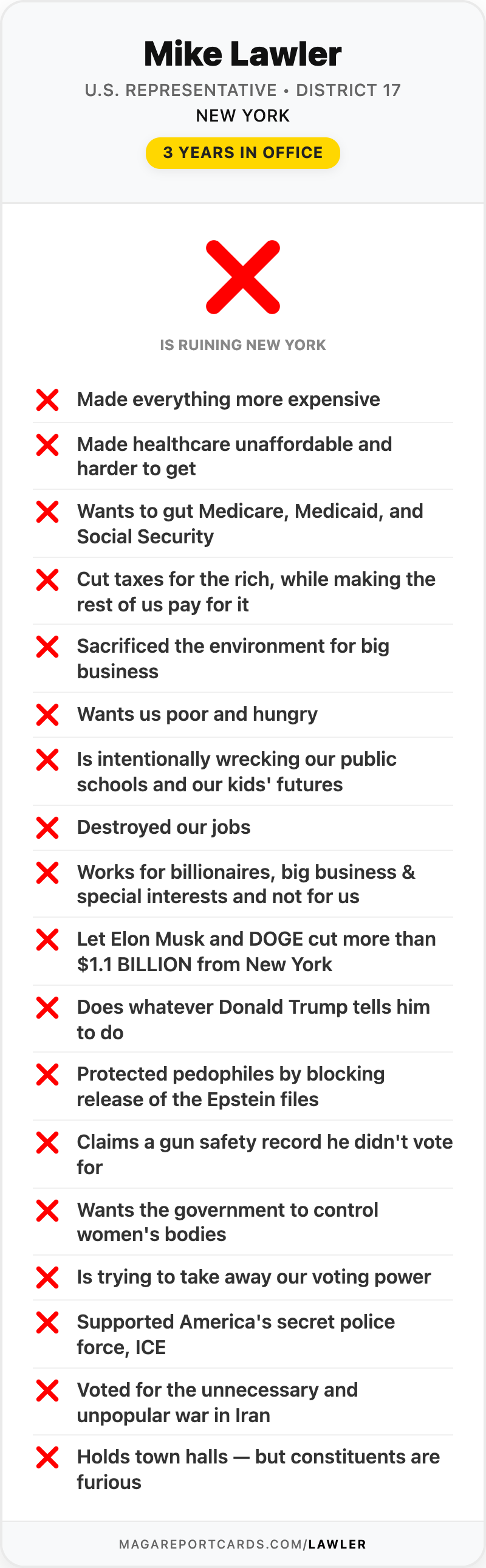
Mike Lawler is the lead sponsor of a bill that would make taking part in certain boycotts a federal felony punishable by up to 20 years in prison and $1 million in fines.
It is called the IGO Anti-Boycott Act. He introduced it in April 2023, got it through the House once, and reintroduced it as H.R. 867 on January 31, 2025. In May 2025 House leadership scheduled it for a floor vote — and then quietly pulled it, after Republicans revolted.
What the bill actually does
Start with the law it amends, because that is where the prison sentence comes from.
In the 1970s, the Arab League required American companies to boycott Israel as a condition of doing business in Arab League countries. Congress responded with anti-boycott rules barring U.S. companies from going along with a boycott demanded by a foreign government. In 2018 Congress tightened them, setting a maximum penalty of 20 years in prison or a $1 million fine. "Complying" includes something as passive as furnishing information — telling a foreign body whether a company does business somewhere.
Lawler's bill takes that machinery and points it at a different target. It extends the same rules — and the same penalties — to boycotts called for by international governmental organizations like the United Nations and the European Union.
That difference sounds technical. It is not. The old law protected American companies from economic coercion — do this or lose your market. The UN Human Rights Council has no such power over anybody. It publishes lists and passes resolutions. Nobody complies with a UN resolution because they'll be shut out of a market; people go along with it because they agree with it.
Which means, as the ACLU put it, the bill "would turn the [law] on its head." In a letter to every House member dated May 4, 2025, the organization was blunt:
"H.R. 867 would punish Americans for their purely voluntary, and constitutionally protected, participation in political boycott campaigns."
And more specifically:
"H.R. 867 plainly extends to voluntary, politically-motivated speech seeking to support proscribed boycotts. The bill would make it a federal felony to furnish information to an international governmental organization, such as the U.N. Human Rights Council, about whether any person has business relationships with or in the boycotted country."
The ACLU said it would score the vote, and that if the bill passed it would consider suing.
Read that middle sentence again, because it's the heart of it. Under Lawler's bill, an American who tells a UN human rights body which companies operate in a particular place could be committing a felony. Not organizing a boycott. Not refusing to sell anything. Telling the truth to an international organization. The ACLU noted that this exact tactic — naming companies publicly — was among the forms of boycott-facilitating speech the Supreme Court expressly identified in the Claiborne Hardware case.
His own party wouldn't vote for it
The bill did not die because of Democrats. It died because Republicans read it.
Rep. Anna Paulina Luna of Florida — no one's idea of a critic of Israel — wrote on X: "Americans have the right to boycott, and penalizing this risks free speech. I reject and vehemently condemn antisemitism but I cannot violate the first amendment."
Rep. Thomas Massie of Kentucky called it "a ridiculous bill that our leadership should have never scheduled for a vote," and it was Massie who revealed on a Sunday night that the vote had been quietly postponed.
Rep. Marjorie Taylor Greene put it this way: "It is my job to defend American's rights to buy or boycott whomever they choose without the government harshly fining them or imprisoning them."
Former Rep. Matt Gaetz called it a "dangerous and unconstitutional Lawler virtue signal."
This is the same congressman who spends a great deal of energy telling Hudson Valley voters he's the reasonable one, the moderate in the swing seat. On this bill, the objection that stopped him came from his right, and the objection was the First Amendment.
Lawler's defense was that he was only extending something that already exists. "This expands existing federal law to any boycott organized by IGOs like the United Nations. President Trump signed the first bill into law," he said. His office added that the bill "does not limit free speech, political activism, or any business decision" of U.S. entities.
The ACLU, and several members of his own conference, read the text differently.
Who wanted this bill
Lawler's own January 31, 2025 press release announcing the reintroduction is filled with endorsements. One of them is a single sentence from the most powerful pro-Israel lobbying group in Washington:
"AIPAC strongly supports the IGO Anti-Boycott Act which makes clear the U.S. will not countenance U.N. instigated boycotts of our ally Israel."
AIPAC is not a bystander in Mike Lawler's career. Pro-Israel PACs, led by AIPAC, have given him $1,181,950, on TrackAIPAC's count of the FEC filings through July 2026. He sits on the Foreign Affairs Committee, which handles the policy those groups lobby for.
There is also a paper trail on where the idea came from. An Israeli government strategy memo written in February 2019 — obtained and published by the transparency group Distributed Denial of Secrets in July 2024, and reported by Reason — recommended getting the UN's list of companies covered by "existing U.S. antiboycott regulations imposed by the Commerce and Treasury Departments." The memo noted the obstacle: those departments had long held that the rules apply only to boycotts enforced by governments, not to what companies choose to do on their own. Its assessment was that "new Congressional legislation" would be the "most difficult approach, but the one that would provide the most flexibility."
Lawler's bill is that legislation. Whether he ever saw the memo is unknown and not the point. The point is that his bill closes exactly the gap a foreign government identified, in exactly the way that government said would work best — and the cost of closing it is paid by Americans' right to speak.
It has already passed the House once
This is not a symbolic bill going nowhere.
An earlier version, H.R. 3016, cleared the House Foreign Affairs Committee 42–3 and passed the full House on February 13, 2024 by voice vote — meaning no member had to go on record. It died in the Senate. Lawler and Gottheimer reintroduced it expecting a better outcome with Republicans controlling both chambers.
H.R. 867 currently has 24 cosponsors, 19 Republicans and 5 Democrats. It has not been withdrawn. It is sitting there, one floor calendar away from a vote, and the only thing that has stopped it is a handful of Republicans willing to say out loud that Americans get to decide for themselves what to buy.
The pattern
Punishing people economically for their politics has become a habit in this party, and it runs in both directions. Riley Moore, as West Virginia's treasurer, blacklisted five of the largest banks in America over their climate policies — a decision analysts estimate cost his own state up to $29 million in a single year. The principle there was that a company's political choices are the government's business. Lawler's bill takes the same principle and attaches a prison sentence to it.
The consistent thing about a free-speech right is that it protects speech you hate. That is the entire job. A congressman who would jail an American for handing accurate information to a United Nations body is not defending an ally — he is proposing that Washington decide which political opinions an American is allowed to act on.
His constituents in Rockland, Putnam, Westchester and Dutchess should know he wrote it, that he is still trying to pass it, and that the people who stopped him were in his own party.
Sources
Reason, "Should sharing information about Israeli businesses get you 20 years in prison?", May 5, 2025; ACLU, "Vote No on HR 867, the IGO Anti-Boycott Act", May 4, 2025; Jewish Insider, "House cancels vote on IGO Anti-Boycott Act following right-wing objections". Photo: official congressional portrait via Wikimedia Commons.