In April 2025, about 300 people squeezed into Peace Lutheran Church in Bowling Green, Ohio, overflowing into other rooms. They came to talk to their congressman about immigration, Social Security, schools, voting, and the environment.
Their congressman was not there. So they set up a life-size cardboard cutout of him at the front of the room and talked to that.
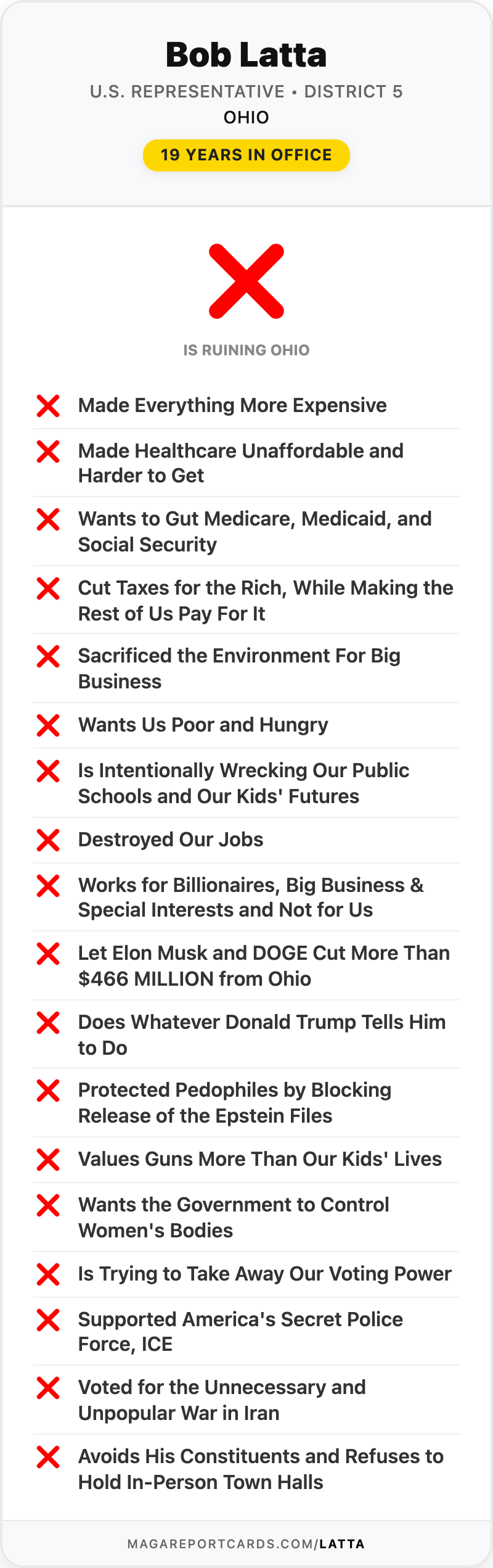
Bob Latta has represented Ohio's 5th District since 2007. When 13abc checked the "district events" tab on his own congressional website in April 2025, the last one listed was from 2015. That's eleven years. Since then he holds telephone town halls, where the questions are screened.
The first empty chair: Norwalk, March 2025
The Bowling Green event wasn't even the first one that year.
On March 18, 2025, nearly 200 people filled a community center in Norwalk, in Huron County. Firelands Indivisible, a local constituent group, organized it. They had reserved a seat at the table for Latta, with a microphone and a name placard.
Ohio Capital Journal columnist Marilou Johanek was there. She reported that organizers had contacted Latta's office repeatedly, and that some had even tried to hand-deliver an invitation in person. They never heard back.
Latta's chief of staff, Emily Benavides, told Johanek the congressman would be in "Seneca and Hancock counties all day" — two other counties in the district — and sent along a statement saying Latta "appreciates the opportunity to continue meeting and speaking with constituents."
The people who had driven to Norwalk to meet and speak with him wrote their questions on cards instead. A panel of local experts answered in his place: a fifth-generation farmer who had led the Ohio Farmers Union, a former Navy pilot, a nurse with 30 years in the field, an Oberlin professor.
Johanek's last line was six words: "He gave them an empty chair."
The second empty chair: Bowling Green, April 2025
Less than a month later, organizers in Latta's hometown tried again. Bowling Green Persist and the League of Women Voters put together a nonpartisan town hall at Peace Lutheran Church and invited him.
He declined in writing, in an email to BG Independent News:
"At this time, I will not provide a platform for orchestrated disruptions to create media spectacles."
The 300 people who showed up were not, as it turns out, an orchestrated disruption. BG Independent News reported that the nearly two-hour meeting was civil throughout. The moderator was Jerry Anderson, a retired local newscaster who calls himself a "proud political independent" and lives in Bowling Green. "He is not an outside agitator coming here," organizer Debbie Dalke said of him.
Dalke's own summary of the effort to reach the congressman was shorter:
"We have tried to contact Bob Latta. He did not respond to our invitation."
Asked how many in the room had called or written Latta's office, a sea of hands went up.
People wore "Where's Bob Latta?" T-shirts. Sandy Wicks of Bowling Green asked how he justifies supporting President Trump's dismantling of the federal government: "If you sit back and say nothing, we will remember your unwillingness to save our community and our country." An older man said he did not expect to see the country recover in his lifetime.
Another organizer, Brittney Klockowski, described the pattern plainly. Latta, she said, is "only talking to people who he invites to be spoken to; he's not actually listening."
This is not new. It goes back to 2017.
Johanek dug up the precedent. In 2017, when House Republicans including Latta voted to repeal the Affordable Care Act, constituents in the 5th District asked for a town hall to talk about health care. They heard nothing back.
His hometown newspaper ran the story under this headline: "Latta missing in action as citizens demand town hall."
Residents quoted in that account said he was "hiding" from them, that his public appearances were photo ops meant to "give the impression you are listening," and that his telephone town halls screened calls "so as not to include anything we actually are demanding accountability on."
Nine years later, the complaint hasn't changed a word.
One constituent's paper trail
A David Neuendorff of Bowling Green stood up at the April 2025 town hall. BG Independent News quoted him on Social Security — he said Congress could solve its crisis in one afternoon, "Take the cap on earnings off," and was instead "standing to the side and letting Elon Musk destroy it."
A David J. Neuendorff of Bowling Green was still trying in 2026. He got onto one of Latta's telephone town halls and tried to ask about tax breaks for the wealthy. Latta had invited questions repeatedly during the call. His went unanswered.
So he wrote to the paper. In June 2026, the Sentinel-Tribune ran his letter under the headline "Should I vote for Bob Latta?" He wrote that Latta "has repeatedly refused to have any Town Hall meetings or regularly meet with his constituents," and called it dereliction of duty.
That is what the process looks like from the other end. Show up in person: cardboard cutout. Call in: question skipped. Write a letter: it runs in the opinion section, and nothing happens.
The telephone town hall is the whole strategy
Latta isn't improvising. In March 2025, House Speaker Mike Johnson told Republicans to stop holding in-person town halls — and across the country, members swapped them for phone calls where staff screen the questions. His Ohio colleague Mike Carey promised on Facebook and X to post his telephone town hall's call-in number in advance, never did, and then put out a press release celebrating that 12,000 people joined. In Arizona, Paul Gosar hasn't held an in-person town hall since June 2016 and has missed 541 votes. In Arkansas, a 90-year-old constituent stood outside French Hill's office every Thursday for 52 straight weeks asking for one.
The format isn't the point. The screening is. A telephone town hall lets a member say he took questions from thousands of constituents without ever standing in a room where someone can follow up.
Someone is holding town halls in the 5th District
Just not the congressman.
Brian Shaver, the Fostoria city council president and a social studies teacher, won the Democratic primary in May and is on the ballot against Latta this November. He is running what he calls a "Tacos and Transparency Tour" — informal town halls at Mexican restaurants in all nine counties of the district, because "there are really good taco places in every county in my district."
Shaver's platform is three words: affordability, accountability, availability. He dismisses telephone town halls on the grounds that only vetted questions get through.
Constituents at his BG stop said the same things they'd been saying for a year. Cathy Masin: "He's not meeting the people. He's not understanding local issues." Jane Allison, on the choreographed events where Latta does appear, like pancake breakfasts: "He's very protected at those."
What the job is
A member of the House represents about 761,000 people. The mechanism by which those people get to say something to him — and be answered where others can hear it — is the town hall. It is not a favor. It is close to the entire job description.
Latta has held that seat for 19 years. The last district event listed on his own congressional website was in 2015. In the eleven years since, his constituents have organized the meetings themselves, twice in a single year, and both times he made them talk to furniture.
Source
"Rep. Latta declines constituent-led town hall request", WTVG 13abc, April 2025. Photo: moderator Jerry Anderson beside a cardboard cutout of Bob Latta at the Bowling Green town hall, by Jan McLaughlin / BG Independent News.