Zach Lahn has built an unusual campaign for a Republican in Iowa. He calls agribusiness multinationals "cartels" that "have pillaged our state." He wants to break them up with antitrust lawsuits. He promises to "tax the heck" out of Wall Street hedge funds. He says the EPA has been captured by corporate interests.
He told Tucker Carlson it sometimes makes him sound like a "hippie."
A new investigation by Mother Jones and the Food & Environment Reporting Network asks the obvious question about a man who says all that: where was he before?
The answer is that he was working for the other side.
He ran the Koch brothers' Montana operation
In 2014, Lahn was hired to direct the Montana branch of Americans for Prosperity — the Koch brothers' flagship political advocacy group.
What did he do there? He urged Montana's Republican legislators to vote against the state's Medicaid expansion. When some of them supported it anyway, he tried to run them out of office.
Lahn is singled out by name in the award-winning 2018 documentary Dark Money as an example of how the Koch political operation works.
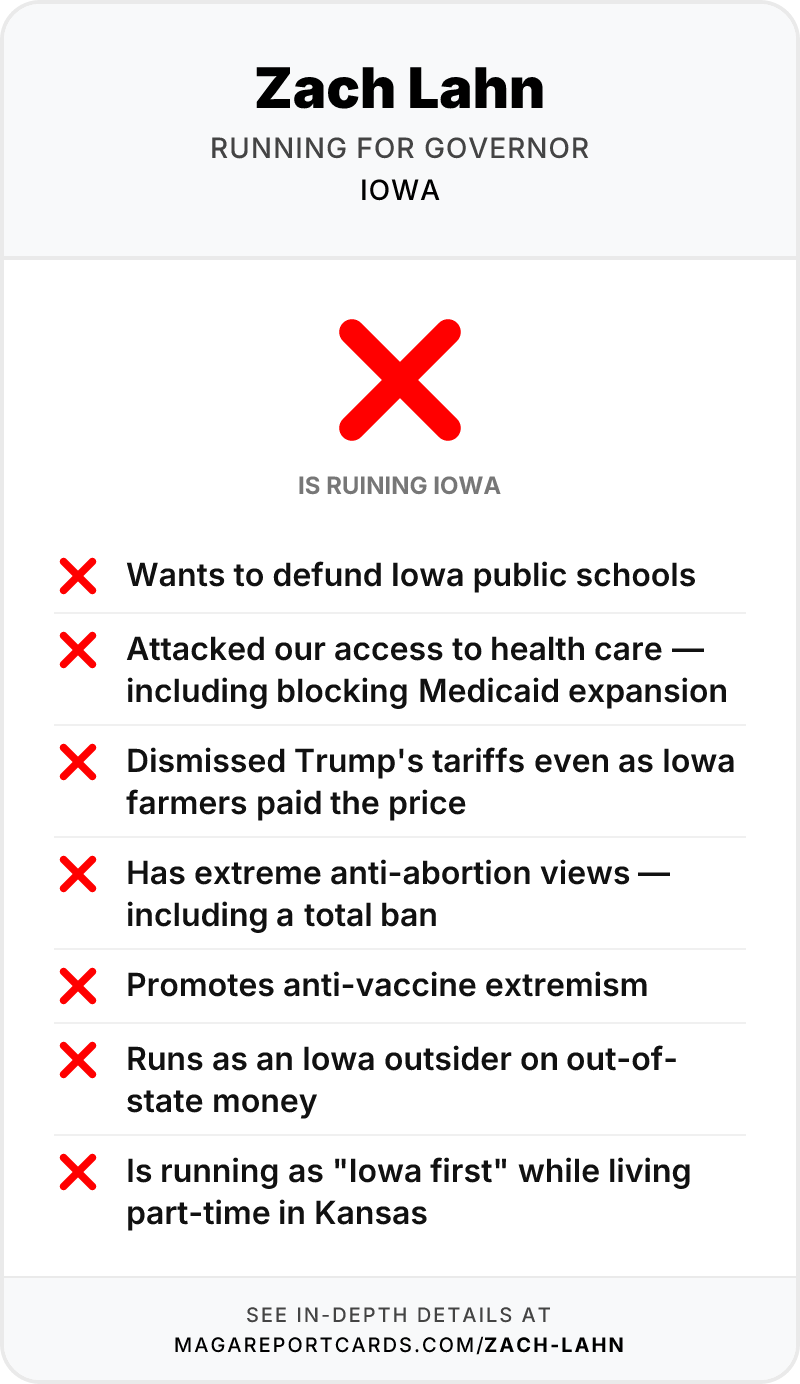
That is not ancient history that a man can simply grow out of. It is a career spent doing the specific thing Iowa's rural communities are still paying for. He's still defending privatized Medicaid today, after Iowa's own state auditor found it caused an 891% jump in illegal denials.
And he still sits on a Koch-financed board
In 2018, Lahn co-founded a private school in Kansas with Annie Koch, wife of Koch scion Chase Koch, who financed the project. Lahn and Annie later married.
Lahn still serves on that school's board of directors.
Now hold that next to his stump speech. Lahn wants the agribusiness "cartels" broken up. Koch Industries is one of them: its fertilizer arm, Koch Ag & Energy Solutions, is one of just four companies — with CF Industries, Nutrien and Yara — holding 84% of North America's nitrogen fertilizer capacity. Farmer advocacy groups have accused it of monopolistic practices in Iowa specifically.
To be fair and precise: Lahn did not work in the Koch family's agricultural business. He worked in their politics. But the distinction is thinner than it sounds — the politics existed to protect the business, and Americans for Prosperity was campaigning in Iowa too, for Republican candidates Mother Jones describes as friendly to Big Ag and corporate interests.
Austin Frerick, an expert on Iowa agricultural antitrust and author of Barons, offered the most economical summary:
Lahn, "at his core, is an all-star, major league political operative."
The crisis he's campaigning on is real
None of this means Iowa's problem is invented. It is severe, and both parties have avoided it for decades.
- Iowa has the nation's second-highest cancer rate, and is one of only three states where the rate is increasing. The Iowa Environmental Council has explicitly tied that trend to agricultural pollution.
- Pesticides, high-nitrogen fertilizers and hog-manure lagoons have laced the majority of Iowans' drinking water with unsafe contaminants.
- The average farmer now makes less than 15 cents of every food dollar consumers spend.
- Agribusiness spent about $224 million on lobbying last year — often outspending defense and oil and gas.
"When you live in these areas, you're living in a crisis," Frerick says. Aaron Lehman, a fifth-generation Iowa farmer and president of the Iowa Farmers Union, puts it this way: "We have hit a level of corporate control that we've never gone through before."
That's why Lahn's pitch works. The grievance is genuine. The question is whether the messenger will act on it.
The test he's already failing
Here's the cleanest way to judge whether Lahn will actually take on the powerful: watch what he says about the administration he's tied himself to.
Because on the specific issue at the center of his campaign — glyphosate, the weed killer in Roundup that Lahn says the EPA won't admit causes cancer — the Trump administration has gone the other way, repeatedly:
- Trump signed an executive order declaring the production of glyphosate critical to U.S. national security.
- The nation's top pesticide regulator and its undersecretary for food safety are both former Big Ag lobbyists.
- In June, the Supreme Court ruled that states cannot sue Bayer, glyphosate's producer, over failing to warn consumers about the herbicide's alleged dangers.
Lahn accepted Trump's endorsement as a "patriot." He has not, so far as the reporting shows, challenged any of it.
The same goes for the rest of what Washington has done to Iowa farm country: tariffs crushing farmers, fertilizer costs climbing as the war in Iran drags on, DOGE's cuts to USDA services and regenerative farming programs, and the Medicaid and SNAP cuts in Trump's budget bill that agricultural communities increasingly rely on.
One Iowa soybean farmer told Mother Jones what he wants: "We need a governor who will stand up for Iowa when our Iowa interests are being ignored" — including, he added, by the president.
Who's paying for the anti-corporate campaign
Lahn deserves credit for one thing: unlike his primary opponent and his general-election rival, he didn't fund his primary campaign with big checks from Big Ag. He put in roughly $2.5 million of his own money.
But the money coming in now is not grassroots either. A PAC associated with the Republican Governors Association contributed $5 million. Steak 'n Shake CEO Sardar Biglari gave $25,000.
The party establishment does not write $5 million checks to candidates it expects to break up its donors' companies.
The rest of the platform
Lahn's anti-corporate message travels with positions that have nothing to do with fertilizer monopolies:
- He's vowed to pull mRNA Covid shots off the market and end every childhood vaccine requirement in Iowa schools — during the worst measles year since 1991.
- He's pushing a life-at-conception law, which would effectively end abortion access in Iowa.
- He promises to drive "Marxists" out of Iowa schools, after running a school that never sought accreditation, and so owed the state no tests and no licensed teachers.
- He accepted an endorsement from former Rep. Steve King, who lost his seat in 2020 after questioning why "white nationalist" and "white supremacist" are offensive terms.
And the man presenting himself as a sixth-generation Iowa farmer didn't register to vote in Iowa until October 2024 — barely clearing the state's two-year residency requirement — as the Wall Street Journal documented. The Des Moines Register reported in May that he still flies to Kansas about once a week. The Daily Beast reported he has never claimed the Belle Plaine farm as his primary residence.
Lahn's campaign declined Mother Jones' interview request, and declined to answer questions about his role in the farm's day-to-day operations.
Lahn rails against out-of-state owners of Iowa farmland, and his critics note that he was one of them until recently. Silvia Secchi, a natural resources economist at the University of Iowa, put it this way: "It takes one to know one."
What Iowa should ask
Iowa farmers are right to be furious, and they are right that nobody has been fighting for them. If Lahn has genuinely changed his mind about the Kochs, monopolies and corporate power, that would be worth something.
But a conversion is proved by what you give up, not by what you say. Lahn is still on the board of a Koch-financed school. He has not criticized a president who declared glyphosate a national security priority. And on Medicaid he has not moved: he campaigned against expansion in Montana, and he is defending Iowa's privatized system now.
Iowa deserves a governor who fought Big Ag before it was popular, not one who joined the fight after checking the polling.
Source
Zach Lahn Is MAHA's Great Farm Country Hope. Is He the Populist Hero He Claims to Be? — Teresa Cotsirilos, Mother Jones, in partnership with the Food & Environment Reporting Network, August 18, 2026. Top image illustration by Mark Harris.