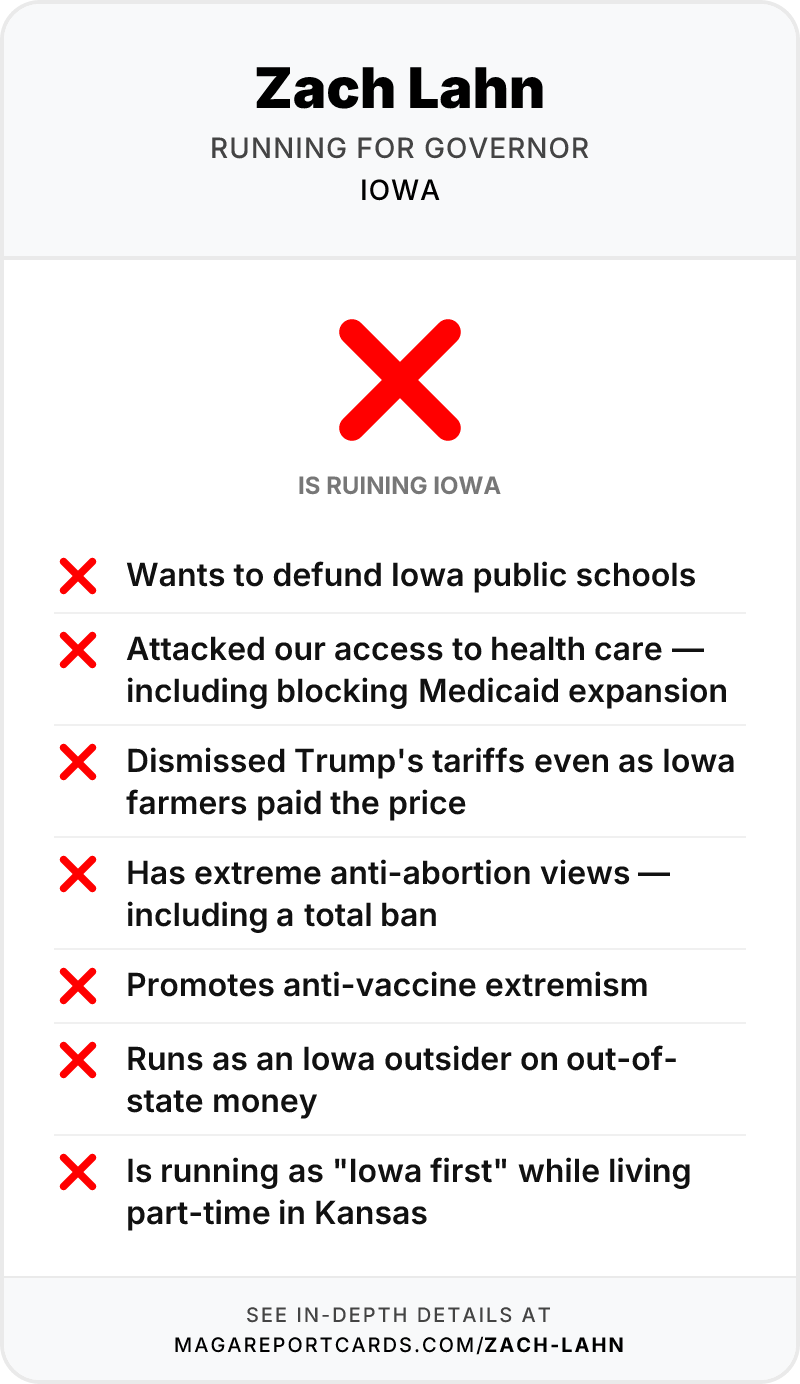
At a Moms for Liberty debate in Iowa on January 27, 2026, the Republican candidates for governor were asked about vaccines. Zach Lahn — who would go on to win the primary in June and is now the party's nominee — gave two answers that would change life in every school district in the state.
He said he would pull all COVID shots off the market in Iowa. And he said he would end all childhood vaccine requirements connected to enrollment in Iowa schools.
His reasoning:
"We cannot trust the medical establishment in Iowa anymore. They have lost our trust, and they have done nothing to earn it back."
Not COVID vaccine requirements. All of them. Measles, mumps, rubella, polio, whooping cough, diphtheria, tetanus, chickenpox — the whole schedule that has kept those diseases out of American classrooms for two generations.
The timing could not be worse
The CDC reported on July 24, 2026 that the United States has logged 2,318 measles cases in the first seven months of this year — already more than all of last year, and the most in 35 years.
Ninety-three percent of the people who got sick were unvaccinated. Childhood MMR coverage nationally has slipped to 92.5%, below the roughly 95% needed to stop the disease from spreading. Two young girls died in the West Texas outbreak — the first U.S. measles deaths in more than a decade.
The United States eliminated measles in 2000. The Pan American Health Organization will decide in November whether this country still gets to say that.
That is the national picture into which Iowa's Republican nominee for governor proposes to remove every vaccination requirement for school.
School requirements are the reason the diseases went away
It's worth being clear about what a school vaccination requirement actually does, because "mandate" has become a fighting word that obscures a very old, very boring public health tool.
Vaccines protect the child who gets one. School requirements protect the children who can't get one — kids in cancer treatment, kids with immune disorders, infants too young to be vaccinated who share a house with a school-age sibling. Those kids are safe only if the people around them are vaccinated, which is why the threshold matters and why the requirement is attached to the place where children gather in large numbers.
Lahn's answer to that is that the medical establishment has lost his trust. That's a statement about his feelings. It isn't an answer to the kindergartner in remission.
The rest of the platform
The school requirement isn't a one-off position taken in a debate. It's part of a set.
- He repeated both positions to the Washington Post after winning the primary, saying vaccination should not be a "requirement to participate in society."
- He is a listed signer of Americans for Health Freedom's candidate pledge, which declares COVID shots "not safe and not effective" and asks officials to call for them to be pulled off the market. He also announced the endorsement of Stand for Health Freedom, an anti-vaccine-mandate group.
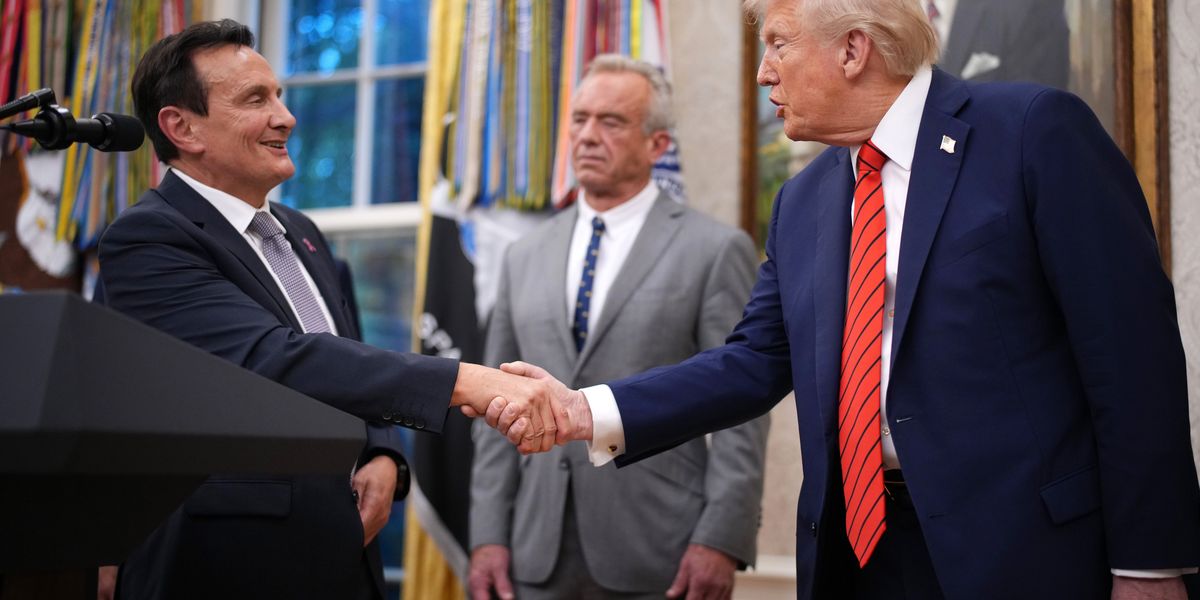
- When federal advisers dropped the universal recommendation that newborns get a hepatitis B shot within 24 hours of birth, Lahn called it "A MAHA Win," arguing there is "no logical argument" for vaccinating one-day-old babies "whose mothers have already tested negative."
That last one has been studied, and the numbers are public. Two studies published in JAMA Pediatrics in April 2026 modeled what happens when the birth dose stops being universal. One projected 628 additional newborn infections in a single birth cohort if uptake among babies of unscreened mothers falls to 10%. The other projected that delaying the first dose to two months would mean 76 additional chronic infections, 29 additional deaths, and $16.4 million in added lifetime health care costs — and that pushing it to age 12 would mean about 50 deaths and nearly $30 million.
The reason the shot is given on day one is not bureaucratic inertia. Roughly 90% of newborns who catch hepatitis B develop a chronic infection, and a quarter of them die early of cirrhosis or liver cancer. The 24-hour window exists because that is when it works.
What this would mean in Iowa
Iowa's governor doesn't set the childhood immunization schedule — the CDC does. But the governor absolutely can push the legislature to strip school requirements, direct the state health department, and set the tone for every school board and clinic in the state.
Lahn has told Iowans exactly what he would use that power for. He said it at a debate, and he said it again to a national newspaper after he'd already won.
Iowa's public health infrastructure is not a hypothetical. It's the school nurse who checks the immunization card, and the herd immunity that keeps a measles case from becoming a measles outbreak in a county with one hospital.
He is on the ballot in November against Democratic nominee Rob Sand. We deserve better.
Source
"Four GOP candidates for Iowa governor back mRNA vaccine ban," Radio Iowa, January 31, 2026, with additional reporting from Iowa Public Radio and The Washington Post. Photo: Iowa Public Radio.