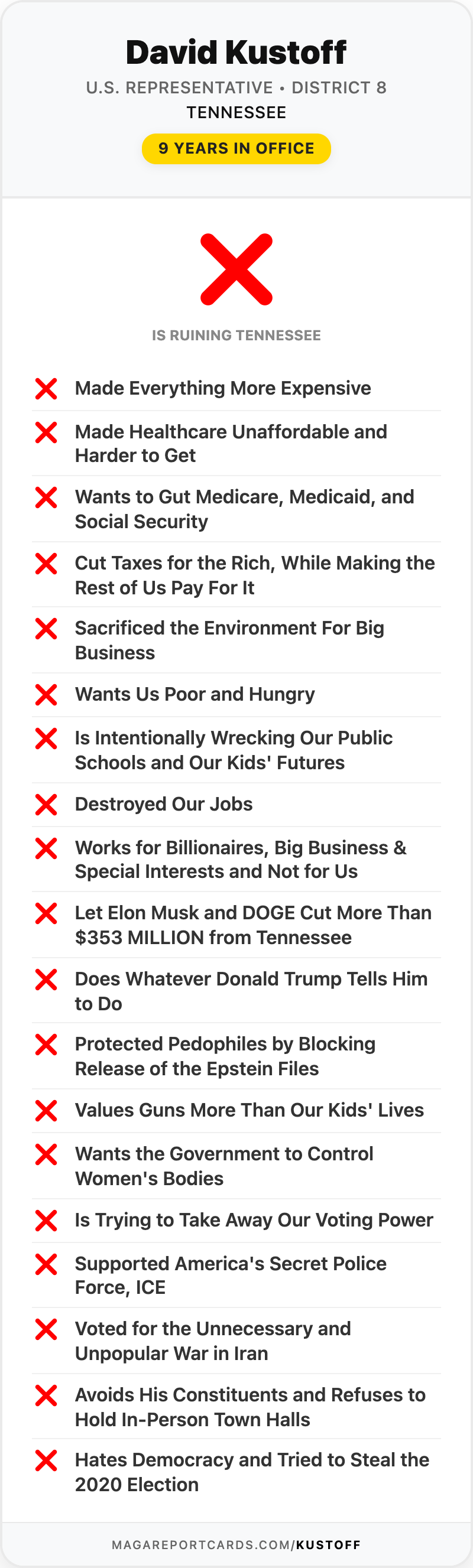
On September 10, 2025, David Kustoff introduced a bill to wipe two laws off the books in a city hundreds of miles from his district, where nobody can vote for him or against him.
The House Oversight Committee marked it up the same day. It was reported out 24 to 20, and it now sits on the Union Calendar waiting for a floor vote.
Kustoff's H.R. 5242 repeals two laws the elected D.C. Council passed: the Incarceration Reduction Amendment Act of 2016 and the Second Chance Amendment Act of 2022. The bill is opposed by D.C. Mayor Muriel Bowser, the entire D.C. Council, and D.C. Attorney General Brian Schwalb — that is, by every elected official the 700,000 people who live there actually chose.
It was one of 13 bills targeting D.C.'s local laws that the committee marked up in a single sitting.
What the two laws actually do
The Republican case for the bill, written into the committee's own report, is that D.C. lets "convicted criminals" off the hook. Here is what the laws say.
The Incarceration Reduction Amendment Act is a sentence review law. It lets someone convicted of a crime they committed before age 25, who has already served at least 15 years, ask a judge to look at the sentence again. The judge doesn't have to do anything. Before a sentence can be reduced, the court has to find that the person is not a danger and that the interests of justice warrant it.
Twenty-five states and the federal government have laws like it.
The Second Chance Amendment Act is a record-sealing law. It lets more people petition to have old convictions and arrests sealed from public view — not from police, not from the courts, not from employers legally entitled to see them. First-degree murder isn't eligible at all. An eligible felony can't be sealed until eight years after the sentence is finished. The judge must weigh the person's interest in sealing against both the community's interest in his rehabilitation and the community's interest in keeping the record open, and may consider seven more factors.
All 50 states and the federal government have criminal record sealing laws. As Oversight Democrats pointed out in their minority views, four Republicans on the committee are from states whose own sealing laws meet the bipartisan Clean Slate Initiative's minimum criteria.
The reason those laws exist is not softness. A criminal record — even for an arrest that went nowhere — follows a person into every job application and every apartment application for the rest of their life.
The evidence in the committee report includes a TV station's viewer poll
The report Republicans filed to justify the bill runs several pages on D.C. crime. Its cited support includes this:
A poll given by Fox 5 DC asked, "Should juveniles who commit violent crimes face tougher punishments?" 98% of respondents said yes.
That is an unscientific viewer poll from a local TV news segment, cited in a committee report as evidence that Congress should override a city's elected government.
The report also praises President Trump's takeover of the D.C. police force and the deployment of the National Guard into the city, and concludes: "Clearly the Executive actions taken by the Trump Administration are working."
Then they bolted on the speed cameras
Here is the part that gives the game away. During the markup, Rep. Scott Perry offered two amendments to Kustoff's bill that have nothing to do with juvenile sentencing or criminal records. The committee report records both as passing by recorded vote, and both are in the bill as reported:
- Section 2 repeals D.C.'s authority to run automated traffic enforcement — the cameras the District uses to catch speeding, red-light running, stop-sign running and failure to yield. It also strikes the requirement that a car's owner pay the ticket.
- Section 3 repeals D.C.'s restrictions on right turns at red lights. The D.C. Council passed that ban 12–1 in October 2022 as a pedestrian and cyclist safety measure. The bill's author, Council member Mary Cheh, said a city transportation study of 100 intersections already converted had found "far fewer conflicts between cars and people, more cars yielding for pedestrians and generally safer conditions."
The committee explained its reasoning in the report. The cameras, it wrote, "do less to advance traffic safety than harass unsuspecting citizens and visitors to bridge budget gaps," and D.C. should instead "implement sound budget policies that match modest spending levels with proper revenue sources."
So a bill titled "to repeal the Second Chance Amendment Act of 2022 and the Incarceration Reduction Amendment Act of 2016" now also tells the District of Columbia it may not use speed cameras and must allow right turns on red — because members of Congress from other states find the tickets annoying and think the city spends too much.
Nobody in D.C. gets a say
Congress does have constitutional authority over the District. The Republicans' report leans on it hard, quoting the Enclave Clause and the Home Rule Act.
But the Home Rule Act was passed in 1973 for a stated purpose — as the minority views put it, to "grant to the inhabitants of the District of Columbia powers of local self-government" and to "relieve Congress of the burden of legislating upon essentially local District matters."
Delegate Eleanor Holmes Norton, who represents D.C. in the House and cannot vote on the floor, put it plainly after the markup:
"Republican members of Congress, who are not accountable to D.C., have no business dictating the local laws of a city where 700,000 people live, work, and have chosen their own leaders through the democratic process."
Kustoff is not accountable to a single person affected by his bill. Not one D.C. resident can vote for him, vote against him, show up at his office, or throw him out.
This is becoming the House Republicans' favorite hobby. Oversight Chairman James Comer wrote a separate bill that would require an act of Congress before the District could change any tax or fee — and a delivery company wrote in to back it after the District added a 20-cent charge to its orders.
He believes in local control right up until he doesn't
The tell is what Kustoff wants for the city he lives beside.
In October 2025 he spent a day with Trump's Memphis Safe Task Force and came away arguing that the federal presence in Memphis should never end — "on a permanent basis, we have extra federal law enforcement," as he put it — and that Memphis should be "a blueprint" for other cities. Tennessee's governor sent the National Guard into Memphis at the president's request, not at the request of anyone in Memphis. Local elected officials sued to stop it.
So the pattern is consistent, just not in the way Kustoff would say it is. When Washington wants to override a city's elected government, he is for it — in D.C., where he writes the bill, and in Memphis, next door to where he lives.
One more thing worth noticing about H.R. 5242: Section 4 says it applies only to criminal conduct that happens after it becomes law. The committee wrote that this is "so as to not impact those who have already utilized" the two laws. Meaning the bill does nothing at all about the people Republicans spent five pages of the report warning about. It only closes the door on the kids who come next.
Sources
Norton Statement on Markup of Her Bill to Allow Electronic Transmission of D.C. Legislation to Congress and 13 Anti-D.C. Home Rule Bills, Office of Rep. Eleanor Holmes Norton, September 11, 2025. Bill text, committee vote and both sets of committee views: H.R. 5242 and House Report 119-341. Photo: official congressional portrait.