On April 22, 2026, Young Kim introduced a bill called the Stop DEI Act.
Here is the entire operative text of it. Not a summary — the whole thing:
"Notwithstanding any other provision of law, no funds may be made available under an applicable program to an institution of higher education that considers race, sex, ethnicity, color, or national origin in ways that violate the Nation's civil rights laws."
That's H.R. 8445 in full. One sentence, plus two definitions borrowed from other statutes.
Read it again slowly, because the trick is in the last nine words: in ways that violate the Nation's civil rights laws.
Colleges considering race in ways that violate civil rights law is already illegal. That is what "violate civil rights laws" means. Title VI of the Civil Rights Act of 1964 has barred discrimination on the basis of race, color or national origin at any program receiving federal money for sixty years, and in 2023 the Supreme Court struck down race-conscious college admissions under both the Equal Protection Clause and Title VI.
So the Stop DEI Act bans conduct that is already banned.
Her own press release says so
We don't have to infer this. Kim's office wrote it down:
"The Stop DEI Act reinforces existing federal civil rights protections by ensuring that institutions receiving federal funds do not engage in practices that violate those laws."
Reinforces existing protections. Congress does not need to pass a law to reinforce a law. The law is already the law.
What the bill actually adds is a punishment: any college found to have crossed the line loses all funding under any "applicable program." Under the statute Kim's bill points to, that phrase means "any program for which the Secretary or the Department has administrative responsibility." That is the whole Department of Education — Pell Grants, federal student loans, work-study, TRIO, research grants, everything.
So the one thing the bill does that current law doesn't is hand the Secretary of Education a switch that cuts off federal financial aid to every student at a college, as a penalty for that college's conduct. The students who lose their Pell Grants would be the ones who had nothing to do with it.
Two cosponsors, four months, no movement
If this were a serious legislative priority, it would look like one.
H.R. 8445 has two cosponsors: Tim Burchett and Byron Donalds. It was referred to the House Committee on Education and Workforce on the day it was introduced. As of August 2026 — nearly four months later — that is still the only action on the bill. No hearing. No markup. No floor vote.
A one-sentence bill with two cosponsors that restates existing law and never moves is not legislation. It's a press release with a bill number attached.
Kim is far from alone in this. Texas Rep. Brandon Gill runs an entire congressional task force devoted to hunting DEI, and Kentucky's Andy Barr spent $1 million on an ad telling voters "it's not a sin to be white" — one word away from a slogan the Anti-Defamation League catalogs as a hate symbol. This is a genre.
The quote
Here is what Kim said about her own bill:
"As one of the first Korean American women to serve in Congress, I can tell you firsthand: no one wants to be reduced to a DEI checkbox. I am so much more than that, and our children are so much more than that. That's why I'm introducing the Stop DEI Act to ensure these far-left policies don't continue unchecked."
She opens by invoking her identity — one of the first Korean American women in Congress — to argue that identity should never be considered.
And "these far-left policies" refers to something specific. Her press release names one: California's ACA 7, a proposed state constitutional amendment. Which is a state measure, in a state where voters already passed Proposition 209 banning racial preferences in public education — a fact her own release cites approvingly in the sentence before.
So the argument is: California already banned this, the Supreme Court already banned this, federal civil rights law already bans this, and therefore Congress should ban it again, harder.
What she isn't doing
Kim has served in Congress since January 2021. Her constituents built a website called Where Is Young Kim? to count the days, and as far as they can establish she has not held a single in-person town hall in five and a half years. Long enough that in March 2025 the Democratic Party of Orange County had to bring in a congressman from another district to hold a town hall in CA-40 so her constituents had somewhere to be heard.
If she had held one, someone might have asked her what a one-sentence bill banning something already illegal does for the cost of their kid's tuition.
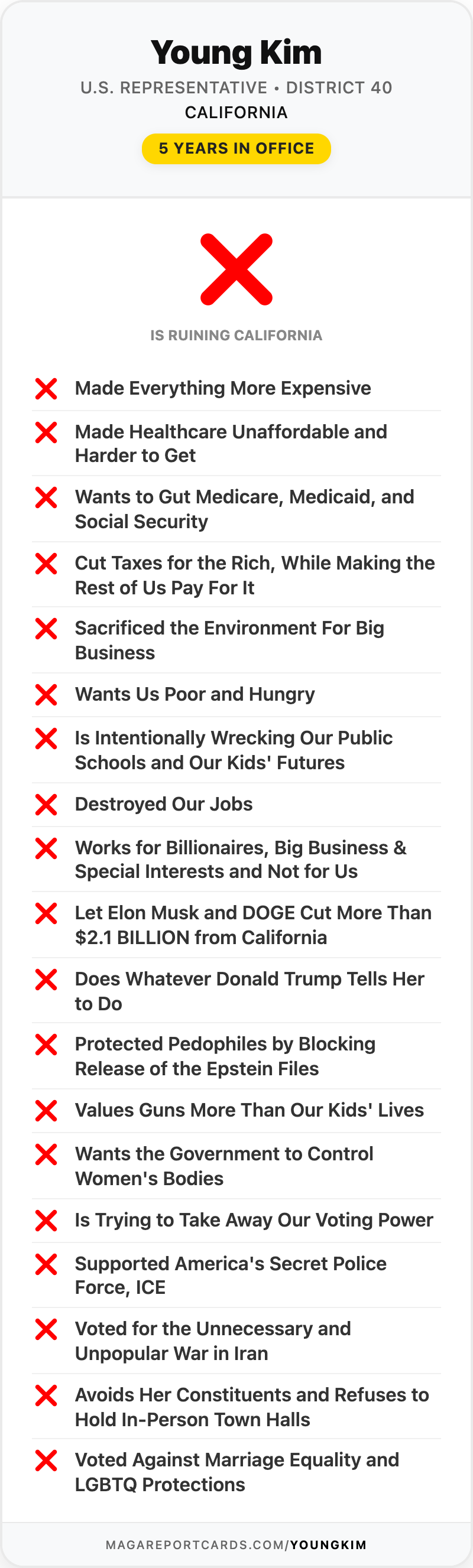
Her actual record is a different story from her press releases. She voted Aye on Trump's budget bill on July 3, 2025 — the one the Washington Post reported would leave at least 17 million Americans without health coverage, 11.8 million of them from its Medicaid cuts and most of the rest as the pandemic-era Affordable Care Act subsidies expire — and she has a 3% score from the League of Conservation Voters for 2025, 13% for her career, while billing herself as a moderate Orange County Republican.
The Stop DEI Act will not pass. It was never built to. It was built to be introduced.
Source
Rep. Young Kim Introduces Stop DEI Act to Protect Equal Opportunity in Higher Education — Office of Rep. Young Kim, April 22, 2026. Bill text and legislative history from congress.gov.