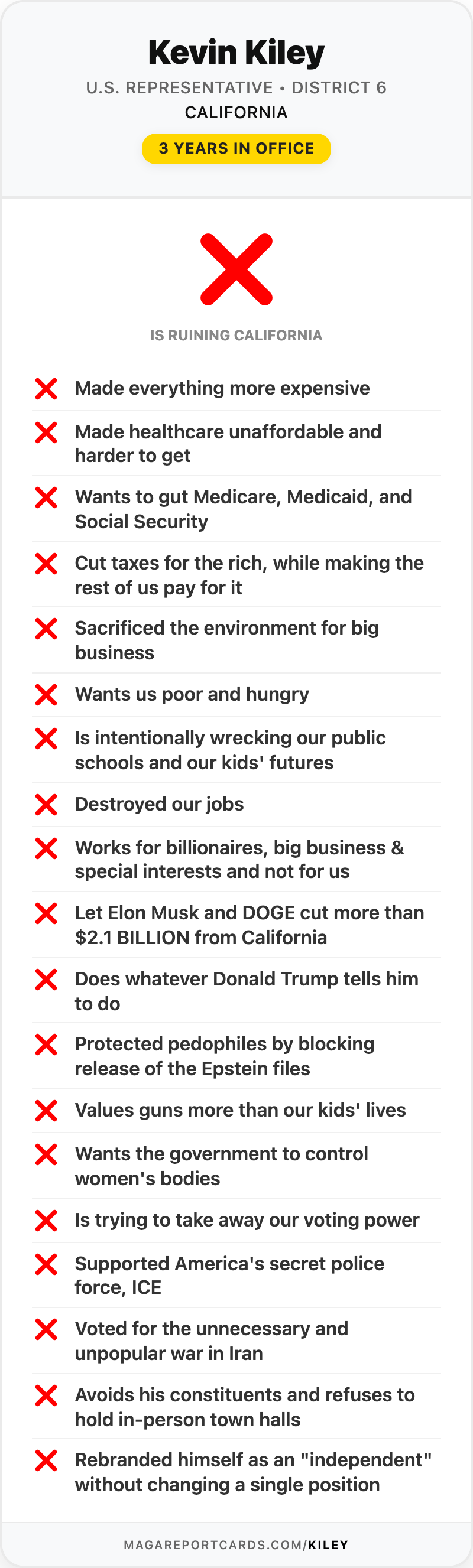
On July 24, 2026, Kevin Kiley signed a letter to Health and Human Services Secretary Robert F. Kennedy Jr. and Medicare and Medicaid administrator Dr. Mehmet Oz. It asked them to kill a California law.
The law is California's Managed Care Organization tax — the MCO tax. It is one of the biggest single pieces of financing behind Medi-Cal, the program that covers more than 14 million Californians.
To understand why this is Kiley's problem and not Gavin Newsom's, you have to start a year earlier.
Step one: he voted for the law that outlawed the old tax
On July 3, 2025, the House passed the One Big Beautiful Bill Act — H.R. 1, Trump's budget bill — by 218 to 214.
Kiley voted aye.
Buried in that law were new restrictions on how states can tax health providers to help pay for Medicaid. Georgetown's Center for Children and Families, walking through the federal guidance, says the law closes off the uniformity waiver for any tax that effectively charges "lower rates to providers and managed care organizations with less Medicaid revenues" and higher rates to those with more — and that the prohibition is "largely targeted at certain taxes on managed care organizations."
California's MCO tax was exactly that kind of tax — the Legislative Analyst says the Medi-Cal rate was more than 150 times higher than the commercial rate — and California is on Georgetown's list of the states it understands CMS to have in view.
So the bill Kiley voted for is what made the old tax illegal.
Step two: California rewrote it to comply
Faced with losing the financing, the Legislature passed Senate Bill 125 as part of the 2026–27 budget. It replaces the old structure with a flat, uniform tax — $8.85 per enrollee per month, applied the same way to commercial health plans, Medi-Cal managed care plans and ACA marketplace plans, for 2027 through 2029.
Uniform is the whole point. Uniformity is what H.R. 1 demanded.
The money it replaces is not small. The state's nonpartisan Legislative Analyst says the MCO tax "currently generates more than $12 billion in gross revenue annually, but less than $8 billion in net revenue is available to the state to spend" — money that, under Proposition 35, is committed to raising what Medi-Cal pays doctors, hospitals, clinics, ambulances and behavioral health providers — from 2027 on, 92 percent of the first $4.3 billion of net revenue has to go to those increases.
California voters passed Proposition 35 in November 2024 by 10,124,174 to 4,783,434 — 67.91% yes. They voted to make this tax permanent and to lock its revenue to Medi-Cal.
Step three: he asked two Trump appointees to veto it
The MCO tax only works if the federal government signs off. That is the leverage, and Kiley used it.
His letter, published in full with his office's release, asks Kennedy and Oz to "deny federal approval of California's Managed Care Organization (MCO) tax proposal," calling it a plan that "would dramatically increase costs on commercial health plans to preserve state revenue rather than make health care more affordable."
He was joined by five California Republicans — Jay Obernolte, James Gallagher, Ken Calvert, Vince Fong and Young Kim.
Then read the letter's own justification:
"The Working Families Tax Cut (H.R.1) took an important step toward ensuring that states use the MCO tax responsibly to support their Medicaid programs."
That is H.R. 1. That is the bill he voted for on July 3, 2025. He is citing the law that created the problem as the reason to block the state's compliance with it.
The premium argument, fairly stated
Kiley's stated objection is real and worth taking seriously.
Because the new tax is uniform, it lands on commercially insured people who were barely touched before. Kiley's release says the Legislative Analyst estimates it will raise premiums by $100 a year for an individual and $400 a year for a family of four. His letter argues small businesses may drop coverage rather than absorb it, and notes that the California Medical Association, the California Hospital Association, the California Primary Care Association, the California Association of Health Plans and the state Chamber of Commerce all oppose the design.
Nobody should want a $400 premium increase. That is a fair thing for a member of Congress to fight.
But look at what the letter asks for, and what it doesn't
The letter's remedy is one sentence: California "should now reprioritize its budget and put forward a proposal that complies with the uniformity standards while avoiding unnecessary increases in health care costs."
That's it. No alternative financing. No federal money to replace what H.R. 1 took away. No bill of his own. Reprioritize your budget.
And if Kennedy and Oz do what he asks, here is what actually happens: California doesn't get the new tax, and it can't go back to the old one, because H.R. 1 banned that. The hole isn't $400 a family. It's billions of dollars a year out of the program covering 14 million people — and under Proposition 35, most of the first $4.3 billion of it was committed to provider rates, which is the difference between a Medi-Cal card and a doctor who will actually see you.
Kiley has an answer for the premium increase. He does not have an answer for that.
He has done this before
In February 2026, when California progressives put a one-time tax on the state's billionaires on the ballot to help backfill federal health care cuts, Kiley wrote federal legislation to block it and told the House floor a wealth tax is "the confiscation of assets."
Same shape, five months apart. California tries to pay for health care. Kiley goes to Washington to stop it.
There is one more thing worth noticing about the venue. Kiley is now the only independent in the House — he dropped the "R" in March 2026 after redistricting made his seat harder, and told NPR that none of his positions were changing.
He did not take this fight to Sacramento, where the tax was written and where he spent six years in the state Assembly. He took it to two Trump appointees, and asked them to overrule a bill signed by the governor of his own state and a ballot measure more than two-thirds of his own state's voters approved.
We deserve better.
Sources
Kiley's letter and statement are published in full via his office, July 27, 2026. Signatories, the SB 125 structure and Kiley's post on X are from "Kiley, GOP Lawmakers Urge HHS to Block Newsom's Healthcare Tax," Megan Barth, California Globe, July 27, 2026. The House vote on H.R. 1 is Roll Call 190, July 3, 2025. MCO tax revenue figures are from the Legislative Analyst's Office; Medi-Cal enrollment from the Department of Health Care Services. Photo: official congressional portrait via Wikimedia Commons.