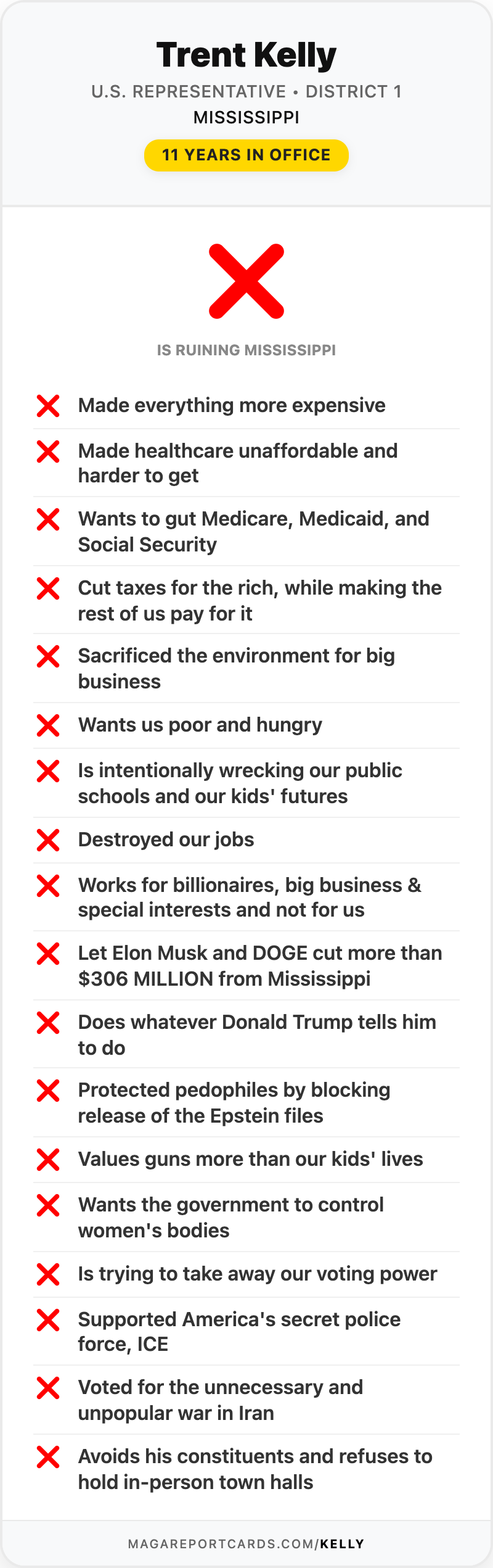
Before he went to Washington, Trent Kelly prosecuted crime in north Mississippi. By his own official biography, he served as Tupelo City Prosecutor and as forfeiture attorney for the North Mississippi Narcotics Unit, and then, right up until he was elected to Congress, as district attorney for the 1st Circuit Judicial District — Lee, Pontotoc, Alcorn, Monroe, Itawamba, Prentiss and Tishomingo counties — "managing all felony cases."
If you run felony cases in Mississippi, you handle domestic violence. And the federal money that helps you handle it — the training, the victim advocates, the rural enforcement grants — comes from one law.
The Violence Against Women Act.
Kelly has voted against reauthorizing it twice.
The votes
April 4, 2019. The House took up the Violence Against Women Reauthorization Act. It passed 263 to 158. Thirty-three Republicans voted yes. Kelly voted no.
March 17, 2021. The House took it up again. It passed 244 to 172. Twenty-nine Republicans voted yes. Kelly voted no again.
These aren't obscure procedural votes buried in a spending package. Both were straight up-or-down votes on final passage of a bill named the Violence Against Women Reauthorization Act.
What VAWA actually pays for
VAWA is not a slogan. It's a grant program, and the biggest piece of it is aimed squarely at people who do the job Kelly used to do.
The Congressional Research Service's breakdown of the 2021 bill lists the programs it reauthorized. The largest is the STOP program — Services, Training, Officers, and Prosecutors — funded at $215 million in fiscal 2021. Other line items that year:
- $47 million for civil legal assistance for victims
- $45 million for rural domestic violence enforcement
- $41 million for sexual assault services
Rural domestic violence enforcement. That is a line item written for districts like Mississippi's 1st.
What it looks like in Mississippi
The National Coalition Against Domestic Violence publishes a fact sheet for Mississippi. The numbers:
- 39.7% of Mississippi women and 31.7% of Mississippi men experience intimate partner physical violence, intimate partner sexual violence, and/or intimate partner stalking in their lifetimes.
- On a single day in 2019, Mississippi domestic violence programs served 354 adults and children — and 57 requests for help went unmet for lack of resources.
- Mississippi does not release intimate partner homicide data to the public.
- As of December 31, 2019, Mississippi had submitted no domestic violence misdemeanor or protective order records to the federal background check index.
That last one deserves a second read. Those are the records a federal background check searches to catch a domestic abuser. Mississippi had submitted none of them.
The reason 172 Republicans voted no
The contested part of the 2021 bill wasn't the shelters or the legal aid. It was the guns.
Federal law already barred people convicted of domestic violence from owning firearms — if they had been married to, lived with, or had a child with the victim. If the abuser was a boyfriend or an ex-boyfriend, the ban didn't apply. That gap has a name: the boyfriend loophole.
The 2021 bill closed it. Per the CRS summary, it extended the firearm prohibition to dating partners and former dating partners, added people convicted of misdemeanor stalking, and covered protective orders issued under state, tribal, and territorial law.
The National Rifle Association came out against the bill's gun provisions. Jason Ouimet, executive director of the NRA's lobbying arm, told Newsweek:
"The NRA did not oppose VAWA for its first 25 years. And today, we only oppose the gun control provisions contained within."
He accused Nancy Pelosi and anti-gun lawmakers of putting those provisions into the bill in 2019 "to pit pro-gun lawmakers against it so that they can falsely and maliciously claim these lawmakers don't care about women."
One hundred seventy-two House Republicans then voted no. Kelly was one of them.
The NCADV fact sheet has the number that makes this concrete: an abuser's access to a firearm increases the risk of intimate partner femicide at least five-fold. When a gun has been used in the most severe abuse incident, the risk goes up 41-fold.
He didn't have to vote this way
Twenty-nine House Republicans voted yes in 2021. Thirty-three voted yes in 2019. This was not a case where a Republican had no room to move.
A paper in his district noticed. Ahead of the 2022 primary, Commercial Dispatch columnist Slim Smith went through Kelly's record and added this vote to the list: "For good measure, Kelly also voted against restoring the Violence Against Women Act, which had lapsed in 2018." Smith's framing was that there are moments when party loyalty and constituents' welfare point in opposite directions, and this was one:
"I have no issue with either Guest or Kelly voting with their party on most legislation. But there are instances where both have made party loyalty a higher priority than the welfare of the people they were elected to represent."
The part that's hard to explain
Plenty of members of Congress vote with the gun lobby every time. That's a position, and voters can judge it.
But a former district attorney knows something a lobbyist doesn't. He knows what a domestic violence file looks like. He knows which victims come back and which ones don't. He knows what happens in the weeks after a woman leaves — which is when the danger spikes, and which is exactly the window the boyfriend loophole leaves open.
He voted no anyway. Twice.
We've written before about how his votes land on Mississippi families — he also voted against capping insulin at $35 a month in a state where 348,000 adults have diabetes — and about what Mississippi's whole Republican delegation is costing the state.
Fifteen years as a prosecutor. Two votes against the law that funds prosecutors who handle these cases.
Source
Slim Smith, "Slimantics: Guest, Kelly have consistently voted against constituents' best interests," The Commercial Dispatch.