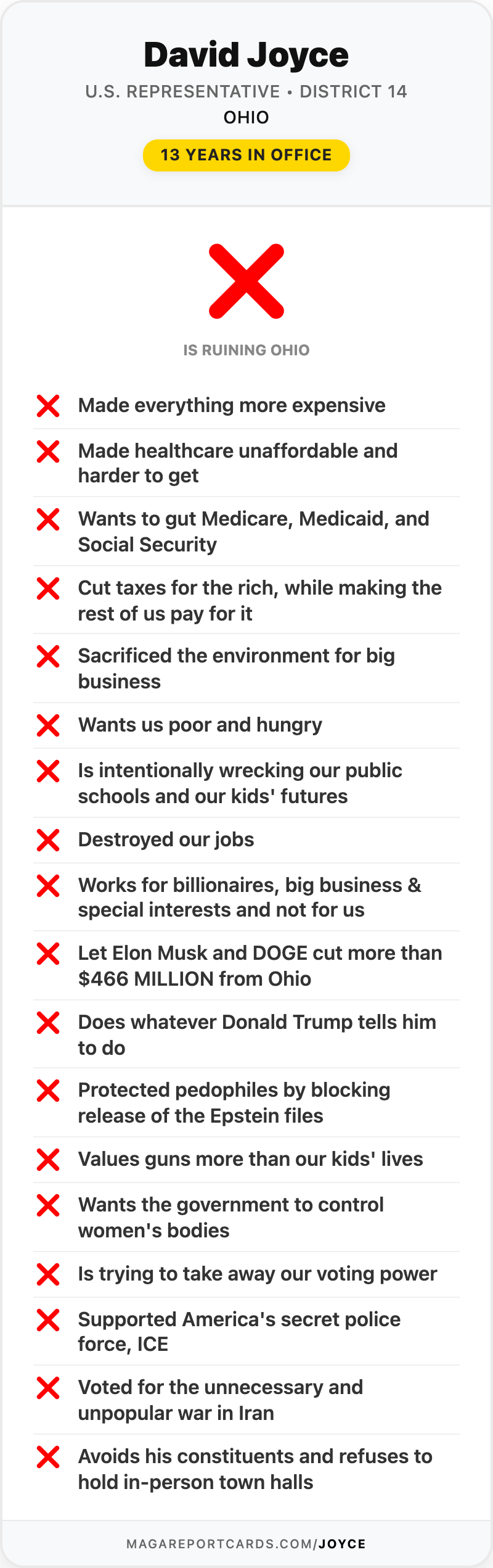
On the morning of April 7, 2026, the President of the United States posted this:
"A whole civilization will die tonight, never to be brought back again. I don't want that to happen, but it probably will."
He gave Iran until 8 p.m. Eastern. He had already described what he meant in more detail — that "every bridge in Iran will be decimated by 12 o'clock tomorrow night, where every power plant in Iran will be out of business, burning, exploding." Carrying through on that threat would, according to legal scholars, clearly amount to a war crime under U.S. and international law. More than 100 international law experts had already signed a letter saying Trump's actions in Iran violated the United Nations Charter and could amount to war crimes.
That afternoon, at a ribbon-cutting in Columbus, a reporter asked Ohio Congressman David Joyce what he made of it.
What he said
Joyce's answers, as News 5 Cleveland's Morgan Trau reported them:
"The president has his way of negotiating, which is unique to him. I don't speak to the things that he talks about or writes about on his social media."
"I think anybody who's dealt with President Trump since 2015, when he came down the escalator, realizes that he talks a lot in hyperbole."
"You have to measure what happens versus what the president says. But right now I'd like to think that part of the bluster and bravado of what the president has to say should be measured against what he actually does."
Read that last one again. A member of Congress was asked about a public threat to wipe out a nation of tens of millions of people, and his answer was that he'd like to think it was bluster.
"I don't speak to" is not a position
Joyce has been in Congress since 2013. He is not a bystander to American foreign policy. He sits on the House Appropriations Committee — the committee that pays for the bombs.
"I don't speak to the things that he talks about or writes about on his social media" is a thing a friend of the family says at Thanksgiving. It is not a thing a member of Congress gets to say about a threat to destroy a country's power grid.
And the constitutional problem isn't subtle. The war with Iran began in February 2026, and Congress never voted to authorize it. The one branch of government the Constitution actually assigns the war power to had, at that point, done nothing — and one of its senior appropriators was on camera in Columbus explaining that the president talks like that sometimes.
Joyce's own suggested standard was "measure what happens versus what the president says." That is the standard of a spectator. Congress isn't supposed to measure what a president does with an unauthorized war. It's supposed to decide whether he gets to do it.
The quote that wasn't hyperbole
Here's the part that got less attention. In the same set of remarks, Joyce wasn't only downplaying Trump. He was agreeing with him.
"Look, for 47 years they've exacerbated the situation in the Middle East. They've wreaked havoc in every country and spread terrorism beyond their own borders, and so eventually they needed to be stopped... We're going to do what's necessary to finally put this cancer to rest."
"This cancer" is a country — students, farmers, nurses, kids. On the same day his president promised their bridges and power plants would be burning by midnight, David Joyce described the whole thing as a cancer to be put to rest, and said we'd do "what's necessary."
That is not measuring what happens versus what the president says. That's signing on.
What his colleague said instead
Joyce wasn't the only Ohioan asked. Ohio Democrat Rep. Shontel Brown answered the same question this way:
"It was reckless, it's embarrassing, it's insane. It's frightening, to be honest, that this is the person who is in charge right now."
"When my Republican colleagues don't push back or stand up or do their jobs, then [Trump] just continues to push the boundaries and really it's putting this fragile thing we call democracy at great risk."
You can disagree with her politics and still notice that one of these two people answered the question.
How it ended, and what he did next
Eighty minutes before his own deadline, Trump announced a two-week ceasefire brokered by Pakistan, contingent on Iran reopening the Strait of Hormuz. The bridges stayed up.
So Joyce could say he was right about the bravado. But notice what that argument actually concedes: his position was that the President of the United States can publicly promise a war crime and the correct response from Congress is to wait and see whether he means it.
Then came the part where Congress got its say. On July 23, 2026, the House voted 214–208 to order U.S. forces out of the war. Joyce voted no — to keep American troops in a war Congress never authorized — five months after it started, and with eighteen U.S. troops dead since the fighting broke out, four of them in the six days before the vote.
He told a reporter in April that once the House was back in session, "we'll have a good chance to have a serious discussion with the White House on where we're going moving forward."
That discussion, when it finally came to a vote, took him about as long as it takes to press a button.
Source
"Bravado": Ohio GOP Congressman dismisses Trump's warning that a "whole civilization will die" in Iran — Morgan Trau, News 5 Cleveland. Photo: News 5 Cleveland/Scripps.