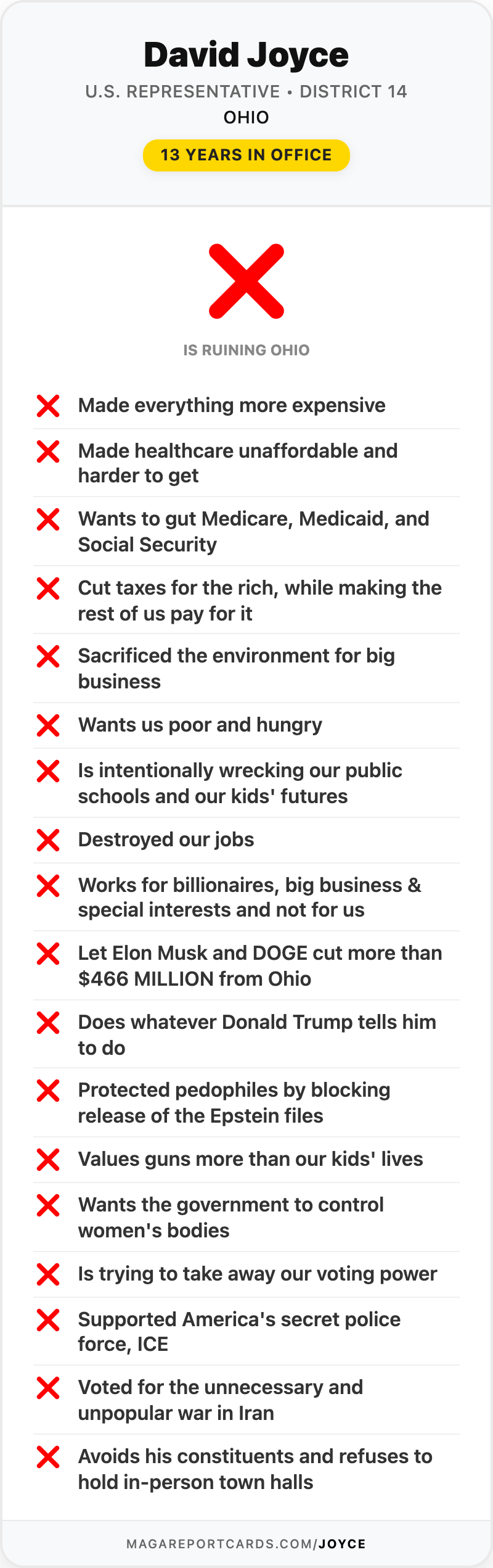
David Joyce has represented Ohio's 14th District — Ashtabula, Geauga, Lake, Trumbull and most of Portage counties — since 2013. That's 13 years, long enough that nobody can call any of this a rookie mistake. We've written about him before. Here are three more things Northeast Ohio should know.
1. He's the "Great Lakes guy" with a 6% environmental score
Joyce likes this part of his brand. He co-chairs the House Great Lakes Task Force and in January 2025 he introduced a bill to reauthorize the Great Lakes Restoration Initiative, the program that fights algal blooms, invasive species and pollution in Lake Erie. Good bill. Real problem. Genuinely bipartisan — Democrats signed on with him.
Now look at the rest of the ledger. The League of Conservation Voters scores every member of Congress on how they actually vote on clean air, clean water and climate. Joyce's score is 6% for 2025, and 12% for his entire career.
You can't square those two things by accident. One press release about Lake Erie does not offset thirteen years of voting with the polluters roughly nine times out of ten.
And he backed the big one. Joyce voted for Trump's budget bill on July 3, 2025 — the law that slashed through the country's climate programs. It came alongside an EPA that has moved to stop counting the lives saved when it writes air pollution rules and to erase the government's power to fight climate change — rollbacks that analysts say will increase cancer-causing pollution.
Lake Erie doesn't care which press release you sent. It cares how you voted.
2. He voted for a bill that could keep millions of citizens from voting
On April 10, 2025, the House passed the SAVE Act. Joyce voted yes.
Here's what that bill does. It would require every American to prove citizenship in person to register to vote or to update a registration — after a move, after a name change. For most people that means digging out a passport or a birth certificate and carrying it to an election office.
The problem is who doesn't have those documents handy. Roughly 146 million Americans don't have a passport, and as many as 69 million women who took a spouse's name have a birth certificate that no longer matches their legal name. Working people who can't take a weekday off to visit an election office get hit hardest. This year's version, the SAVE America Act, goes further, and Joyce voted for that too in February. Ohio Capital Journal columnist Marilou Johanek walked through what it would mean for Ohio voters: a lot more paperwork, for a lot of people who already vote legally.
And the thing it's supposed to fix barely exists. Noncitizen voting is vanishingly rare — election fraud in the U.S. is not widespread, and a review of the actual claim about migrants voting found no evidence of it.
So the bill doesn't stop much fraud. It stops voters. Joyce voted for it anyway.
3. His constituents held a town hall. He wouldn't come.
In spring 2025, people in Geauga County got tired of waiting. After weeks of not hearing back from Joyce's office, they organized their own town hall and invited him.
He said no. A staffer told the organizer he would not attend an event affiliated with the Democratic Party. The organizer pointed out that the people who had registered came from across the political spectrum — they were constituents, which is the only credential that should matter.
What he did instead was a telephone town hall. It ran about 30 minutes. The takeaway from people on the call, per the Geauga County Democratic Party chair who organized the event, was that his answers "were parsed in such a way that Congressman Joyce was sort of playing both sides of the issues."
That's the whole trick. A phone call you control, for half an hour, and you can tell everyone you held a town hall. Meanwhile the neighbors who wanted to look you in the eye and ask about federal cuts — as many as 356,000 Ohioans could lose health coverage by 2028 under the Medicaid work requirements and six-month eligibility checks in the bill he voted for — got an empty chair.
What kind of representative is this?
A Great Lakes champion who votes green 6% of the time. A yes vote on a bill that solves a problem we don't have by making it harder to do the thing we all should. An empty chair where your congressman was supposed to be.
Different issues, same instinct: take the credit in public, take the vote in private, and don't be in the room when anyone asks about it. Thirteen years in, that's not a habit he's going to break on his own. Northeast Ohio has one reliable way to bring it up — and it comes around in November.