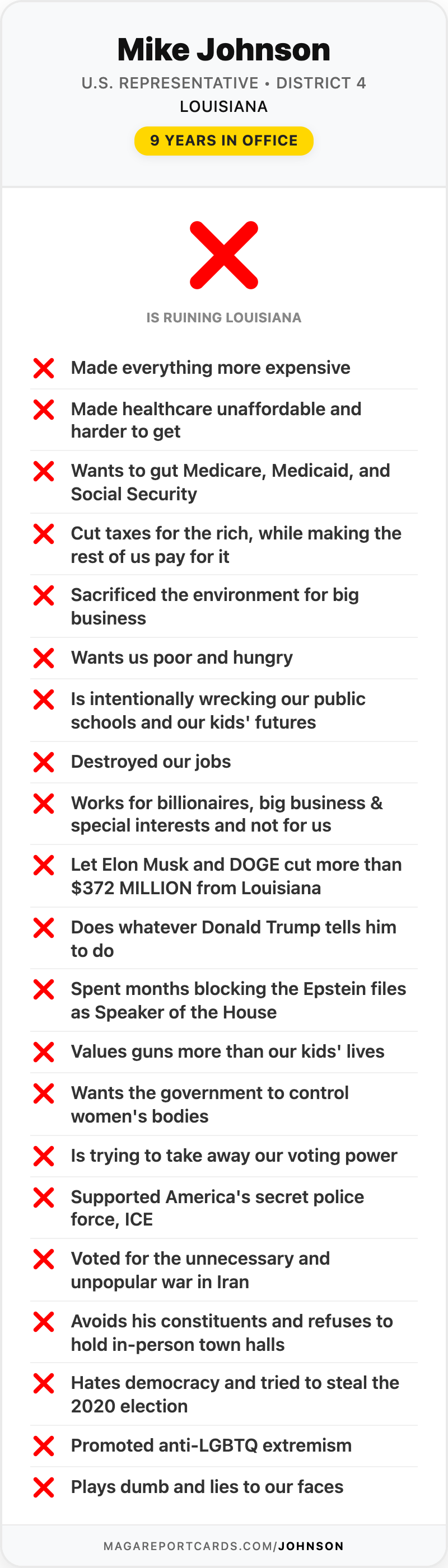
Across the country, people are showing up at city council meetings, county hearings and state capitols to fight AI data centers — over their electric bills, their water and the gas plants that power them. House Speaker Mike Johnson has an explanation for all of it: China.
On Fox Business on Monday, September 28, 2026, host Cheryl Casone suggested the pushback against data centers was "coming from China." Johnson agreed:
"This is what Democrats do. Every election cycle they find something to glom onto and say that this is doom and gloom and everyone will die if we don't win."
"Don't buy it. This is a Chinese psyop. I really believe that. That's not a conspiracy theory."
The New Republic reported the remarks the same day.
The people he's talking about are Americans
Johnson didn't say foreign agents were trying to stir up the debate. He told voters not to believe it. But the opposition isn't a fringe. It's most of the country.
An Economist/YouGov poll taken August 28–31 found nearly two-thirds of Americans oppose building a data center in their own community. About half — 51% — said new data centers are a bad thing for the country. Only 20% called them a good thing.
That opposition is winning. Data Center Watch, which tracks local fights, counted at least 45 projects worth nearly $68 billion blocked or delayed by local opposition in just three months this spring, with regulators taking a closer look in 49 states.
Those aren't bots. They're neighbors who read their power bills.
Yes, foreign actors pile on. That doesn't make the worry fake.
Reporting has found that Chinese and Russian actors have tried to inflame the debate over AI data centers. The New Republic pointed to Jessica Brandt, a former intelligence official who tracked foreign influence, who told The New York Times that "foreign actors aren't manufacturing American debates over the future of AI, they are exploiting them."
That's the difference Johnson erased. Foreign trolls amplify every fight Americans have — over guns, vaccines, elections, immigration. Nobody says the cost of a gallon of milk is a psyop because a Russian account posted about it.
Johnson isn't the first Republican to reach for this. This summer, Republicans we track asked the FBI and the Justice Department to look into who was behind the backlash — while researchers who actually went looking for a Chinese campaign said they hadn't found much.
Meanwhile, in Louisiana
Johnson's home state is one of the biggest data center bets in the country. Amazon said in February it would spend $12 billion on AI data centers in Louisiana. Meta's Louisiana project is set to reach $50 billion, helped by generous tax breaks.
Those campuses need enormous amounts of power from gas-fired plants. The New Republic noted that a local health official has warned the projects threaten to increase harmful toxic exposure from those plants.
People who live near those plants have real questions. Their state's most powerful Republican — the Speaker of the House — just told them their questions come from Beijing.
Why this matters
When you call your constituents' concerns a foreign plot, you don't have to answer them. You don't have to explain who pays for the new power lines, what happens to the water, or why the tax breaks go to trillion-dollar companies. We've laid out who actually pays the bill when a data center comes to town — and it's usually the ratepayers.
As The New Republic put it, Johnson has made clear he won't allow any daylight between himself and President Trump, an outspoken backer of the AI industry. Here, he went one step further: telling Americans who disagree that they've been fooled by China.
What the record shows
On September 28, 2026, Speaker Mike Johnson called opposition to AI data centers "a Chinese psyop" and told voters, "Don't buy it." Nearly two-thirds of Americans oppose a data center in their own community, and local opposition blocked or delayed at least 45 projects worth nearly $68 billion in a single quarter this year. In Johnson's home state, Amazon and Meta are putting a combined $62 billion into data centers.
Source
Mike Johnson Has Bonkers Excuse for Surging Data Center Hate — The New Republic, September 28, 2026.