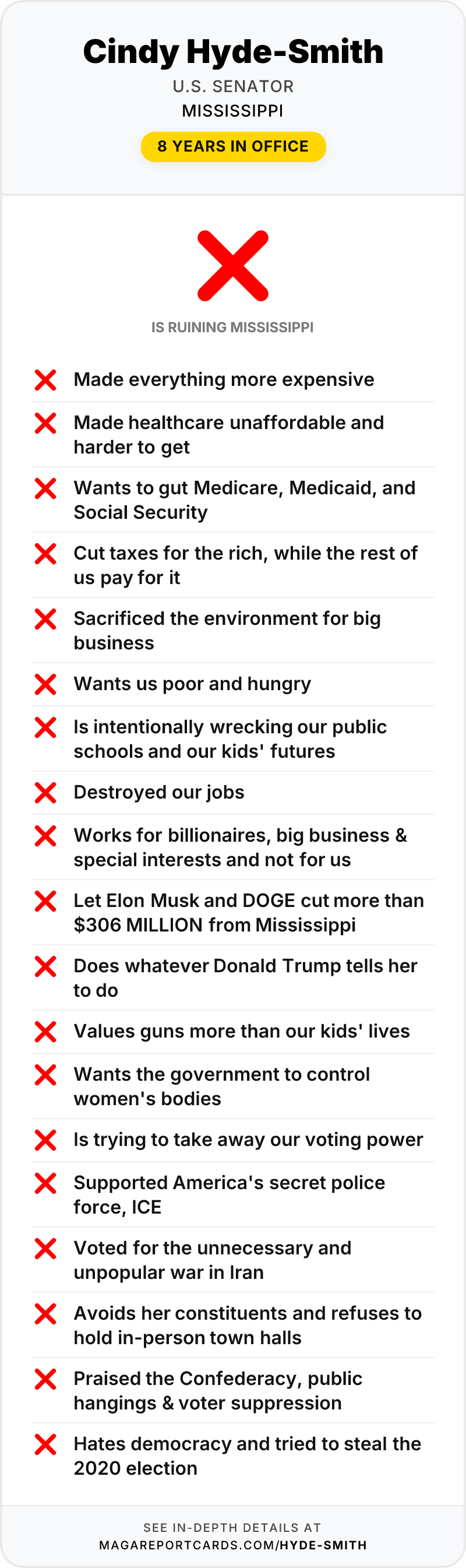
On July 22, 2026, the Senate Energy and Natural Resources Committee held an oversight hearing on the Federal Energy Regulatory Commission — the agency that referees the nation's power grid. Cindy Hyde-Smith sits on that committee, and when her turn came she told the commissioners this:
"Mississippi, my home state, continues to be at the forefront of safeguarding ratepayers by ensuring companies, like data centers, pay their fair share for large loads."
That sentence deserves a hard look, because two months earlier a group of energy economists published a report on exactly that question in Mississippi. Their answer was close to the opposite.
What Mississippi actually did
Amazon is building four data centers in Mississippi — in Ridgeland, Canton, Clinton and Vicksburg — as part of a $25 billion investment the company says will create 2,000 jobs. Enormous facilities like these need enormous amounts of electricity, and somebody has to build the poles, wires and generation to deliver it.
The question in every state with a data center boom is simple: does the tech company pay for that, or do the people already on the grid?
Mississippi answered it in 2024 with Senate Bill 2001. According to the May 2026 report by Synapse Energy Economics, prepared for Earthjustice and Environmental Advocates Mississippi, that law:
"curtailed the standard oversight role of the Public Service Commission (PSC) over energy infrastructure, making it easier and faster to expand the electrical grid for data centers."
The report is blunt about who absorbed the risk: "By limiting the role of the PSC, Mississippi legislators transferred significant risk to residential consumers, who as a class of ratepayers, have now lost a key transparency and fairness check on Entergy Mississippi."
The law also hid Entergy's agreement with Amazon from the public, and let the utility start recovering data-center costs through everyone's rates before the facilities are even running. Ben Havumaki, one of the report's authors, put it plainly: the law "creates an unusually frictionless path for the utility to make investments on behalf of data centers."
Normally, he explained, a utility spends its own money first and then has to convince regulators the spending was prudent — "in public with transparency and reasonable vetting from other parties. In this case, a lot of that is just shrouded in regulatory cover and secrecy."
That is the state Hyde-Smith described to federal regulators as "at the forefront of safeguarding ratepayers."
What it has cost Mississippi households so far
The Synapse report put numbers to it. Entergy Mississippi's residential customers:
- have already paid approximately $38 million as of March 2026 for investments related to serving these data centers, and
- will contribute $74 million by the end of 2026.
Mississippi Today, reporting on the same analysis, put the household effect at about $10.60 more per month on residential bills. Against the average monthly bill the report used — $157 — that's roughly a 7% increase.
In Mississippi, $10.60 a month is not a rounding error. It's about $127 a year, taken from households that did not get a vote on it, to help build data centers for Amazon.
The report is careful, and so are we: these are estimates, and the authors say so, because the contract is secret. That secrecy is the point. Nobody outside Entergy and Amazon can check the math — which is what SB 2001 arranged.
Whose words she was using
Entergy disputes all of it. The company says its customers "are not subsidizing data centers — they're benefitting from them," and that data centers "are paying their fair share, plus additional benefits for customers." In March 2026 it launched a public pledge branding this promise: "Fair Share Plus." It projects that by 2030 customers' bills will be 16% — about $30 a month — lower than they'd be without Amazon.
Entergy has released limited data supporting those projections, citing trade secrets in its agreement with Amazon.
Now read the senator's sentence again: Mississippi is safeguarding ratepayers by "ensuring companies, like data centers, pay their fair share for large loads."
She didn't test the utility's claim in front of federal regulators. She repeated its slogan.
There's a reason to notice whose language she reached for. Entergy is one of her donors — her campaign committee and leadership PAC have taken $37,250 this cycle from Entergy's PAC and employees, and she sits on both the Energy and Natural Resources Committee that oversees FERC and the Appropriations Committee.
To be fair to her, she did ask the commissioners a real question that day — what mechanisms FERC is putting in place to make large-load customers pay upfront so rates don't rise. That's the right question. But she asked it while telling the room that her own state had already solved the problem, when her state had in fact removed the referee and sealed the contract.
We have seen this exact script
This is becoming the standard move for Republicans in data-center states: warm words about protecting the electric bill, delivered by someone the power industry is paying.
In Ohio, Jon Husted says he'll protect your electric bill while the companies raising it fund his campaign — $69,750 from the tech and utility companies at the center of Ohio's data center fight. The pattern travels.
What makes Mississippi's version sting is the underlying condition of the state. Mississippi already ranks 48th out of 50 on the measures we track. Its households have as little slack as any in the country to absorb an extra $10.60 a month, and the least ability to hire lawyers to pry open a sealed utility contract.
Their senator went to Washington and told the referees everything was fine.
If Mississippi really is "at the forefront of safeguarding ratepayers," there's an easy way to prove it: unseal the contract and let the Public Service Commission do the job the Legislature took away from it. Until then, the only people who know whether Amazon is paying its fair share are Amazon and Entergy — and one of them writes checks to Cindy Hyde-Smith.
Source
Data centers likely increasing Mississippi power rates — Alex Rozier, Mississippi Today, May 28, 2026. Photo: site of Amazon's data center under construction in Canton, October 2025, Vickie D. King/Mississippi Today.