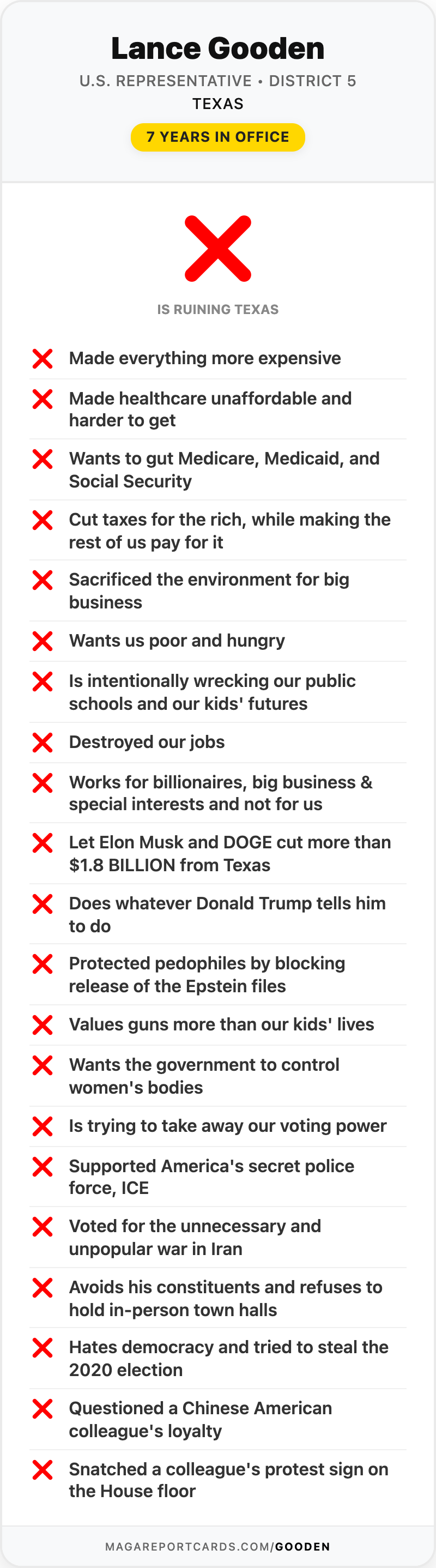
In July we wrote that Lance Gooden, the Republican congressman from Texas's 5th District, was under House ethics investigation — and that nobody would say what it was about except Gooden, who said "spending." On November 9, 2026, six days after he won a fifth term, the House Ethics Committee published the full report.
Now we know what the spending was. Luxury hotels. First-class flights. Month-long rental cars. Taxpayer-paid rides to a steakhouse his campaign was also paying. And a campaign whose credit-card reports to the federal government almost never add up.
The board of the Office of Congressional Conduct — the House's own independent ethics office — voted 5 to 0 that there is "substantial reason to believe" Gooden "improperly sought travel-related reimbursement for non-official travel purposes," and that Gooden "may have knowingly misreported or falsified campaign disbursements." Those are the report's own words. The Ethics Committee is now doing its own review.
The congressman who thought $800 a night was a lot
The investigation started from a December 2025 report that Gooden had collected more travel reimbursements than any other member of the House — $140,000 in 2025 alone, at the time it was written. That is taxpayer money, from the budget every member gets to run their office.
Here is how the report says he spent it. On official trips, Gooden and his staff stayed at places like the Park Hyatt in Washington and The Chatwal in New York, where nightly rates "frequently exceeded $1,000 and, in some instances, reached over $2,000 per night." Investigators flagged "the frequency of brief stays at luxury hotels, often amounting to thousands of dollars per visit."
Then they found a message Gooden wrote about a family vacation in Brazil, which investigators got from a third-party vendor. He was complaining. On New Year's Eve, he wrote, he had to find a hotel at midnight, and it was "expensive ($800 for one night but we 4 shared it)."
So $800 a night was too much when it was his own money. When it was ours, the report says, the bills ran past $1,000 and $2,000. The investigators put it plainly: the evidence suggests "the Congressman failed to exercise the same care with official funds that a reasonable person would exercise if traveling on personal business."
First class, his son's ticket, and his wife's rewards card
The hotels weren't the only thing. According to the report:
- First class, almost every time. Gooden and his staff flew business or first class "almost exclusively," the Texas Tribune reported from the findings. The report says that without a medical need, a security reason or no coach seats available, "an almost exclusive preference for flying business or first class could indicate unnecessary expenditures."
- Paid twice for one flight. In June 2025, Gooden flew from Washington Dulles to Dallas with his son. He asked to be paid back $378.48 for his own seat. A week later, another request came in for the exact same amount — which, the report says, "seemingly covered his son's travel costs."
- His wife's rewards account. On at least two occasions, staff travel paid for with House money appears to have been booked through the Chase Travel account of Gooden's wife. House rules ban that, because the points and perks from taxpayer-funded trips then go to the member's family.
- Paid back for a flight he may not have paid for. Gooden was reimbursed $735.68 for a September 2025 flight from Dallas to Houston. The receipt shows he used an airline "future flight credit." If that credit came from a canceled personal trip, he was paid back for money he never spent on official business — which the report says would break House rules and federal law.
- Rental cars by the month. In 2025 he was reimbursed $19,613.21 for rental cars and $18,593.66 for Uber and Lyft. Investigators found "a pattern of extended, month-long rentals" and rideshare charges on top of them.
- Rides to the restaurant his campaign was paying. Taxpayers paid for a $104.60 Lyft from Dulles airport to the Capital Grille in Washington on May 20, 2025. The next day, Gooden's campaign paid the Capital Grille $240. House office money can't be spent on campaigning.
His campaign's books don't add up
The second half of the report is about his campaign money — what donors gave him to run for office.
From January 2025 through February 11, 2026, his campaign reported 23 payments to "Chase Bank" totaling $256,465.77 — credit-card bills. Federal rules say a campaign has to itemize what those charges were for — at least every vendor paid more than $200 in an election cycle. Investigators added up the itemized lists and compared them to the payments. For nearly every one, "the itemized values fail to account for the total amount charged." Only one of the 23 matched exactly.
At best, the report says, that is "deficient or negligent accounting." At worst, the campaign "may be misreporting financial activity to obscure potentially improper expenditures."
Then there are the trips:
- Vail. In November 2024, his campaign paid $17,160.70 to The Hythe, a luxury resort in Vail, Colorado, for a "fundraising trip, room, food, and bev." Investigators could not find a single invitation or flyer for any fundraiser there. No other Republican member of Congress reported a campaign expense in Vail at the time.
- Mardi Gras. On February 27, 2022, Gooden posted a photo with his wife in New Orleans on his campaign Facebook page: "Took a detour on the way to DC for my beautiful Louisiana wife. Happy Mardi Gras!" The next day his campaign paid $1,286.20 to the W New Orleans hotel for "event food & beverage." Investigators found no record of any event. "It seems Rep. Gooden and his wife took a personal 'detour' trip to New Orleans," the report says, "and the stay was not for bona fide campaign purposes."
Spending campaign money on yourself — your vacation, your lifestyle — is against federal law. It's called personal use. That is what the board says there's substantial reason to believe happened here.
He wouldn't answer. Neither would anyone around him.
This is the part that should bother everyone in the 5th District most.
The report lists 10 people and companies that refused to cooperate. The first name on it is Gooden's. Eight more are individuals the report says were "either represented by his attorney, or an individual who is/was closely associated with him." The tenth is JPMorgan Chase, which said it would hand over records if the Ethics Committee subpoenaed them. Gooden and two of the others shared one lawyer, and the report says they "refused to resolve a conflict of interest" over it.
It gets worse. In a March 2026 letter, Gooden's lawyer referred to the office's conversations with outside witnesses — which, the report says, "suggests counsel and/or Rep. Gooden" or his aides had been in contact with them. Those witnesses had first said they were willing to be interviewed. Then they "subsequently ceased all communications." The board said Gooden's refusal "casts doubt on the credibility of Rep. Gooden as the subject of this review," and asked the Ethics Committee to use subpoenas.
Because he wouldn't talk, the investigators say over and over that they couldn't tell whether a given charge was a mistake or something worse. That was the choice Gooden made.
His answer: call it a witch hunt
Gooden's lawyer told the Ethics Committee in June that the request for a year of records was "unreasonably burdensome," that the office had been "playing hide-the-ball," and that its characterization of its own process was "fundamentally dishonest." He offered one explanation in that letter: a Capitol Hill lunch on the same day as a taxpayer-paid airport ride was a meeting with his staff.
Gooden's own statement on November 9 skipped the details entirely. "There's a reason the Senate doesn't have an OCC – because of insane, bogus referrals like this one," he said, calling it a "witch hunt" and demanding an investigation of the investigators.
It is the same move he made in July, when he called them "dishonest unelected OCC bureaucrats" before anyone had seen a page of the evidence. Now we've seen 36 pages of it. His answer hasn't changed.
The timing
The investigators adopted their findings on May 27. The Ethics Committee got them on June 10. Voters in Texas's 5th District went to the polls on November 3 without seeing a word of it. Gooden beat Chelsey Hockett by about three points. The report came out six days later.
A congressman who wanted his voters to have the facts could have released his own records any time in those five months. Gooden didn't.
What the report shows
The House's own ethics office voted 5–0 that there is substantial reason to believe Lance Gooden billed taxpayers for travel that wasn't official business and that his campaign misreported its spending. The report documents taxpayer-paid hotel stays over $1,000 and $2,000 a night from a man who called $800 "expensive" on his own dime, a doubled flight reimbursement, staff trips booked on his wife's rewards account, a $17,160.70 Vail resort bill for a fundraiser no one could find, and campaign credit-card reports where only one of 23 payments added up. Gooden and nine others refused to cooperate.
Source
This post is based on the Office of Congressional Conduct's report and findings, released by the House Ethics Committee on November 9, 2026, and on reporting by The Texas Tribune.