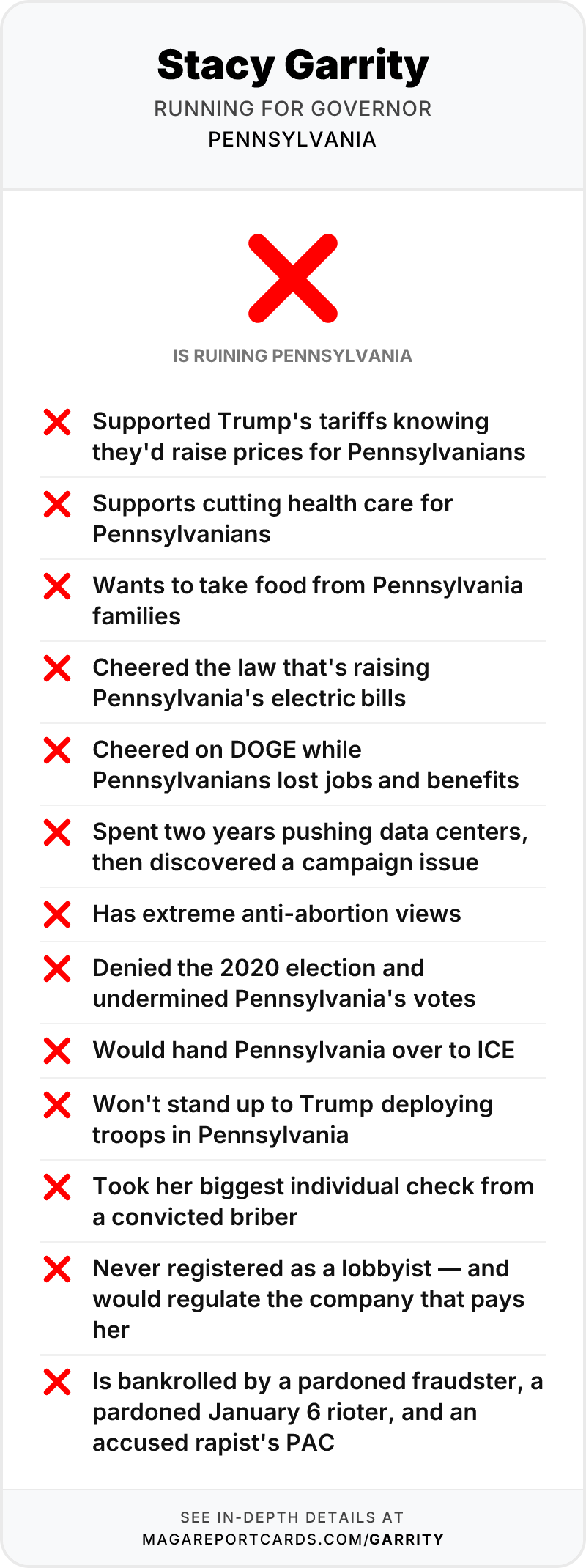
It is a simple question, and it has a simple answer. Did Donald Trump lose the 2020 election?
Stacy Garrity — Pennsylvania's treasurer and the Republican nominee for governor — was asked exactly that on abc27's This Week in Pennsylvania with Dennis Owens. Her answer opened with the word "Yeah," which Democracy Docket reported as a concession that Trump lost. Every sentence after it went the other way:
"Yeah, I mean, I won, and that's what I'm most concerned about," Garrity said, citing her upset win in the 2020 state treasurer's race. "But we know there were irregularities. We know there were, I just can't tell you to what extent. But the president seems, you know, he's very convinced that there was a lot there. And it seems like more information comes out all the time. But I'd rather look forward."
Read that again. The concession is one word long. Then she answers a question about Trump by talking about her own race for treasurer. She asserts "irregularities" and in the same breath admits she can't say what they were. She hands the question to Trump's opinion of it. And then she closes the door: I'd rather look forward.
Six years on, the woman asking Pennsylvanians to put her in charge of their state is still telling them the last presidential election was dirty, and still cannot say how.
"Why not hand over the rolls?"
The more consequential part of the interview came next.
The Department of Homeland Security has asked Pennsylvania to turn over its voter rolls, claiming noncitizens are voting in the state. Pennsylvania Secretary of State Al Schmidt — a Republican, picked by Democratic Gov. Josh Shapiro precisely because he stood up to Trump in 2020 — questioned the administration's methodology and asked DHS to produce the numbers behind its claim. It isn't clear the administration ever did.
Garrity said she would "absolutely" be more cooperative with the federal government than that. Her reasoning:
"If we think there's not voter fraud, then why not hand over the rolls and prove him wrong?"
That is a striking thing for a candidate for governor to say about her constituents' personal data — and it inverts how this is supposed to work. The federal government is the one making the accusation. Garrity's answer is that Pennsylvania should hand over its voters' records to prove the accusation wrong.
Pennsylvania has already beaten one of these demands. The Justice Department sued Schmidt for the same unredacted voter files, and in June 2026 a federal judge threw the case out, writing that the government's purpose was "to create a nationwide voter-database, for potential weaponization in future elections." It was the tenth straight loss for the department in cases like it. The department has appealed.
Her willingness isn't new either. In February 2026, after Trump called for Republicans to "nationalize" elections, Garrity said she "would work with the Trump administration, obviously" on running Pennsylvania's elections. Weeks before that she had already said she would comply with the effort to obtain Pennsylvania voters' personal information.
The evidence Garrity reached for tells you how thin the case is. She cited a recent finding that 6,600 noncitizens had been registered to vote in New Jersey after an error in that state's motor vehicle system. New Jersey Gov. Mikie Sherrill said fewer than 400 of them were ever able to cast a ballot — and the cause was a motor vehicle agency error, not a conspiracy. Garrity used a DMV glitch in another state as her reason to open Pennsylvania's files.
This is the same playbook we've watched all year: manufacture a noncitizen-voting crisis, then use it as the reason federal officials need control of state elections. The Justice Department has already sent letters threatening election officials in at least 14 states with criminal prosecution over the same barely-existent problem.
Garrity did not "look forward" in 2020. She sued.
The "I'd rather look forward" line only works if you don't know her record. Garrity was not a bystander to the 2020 fight. She was a participant.
- Within days of the 2020 election, Garrity's own campaign committee signed on to Trump's petition to throw out 2,177 Bucks County mail-in ballots over envelope technicalities. The petitioners stipulated in court that they did "not allege, and there is no evidence of, any fraud." On November 19, 2020, the judge denied the petition and ordered every ballot counted.
- On January 5, 2021 — the day before the Capitol attack — Garrity spoke at a rally at the Pennsylvania Capitol whose organizer said the point was to get lawmakers to decertify the state's presidential results. She told the crowd, "The election from this November is tarnished forever."
- On January 6, she replied from her personal Facebook account to a commenter defending the rioters: "I am proud of our Patriots."
- At a May 2022 rally with Trump in Greensburg, she said of him, "We know that he won." Pressed on it in January 2026, she explained that "that was at a Trump rally and those are kind of fun things" — and added that "after the 2020 election, I know Joe Biden was the president."
So when Garrity says "we know there were irregularities," she is not reporting something she discovered. She is repeating something she has been saying since November 2020 — through a court case that collapsed, through recounts, through audits, and through her own party's investigations.
There is a pattern in how she handles being asked about it, and it depends on the room. At a Harrisburg press club luncheon in January 2026, in front of reporters, she said Joe Biden was president and called the Trump rally line a bit of fun. Her campaign told the Capital-Star in 2024 that she accepts the 2020 result, and that she "has previously stated that Joe Biden is the duly elected president of the United States." On television in August 2026, asked the same question, that answer lasted one word.
Pennsylvania's 2020 result was affirmed by multiple lawsuits and independent reviews. Joe Biden carried the state by more than 80,000 votes. There is no "extent" left to determine.
She is not the only Republican doing this. Michigan's Tom Barrett has spent years calling the 2020 election "an unknowable thing" — 15 months after his own Republican colleagues in the Michigan Senate investigated it for seven months and found nothing. Neither of them will say what they think happened. Both keep telling voters that something did.
The rest of the interview
Two other things Garrity said in the same sitting are worth writing down.
She described herself as "pretty much aligned" with Trump — but acknowledged she would have handled tariffs "differently." That is a quiet reversal. In April 2025, days after Trump's tariff announcement set off the worst week for the stock market since the pandemic, Garrity told a conservative conference that his tariff policy, along with the rest of his agenda, amounted to "common sense measures" that were good for the American people. In a separate interview that month she said of the tariffs, "It's a very short-term pain but with a very long-term gain." By February 2026, an analysis by Trade Partnership Worldwide found they had cost Pennsylvanians $4 billion in a single year.
She backed the tariffs when they were popular with her party and Pennsylvanians hadn't yet felt them. Now that the bill has come due, she would have done it "differently."
And asked whether she blamed Trump for high costs, Garrity said she would blame Gov. Josh Shapiro and his predecessor Tom Wolf instead — not the tariffs she herself now says she'd have handled another way.
What's at stake
Governors don't just talk about elections. In Pennsylvania, the secretary of the commonwealth — the state's top election official — is a member of the governor's cabinet, appointed by the governor — the job Schmidt holds now, and the office currently pushing back on the federal demand for voter data.
Garrity is asking for the power to appoint that person. She has told Pennsylvanians she would be more cooperative with the administration making the demand, that she'd "rather look forward" when asked about the last contested presidential election here, and that she still believes in "irregularities" she cannot describe.
Election Day is November 3, 2026. Pennsylvanians can register to vote until October 19 and request a mail-in or absentee ballot until October 27.
Source
- Garrity on Trump's election fraud claims: "I'd rather look forward" — abc27 (WHTM), This Week in Pennsylvania with Dennis Owens. Photo: Getty Images.