In the spring of 2020, with COVID-19 spreading, Gov. Gavin Newsom ordered that every registered voter in California be mailed a ballot for the November election. It wasn't a solo idea: the chairs of the Legislature's own elections committees had written to the governor urging him to do it, noting that "three-quarters of California voters already receive a mail ballot. Let's mail a ballot to the rest."
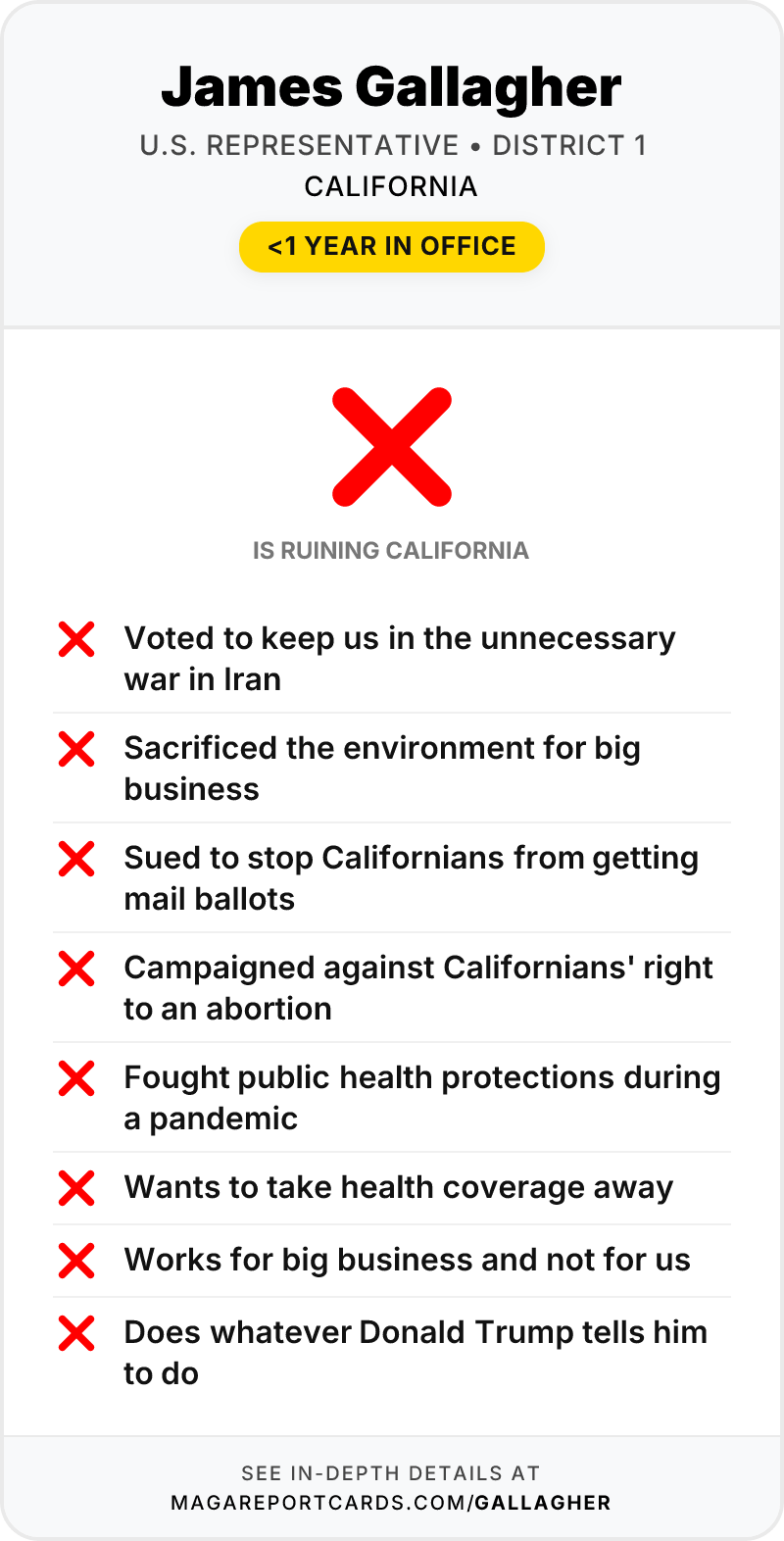
James Gallagher, then a state assemblyman, went to court.
The lawsuit
On June 11, 2020, Gallagher and fellow Assemblyman Kevin Kiley sued in Sutter County, asking a judge to declare Newsom's election order "null and void as it is an unconstitutional exercise of legislative powers reserved only to the Legislature." The next day, the judge granted their request for a temporary restraining order suspending it.
Their argument was about who gets to write California's election rules. The governor had issued the order under his emergency powers; Gallagher said only the Legislature could change election law.
A week later, he voted for it
Then the Legislature did change election law.
On June 18, 2020, the Assembly passed AB 860, which required county election officials to mail a ballot to every registered voter for the November 3, 2020 election. The vote was 68 to 5. Gallagher voted yes. So did Kiley. Newsom signed it the same day.
So the thing Gallagher had gone to court to block, he voted for a week later — once it came through the Legislature instead of the governor. Newsom's order was, in the appeals court's words, "superseded by legislation." The law that required a ballot for every registered voter had Gallagher's vote on it.
That should have been the end of the case. It wasn't.
The part that grew
Gallagher and Kiley kept suing. What began as a challenge to the vote-by-mail order evolved into "a dispute that challenged the very power of the Governor to issue Executive Orders under emergency authority" — in the middle of a pandemic in which the governor had issued at least 50 of them.
In November 2020, after the election, a Sutter County judge sided with them, placing a permanent injunction on the governor that barred him from changing existing state law, "even during a pandemic." The ruling did not affect the 2020 results. Gallagher called it a victory over reverting "to a dictatorship where one person makes those decisions for everyone."
Every higher court said no
The win didn't last.
- The Third District Court of Appeal had already thrown out the June restraining order in July 2020.
- On May 5, 2021, the same court reversed the trial judge, holding that California's Emergency Services Act let the governor act as he had.
- On August 11, 2021, the California Supreme Court unanimously declined to hear Gallagher's appeal. Gallagher's response on Twitter: the court had "taken a pass on providing any legal review of perhaps the greatest example of executive overreach in modern history. They literally have nothing to say about it. Sad."
It fits the rest of his record from those years. When California considered removing the personal belief exemption for the COVID vaccine in schools, Gallagher called it "wrong and an unconscionable overreach into the family over a virus that poses very minimal threat to young children."
Where it points now
The principle Gallagher took to court was simple: California's elected Legislature, not one official acting alone, should make California's laws.
Now he's in Congress. Last month he put an amendment on the House floor asking the federal government to study how it could "preempt or otherwise mitigate" state fuel policies — Washington overriding what California's Legislature and regulators decided. It failed by four votes.
In 2020 he said the Legislature had to decide. In 2026 he asked Washington to find a way around it.
Why it matters
Gallagher cast his fight as a stand against the governor's power, saying "California has not been well-served by one-man rule." The record shows what it cost: a year of litigation aimed at the governor's power to respond to a pandemic, a restraining order against a ballot plan he then voted to enact, and a string of losses at every court above the county level.
Californians deserve a representative whose principles don't change with the venue. We deserve better.
Sources
Newsom v. Superior Court (Gallagher), California Third District Court of Appeal, May 5, 2021; AB 860 floor votes, California Legislature; trial ruling via KRCR and the Appeal-Democrat; Meyers Nave on the appellate decision; California Supreme Court review denial via CBS San Francisco/AP. Official portrait, 119th Congress.