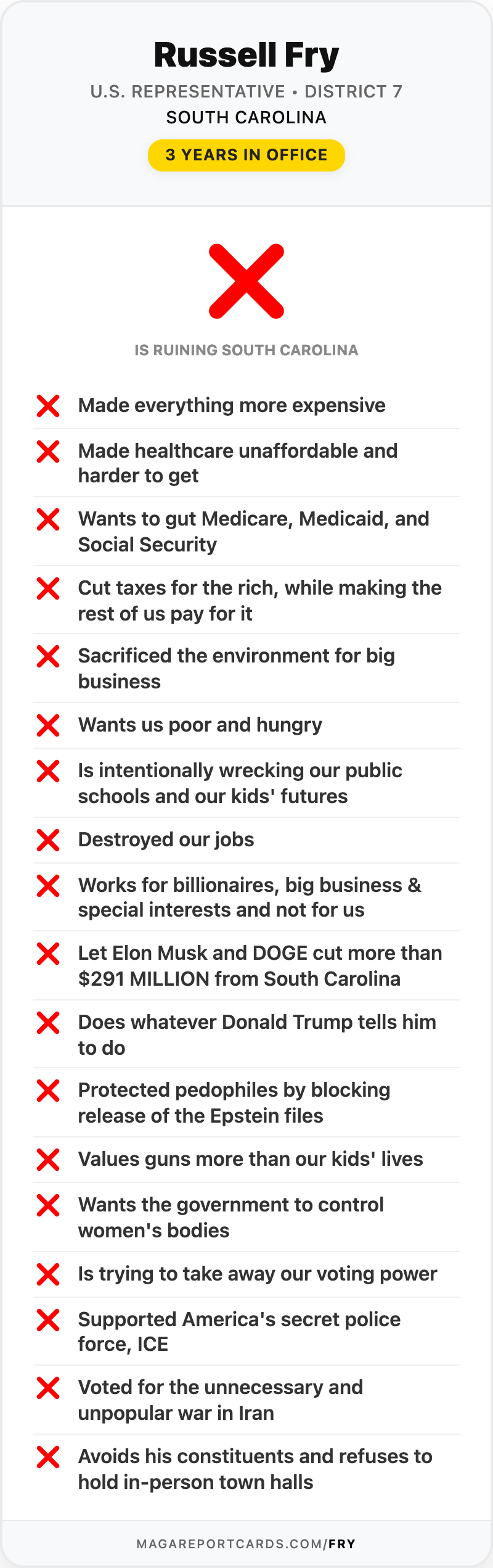
On April 16, 2025, Russell Fry held a telephone town hall for South Carolina's 7th District — most of the Pee Dee plus Horry and Georgetown counties. For nearly an hour he took questions from callers, on a call that was closed for media questions.
Constituents asked about Medicare and Medicaid. Fry acknowledged the programs matter, then said this about the people on them:
"There are a lot of people who are on it who quite frankly shouldn't be."
Two months earlier, on February 25, 2025, he had already voted Yea on the budget blueprint ordering the committee that oversees Medicaid to cut $880 billion — it passed 217 to 215.
On July 3, 2025, he voted Aye on final passage of Trump's budget bill, which made the cuts law. That one went 218 to 214.
What that did to the district he was speaking to
The Joint Economic Committee's House minority staff ran the Congressional Budget Office's numbers by congressional district, counting the Medicaid cuts and the losses on the Affordable Care Act exchanges together. For SC-07:
37,124 people are projected to lose health coverage — 33,500 losing ACA marketplace coverage and 3,624 losing Medicaid.
That is the most of any congressional district in South Carolina.
Not the most of the Republican-held ones. The most, period. The district whose congressman said too many people are on Medicaid is the district losing the most coverage in the state.
The bigger of those two numbers is ACA marketplace coverage, not Medicaid. The committee counts both under one heading, the way the Congressional Budget Office scored them.
Statewide, it's already happening
This is no longer a projection. The results are in.
A report by the advocacy group Protect Our Care, covered by the Charleston City Paper, found that in the year after the bill was signed, more than 100,000 South Carolinians lost health insurance — over 70,000 off Medicaid and roughly 45,000 out of subsidized ACA plans. By the same group's count, average marketplace premiums in the state are up 235% since 2025. Its illustration: a 60-year-old couple earning $85,000 whose annual premium went from about $7,000 to about $29,000.
Sue Berkowitz, policy director at the South Carolina Appleseed Legal Justice Center, had a blunt answer to the argument Fry was making on that phone line:
"This whole waste, fraud and abuse crap, excuse my language, is just an excuse to try to justify what they're doing to kick people off the rolls."
And the hospitals
South Carolina's rural hospitals were already thin. Six have closed since 2010.
South Carolina Public Radio reported what the law does to the rest. Beginning in January 2028, state-directed Medicaid payments get cut 10% a year for ten years. KFF calculates that South Carolina could lose as much as $5 billion and have as many as 60,000 fewer Medicaid enrollees over that stretch. Protect Our Care puts another $5.4 billion in added uncompensated care costs on South Carolina hospitals through 2034, with five rural Upstate hospitals already at risk of closing.
Allendale County Hospital is one of the last independent hospitals in the state. Its profit margins are near zero. Three out of four of its patients are on Medicaid or paying out of pocket. It has no surgery, no maternity — it is essentially an emergency room holding a county together.
Its CEO on what the cuts mean: "Small, rural hospitals operate on very thin margins anyway…there's just no way to sustain a hospital like that."
Thornton Kirby, who runs the state hospital association, said hospitals "are moving back into the survival mindset."
Here is what Fry's framing misses. When someone loses Medicaid, they do not stop getting sick. They show up at the emergency room without coverage, and the hospital eats the cost. "People who shouldn't be on it" become uncompensated care — which is exactly the $5.4 billion line item that closes rural hospitals.
The people Fry says shouldn't have coverage and the hospitals he says he wants to save are the same math problem.
Where SC-07 already stands
The 7th District is not a wealthy place that can absorb this.
38,652 households in SC-07 — about 12% of every household in the district — rely on SNAP, including 19,787 with children and 15,645 with someone 60 or older. That's the highest SNAP reliance of any Republican-held district in South Carolina.
Those are the same households on Medicaid. They are the ones whose coverage the JEC counted.
Now he wants a promotion
Fry is on tomorrow's ballot in the Republican primary for the Senate seat Lindsey Graham held until his death in July — while also running for re-election to the House seat, so his district could go without a congressman until May if he wins both races.
The pitch he made statewide, announcing the run, was that "we need a conservative fighter in the Senate who delivers real results."
The result he has actually delivered to his own district is the largest projected coverage loss in the state.
He's not the first to run this play
In Mississippi, Cindy Hyde-Smith told her state "Medicaid is not going anywhere," voted for the cuts, and then began filing rural hospital rescue bills — three in five months — while 24 Mississippi rural hospitals were rated vulnerable to closure. In Arkansas, 14,441 people lost ACA coverage in a single year after Congress let the subsidies expire, and the state's all-Republican delegation had the votes to stop it. We keep a running list of the Republicans with the worst records on health care, and the entry pattern never changes: cast the vote, then tell the district the cut isn't real, or that the people losing coverage didn't deserve it.
Fry chose the second version. On a phone line, in one sentence, with the press unable to ask a follow-up.
We deserve better.
Source
Congressman Fry defends tariffs, applauds Trump in telephone town hall — WPDE ABC 15, April 2025. District coverage-loss figures from the Joint Economic Committee. Statewide figures from the Charleston City Paper and South Carolina Public Radio. Photo: official congressional portrait.