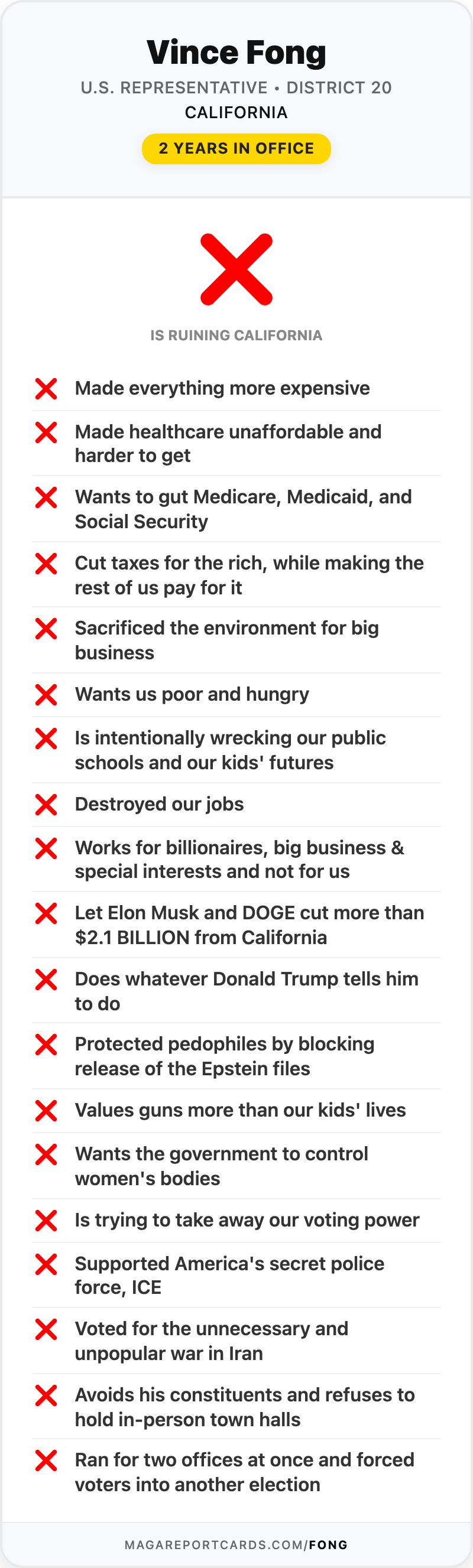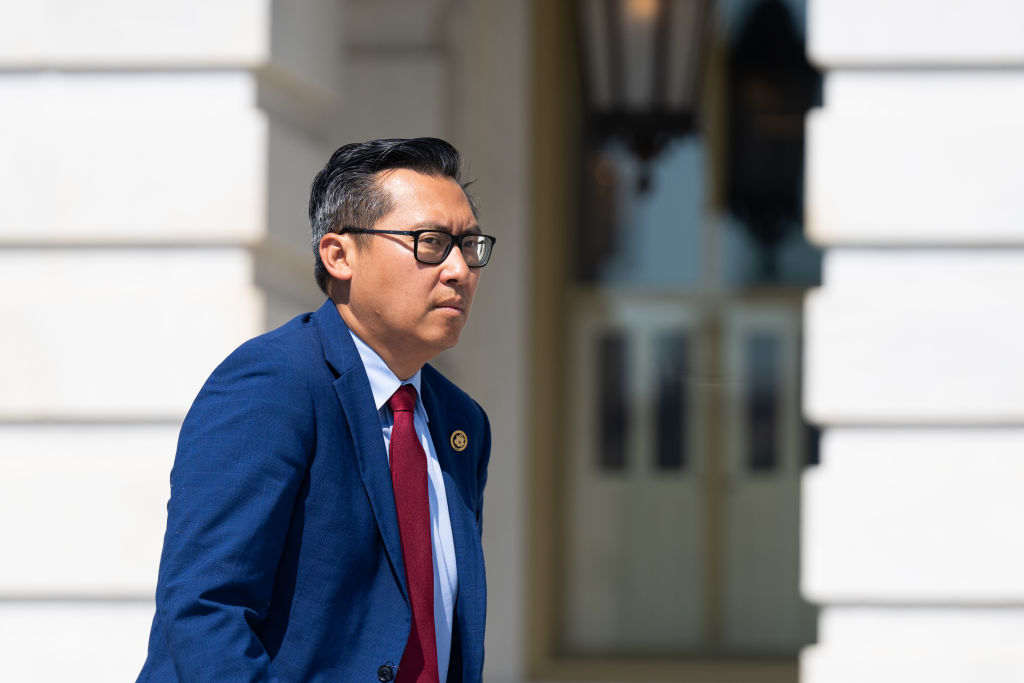
On April 6, 2026, while the Artemis II astronauts were still in the middle of their mission to the moon, Vince Fong introduced a bill with a name built for a press release: the OUTPACE in Space Act. It stands for "Optimizing United States Technology to Preempt Adversarial Communist Expansion in Space."
The pitch is China. A spokesperson in Fong's Washington office told KGET the congressman has a "big focus" on winning the space race, and that China's "unified" and "centralized" approach is letting it "get the upper hand."
That is the bill's cover story. Here is what the bill actually does.
"The Administrator shall issue a blanket waiver"
You can read the whole thing — it is eight pages. The core of it is Section 2, and the sharpest line in Section 2 is this one:
"Upon enactment of this Act, the Administrator shall issue a blanket waiver of 450.101(c) for all reentry vehicles until a final rule is published."
That citation is to 14 CFR 450.101, the Federal Aviation Administration's safety criteria for launch and reentry licenses. Paragraph (c) is titled "High consequence event protection." It is the rule that says a company bringing a vehicle back through the atmosphere has to protect the people underneath it.
It gives operators three ways to do that: build in flight abort, or show that any reasonably foreseeable failure would produce no more than one one-thousandth of an expected casualty, or demonstrate the vehicle is reliable enough that the FAA signs off.
Fong's bill orders the FAA to waive all three. Not to study waiving them. Not to consider a petition from a company that wants one. A blanket waiver, for all reentry vehicles, the day the bill becomes law — with the replacement rule not due for a full year afterward.
And the direction of that replacement rule is written into the bill too. Two separate subsections instruct the FAA that risk considerations must "support the development and authorization of overland launch and reentry operations."
Overland. Not over the ocean, the way reentry has mostly been done, for the obvious reason. Over land, which is where people live.
The bill also tells the Transportation Secretary to "maximize use of performance-based requirements" instead of prescriptive ones, to enable "high cadence" launches and reentries, and hands the FAA power to hire aerospace engineers into its commercial space office within 30 days "without regard to competitive service requirements, examinations, or public notice."
None of that is about China. China does not care what 14 CFR 450.101(c) says. The only entities that rule applies to are American companies that want to bring hardware back down faster, cheaper, and closer to where people are.
Who those companies are, and what they gave him
Fong sits on the House Committee on Science, Space & Technology — and specifically on its Subcommittee on Space and Aeronautics, the panel with jurisdiction over exactly this. He is also a member of the Hypersonics Caucus. His bill's opening section is a "sense of Congress" about the commercial space industry and "the emerging hypersonic industry."
His bill went to the committee he sits on. It has no cosponsors. It is his.
Now look at his campaign account. These are contributions to Vince Fong for Congress in calendar year 2025, from the Federal Election Commission's own records:
- Space Exploration Technologies Corp PAC — $10,000 (Elon Musk's SpaceX: $5,000 in March, $5,000 in October)
- Blue Origin, LLC PAC — $5,000 (Jeff Bezos's rocket company: $1,000 in February, $2,500 in June, $1,500 in October)
Fifteen thousand dollars, in one year, from the two American companies with the most to gain from the FAA waiving its reentry safety rule.
KGET first reported those figures in April. We pulled the FEC records independently and they match to the dollar.
The aviation money is there too — the PACs of Boeing, United Airlines and Alaska Air Group all gave Fong between $1,000 and $5,000 apiece in 2025. Boeing, as KGET noted, is scaling up production to meet demand for more space exploration.
"A separate issue"
KGET asked Fong's office about the timing — a bill deregulating commercial space, introduced by a congressman whose campaign is funded by commercial space companies.
The answer:
"This bill here is really addressing the overall scope of the space race and trying to outcompete and give us the tools to win the space race with China. Anything kind of along those lines would be a separate issue and that isn't really at play here."
That is not a denial. It is a subject change. Nobody asked whether the bill is about China. The question was why the people who profit from it are paying him.
The office also said the bill is "completely separate from anything regarding commercial airlines" — which is a curious thing to volunteer about a bill whose Section 2 is largely about the FAA, the national airspace system, and how to fit more rocket traffic into the sky that airliners use.
This is the going rate in this corner of Congress
Fong is not an outlier here. He is a junior member of a committee where this is simply how it works.
We wrote yesterday about Brian Babin, who chairs the full Science, Space and Technology Committee and has taken $261,250 from six space and defense contractors — including SpaceX and Blue Origin — while writing a NASA bill that hands statutory authority to a contract SpaceX already holds.
And we wrote about Mike Haridopolos, who chairs the Space and Aeronautics Subcommittee Fong sits on. When Blue Origin's New Glenn rocket exploded on the pad at Cape Canaveral Space Force Station in May, the chairman with oversight responsibility issued a statement offering gratitude and prayers, and not one question. Blue Origin's PAC has given him $10,000. SpaceX's has given him $20,000.
Chairman, subcommittee chairman, and now the member writing the deregulation bill. Same donors, all the way down.
What Bakersfield gets out of it
Fong's district runs from Bakersfield across the southern Central Valley, and Kern County has real aerospace and defense employment. A congressman fighting for those jobs would be doing his job.
But that is not what this bill's most consequential provision does. Waiving the FAA's high-consequence-event rule for every reentry vehicle in the country, immediately, before any replacement rule exists, does not create a single job in Kern County. It removes a federal check that stands between a falling rocket stage and the people underneath it — and the bill's own language is that reentry should be authorized over land.
It is the same instinct that produced his amendment to the House highway bill giving Uber and Lyft immunity when their drivers kill someone: find the rule that costs a large company money, delete it, and describe the deletion as competitiveness.
According to FEC-derived donor records, just 1% of Fong's money comes from small grassroots donors. Ninety-six percent comes from PACs, super PACs and large donors. When almost none of your funding comes from small donors, the people it does come from are the ones who get bills written.
Source
"Fong aerospace bill benefits aerospace industry, among campaign donors," KGET 17 News, April 17, 2026. Photo via KGET/Getty Images.