On July 29, 2026, the Wisconsin Court of Appeals reversed a lower-court ruling and upheld Act 10, the 2011 law that stripped collective bargaining rights from most of Wisconsin's public employees. The 2024 ruling had been on hold pending appeal, so nothing changed on the ground: the law "remains in effect, as it has been the past 15 years." The unions are expected to appeal to the Wisconsin Supreme Court.
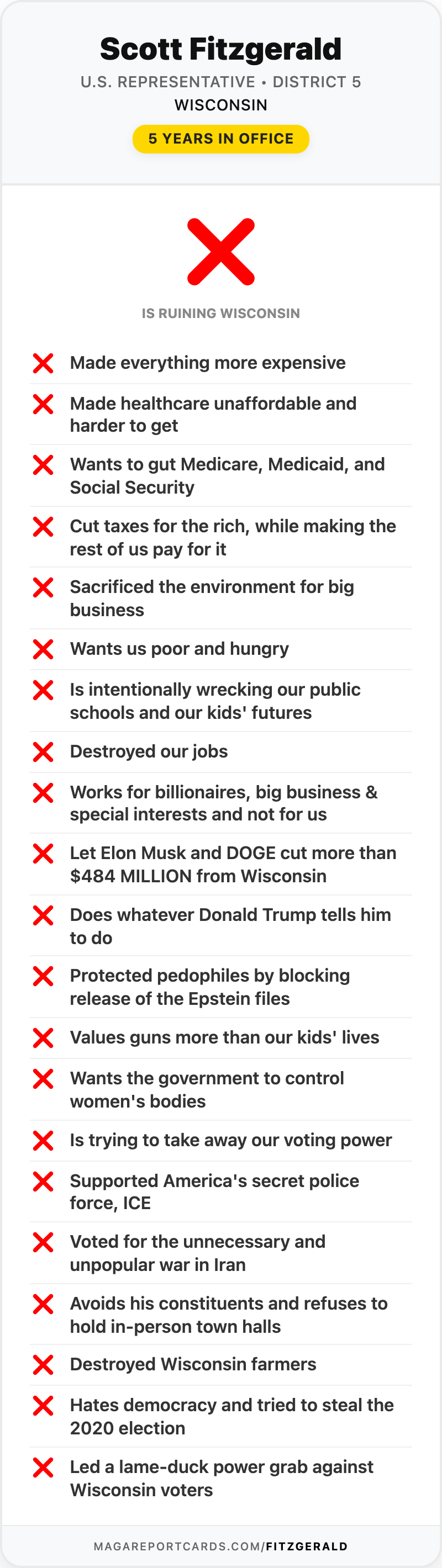
Fifteen years on, that law is still the most consequential thing Scott Fitzgerald has ever done. He was Wisconsin's Senate Majority Leader when it passed. His brother Jeff was Assembly Speaker. Between them, the Fitzgerald brothers ran both houses of the legislature that sent it to Scott Walker's desk.
And the legal defect that has kept Act 10 in court for a decade and a half — the reason a Dane County judge threw out chunks of it in 2024 and the reason it's headed to a state Supreme Court that will have a 5-2 liberal majority in September — is about who the law let off.
One of the agencies it let off had been handed to Scott Fitzgerald's father a week before the bill was introduced.
The timeline
February 8, 2011. The Walker administration named Stephen Fitzgerald superintendent of the Wisconsin State Patrol. Stephen Fitzgerald is the father of Scott Fitzgerald, then Senate Majority Leader, and Jeff Fitzgerald, then Assembly Speaker. He had been Dodge County sheriff from 1989 to 2002, and then U.S. marshal for western Wisconsin.
The Wisconsin State Journal's editorial board did not take long to react. Their editorial ran under the headline "Fitzgerald pick to head State Patrol smacks of favoritism," and opened: "It doesn't pass the smell test. The father of Wisconsin's two most powerful state lawmakers was just picked to lead the Wisconsin State Patrol."
Scott Fitzgerald said he had not been consulted about his father's application and had not asked to be.
February 15, 2011. One week later, Assembly Bill 11 — the budget repair bill that became Act 10 — was introduced at Walker's request.
March 2011. It passed, over weeks of protests that filled the Capitol. Scott Fitzgerald ran it through the Senate.
What the law did — and who it skipped
Act 10 ended most collective bargaining for state, county, municipal and school employees. Teachers, nurses, prison staff, snowplow drivers, clerks: all stripped.
But it carved out a category called "public safety employees." Act 10 wrote that category into state law twice — once for state employees and once for municipal ones — and between them the two definitions cover police officers, firefighters, deputy sheriffs, county traffic police, village and town protective services officers — and members of the state traffic patrol and state motor vehicle inspectors.
Which agency is that? The one Stephen Fitzgerald had been given the week before.
To be precise about what this is and isn't: as superintendent, Stephen Fitzgerald was management, not a union member. He didn't personally collect a bargaining right out of the carve-out. The point is narrower and harder to explain away — while the legislature his two sons controlled was turning every other corner of state government upside down, the agency that had just been handed to their father was written into the safe list.
Why the carve-out is the whole lawsuit
Act 10's exemptions were never clean, and that's what has kept it in litigation.
State law then listed 22 "protective occupation" categories. Act 10 exempted seven of them. Capitol police, University of Wisconsin police and conservation wardens were left out — officers who, in the Legislative Council's summary of the circuit court's ruling, "have the same authority and do the same work as law enforcement officers and state patrol troopers and inspectors" who were exempted.
The unions' argument, as reported by PBS Wisconsin, is that the line was drawn politically: the groups that got the exemption had endorsed Walker in the 2010 election, and the groups that didn't, didn't. In 2024, Dane County Judge Jacob Frost agreed that the split was irrational and violated equal protection. The appeals court reversed him on July 29. The Supreme Court will likely have the last word.
Fifteen years, and Wisconsin still doesn't have a settled answer about whether Scott Fitzgerald's signature law is constitutional — because of how the exemptions were drawn.
He's still taking money from the unions he exempted
Fitzgerald left the legislature for Congress in 2021, but the arrangement travels.
This election cycle, his campaign has taken $4,500 from the Milwaukee Police Association's federal PAC — a police union of exactly the kind Act 10 spared, with its most recent check dated June 15, 2026.
Teachers' unions, whose members lost their bargaining rights under his law, are not on his donor list.
The habit
This is the same man who, after Wisconsin voters elected Democrats to every statewide office in 2018, led a lame-duck session that stripped powers from the incoming governor and attorney general and cut early in-person voting to the two weeks before an election. A federal judge struck that cut down, but a federal appeals court reversed him in 2020, so the two-week limit is still Wisconsin law. It's the same man who, this summer, called the Green Bay Packers' concerns about his push to rewrite the NFL's broadcast law "absolutely ridiculous and almost laughable."
The through-line isn't ideology. It's that Scott Fitzgerald has spent three decades in office deciding who gets left inside the rope, and has never once had to explain the choice to the people left outside it.
Act 10 took bargaining rights from a school secretary in West Bend. It did not take them from the State Patrol. Wisconsin's courts have been arguing about why for fifteen years.
Sources
- Wisconsin appeals court overturns ruling that had restored collective bargaining power, Wisconsin Watch, July 2026
- Court Decisions on 2011 Wisconsin Act 10, Wisconsin Legislative Council issue brief, July 2026
- Top lawmakers' father Stephen Fitzgerald to lead State Patrol, Wisconsin State Journal, February 8, 2011
- January 2011 Special Session Assembly Bill 11 — bill history, Wisconsin State Legislature (introduced February 15, 2011; signed as 2011 Wisconsin Act 10 on March 11, 2011)