North Dakota has five tribal colleges: Turtle Mountain Community College in Belcourt, Nueta Hidatsa Sahnish College in New Town, Cankdeska Cikana Community College in Fort Totten, United Tribes Technical College in Bismarck, and Sitting Bull College in Fort Yates. There are thirty-seven accredited tribal colleges in the whole country, and five of them are in this one state.
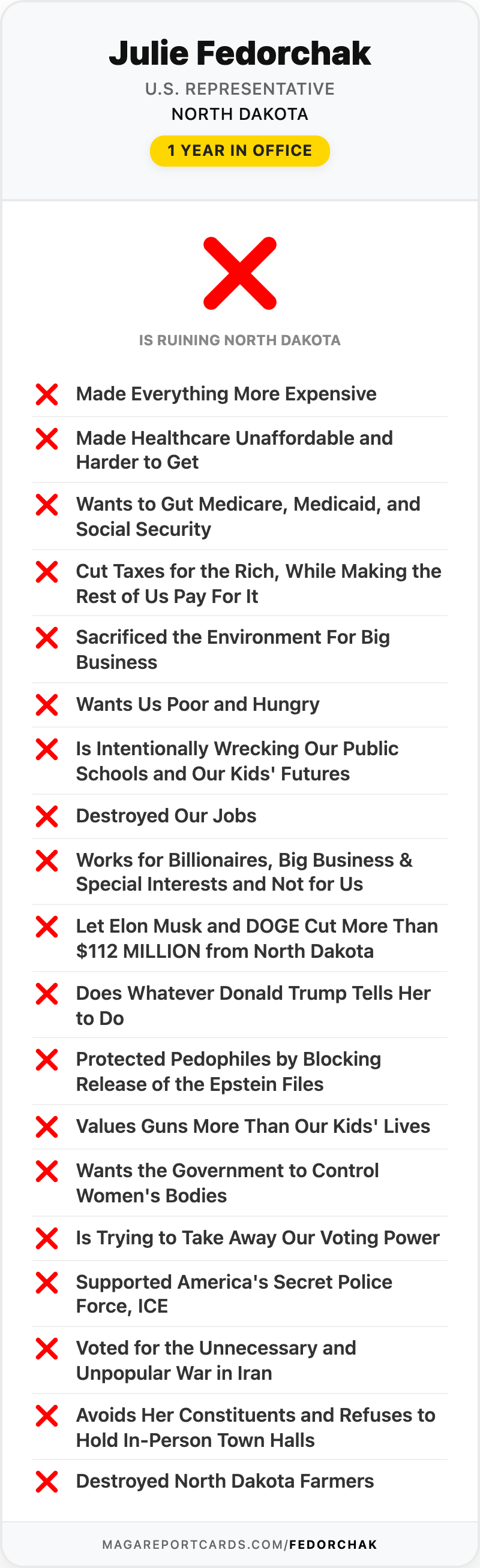
All five are in Julie Fedorchak's district, because North Dakota has one at-large seat and she holds it. Every North Dakotan is her constituent.
In May 2026, the Trump administration proposed cutting all federal funding for tribal colleges and universities. In its fiscal 2027 budget request, the Interior Department asked to cut more than $150 million from tribal colleges and tribal postsecondary programs. That was more than the $105 million cut proposed the year before, which Congress rejected. In fiscal 2025 those colleges received $196 million in total from the federal government.
The North Dakota Monitor asked the state's congressional delegation what they intended to do about it.
What the college presidents said
Twyla Baker is president of Nueta Hidatsa Sahnish College in New Town. More than half her school's funding is federal. Asked what the proposal would mean:
"I can guarantee there would be TCUs that would be shutting down within a year to two years, and that it would be … the death knell for our institutions."
Without the federal money, she said, her college could keep the doors open "three, four years tops, and that would be with extreme budgeting across the board."
Russ McDonald is president of United Tribes Technical College, in Bismarck — the state capital, across the river from Mandan, where Fedorchak and her husband live. Around 70% of his college's funding is federal. He was blunter:
"It'll close us. We'll close the doors."
"I mean, there's some reserves that we have that would just carry us to close. We might last a year."
These are not hypothetical institutions. A study by the North Dakota Tribal College System found the five colleges added $169.5 million to the state's economy over 2022–2023, supporting the equivalent of 2,106 jobs.
What North Dakota's senator said
Sen. John Hoeven gave the Monitor a written statement. Here it is in full:
"We provided strong funding for North Dakota's tribal colleges and universities this year, and I expect we will continue to fund them again in the coming year."
That is a commitment. It has a subject, a verb, and a promise in it. You can hold a man to that sentence next year.
What North Dakota's congresswoman said
Here is how the Monitor summarized Fedorchak's response:
"Rep. Julie Fedorchak, also a Republican, said the president's budget is a starting point and she plans to review priorities that matter to North Dakota communities, including tribal colleges."
A starting point. She plans to review priorities.
Read those two answers next to each other. Her senior senator, from the same party, in the same state, facing the same budget request, said he expects Congress will fund the colleges. Fedorchak did not say whether she'd fight for them at all. She described a proposal to zero out five institutions in her district as an opening bid, and promised to look into it.
That is not a neutral statement. When the president proposes eliminating something and the only House member from that state calls the proposal a starting point, she is telling the people who wrote that budget that she is not going to be a problem.
She has a pattern of calling a cut something else
This is the second time we've seen Fedorchak respond to a cut by disputing the frame rather than the cut.
Last year she voted Aye on final passage of Trump's budget bill. Democrats on the Joint Economic Committee project 17,926 North Dakotans will lose health coverage — 7,255 losing Medicaid because of that bill, and 10,671 losing Affordable Care Act coverage as the enhanced premium tax credits lapse. Her response was an op-ed on her own House website telling North Dakotans they were worried about "cuts that simply don't exist."
The cuts existed. The tribal college proposal exists too. It is written down in a budget request with a number attached to it.
The part about promises
There's a reason the tribal college presidents talk about this differently than a normal appropriations fight.
Federal support for tribal colleges isn't a grant program somebody thought up. It flows from treaty obligations — the United States committed to supporting education for tribal citizens, and Congress passed laws to codify it, guaranteeing tribal colleges $8,000 per student per year with inflation adjustments. As Baker put it to the Monitor:
"There are agreements in place from well before this administration was ever in existence that these structures were to remain in place. We prepaid with the land that this country occupies, and this is just a complete and utter reneging on that agreement."
Congress has never actually paid the full amount. A 2024 ProPublica investigation, cited in the Monitor's reporting, found tribal colleges are underfunded by about $250 million a year, and that the Bureau of Indian Education had never even asked lawmakers to fund them at the level federal law requires.
So the baseline was already a broken promise. The proposal on the table now is to stop paying entirely.
What it would take
Congress rejected last year's cut. It can do this one too — but that takes members of Congress from the affected states saying plainly that they will not vote for it.
Hoeven said something close to that. Fedorchak did not.
She is not powerless here. She sits on the Energy and Commerce Committee — she was the first freshman in 14 years to land that assignment. She has the standing to say a sentence. She used it to say the budget is a starting point.
Meanwhile the dismantling continues elsewhere: Tim Walberg is running the committee effort to break up the Department of Education entirely. The pattern is the same one North Dakota's tribal colleges are living through — the cut is proposed at the top, and the members who could stop it decide to review their priorities.
Twyla Baker had one more thing to say about what her colleges do:
"Everything this administration says they want, we're doing that on our campuses."
Source
Federal cuts would be 'death knell' for North Dakota tribal colleges, campus presidents say — Ceilidh Kern, North Dakota Monitor, May 12, 2026. Photo by Michael Achterling / North Dakota Monitor.