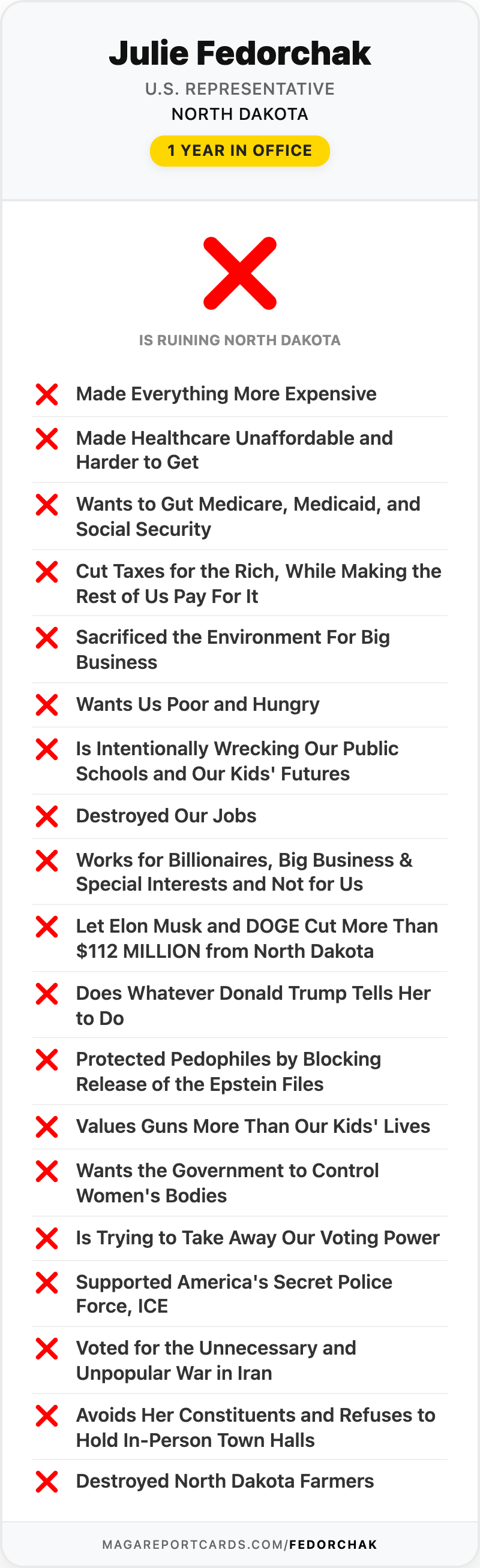
With Congress about to come back to Washington, Julie Fedorchak told a Bismarck television station what she wants to get done. Near the top of the list is a bill that would require every American to prove they are a citizen before they can register to vote.
"Most Americans agree that we want only Americans voting in American elections," North Dakota's lone member of the House told KFYR-TV on September 7. "And the Save America Act is the best way to do that. So that's a really important issue."
The bill she named is the SAVE America Act — the version the House passed in February 2026 and the Senate has been fighting over since March. It mirrors what North Dakota already does, the station reported her as saying, and "mirrors" is the word her office used in writing when she voted for the earlier version.
It does not. North Dakota is exempt from the proof-of-citizenship requirement at the heart of the bill, and the way North Dakota handles citizenship is close to the opposite of what that requirement would impose on everyone else. The one part of the bill that would reach North Dakota would take away identification the state accepts today.
North Dakota is carved out of the bill
North Dakota is the only state in the country with no voter registration at all. You show ID at the polls and you vote.
The proof-of-citizenship requirement is a registration rule, so the bill contains an exemption for North Dakota — the state has no registration process to attach it to. The bill would still expect North Dakota to have some way of verifying citizenship, but as the North Dakota Monitor reported, it "doesn't say anything about what this process must look like."
Whether North Dakota's system would satisfy Washington is not settled. The Secretary of State's office reads it as acceptable, and at the same time will not say the federal government would agree. "We cannot answer how the federal government would determine if our system is satisfactory," Deputy Secretary of State Sandy McMerty told the paper.
So the member of Congress telling her constituents this is a top priority represents the one state the registration requirement does not reach.
The state does the checking. The bill makes you do it.
Here is the part that makes "mirrors what North Dakota already does" hard to defend.
In North Dakota, the Department of Transportation confirms citizenship when it issues a driver's license or a state ID, and sends that information straight to the Secretary of State's office. The government checks. The voter never carries a citizenship document to an election official.
Under the bill, the burden flips. Every voter would have to bring documentary proof of citizenship — a passport, a birth certificate — to an election official, in person, to register or update a registration.
Fedorchak described North Dakota's rule herself in the press release her office issued the day she voted for the bill: North Dakota requires "valid identification that confirms their name, current residential address, and date of birth."
Name, address, date of birth. Not citizenship. Both descriptions are in the same statement, presented as the same thing.
What North Dakota protects, the bill would take away elsewhere
North Dakota's system has several safeguards that the bill would not extend to anyone else. The North Dakota Monitor laid them out:
- Newly naturalized citizens cannot be turned away. If someone shows up with an ID that has not been updated since they became a citizen, state law says their ballot is set aside and their eligibility checked afterward. They still get to vote.
- A married name is not a problem. The Secretary of State's office is not even told when someone legally changes their name, so a woman voting under her maiden name votes. "You are still who you are even after you're married," McMerty said, "so just because you're voting with your maiden name doesn't make it wrong." Under the bill, a name that does not match a birth certificate is exactly the thing that stops a registration.
- Two non-photo IDs are accepted: tribal letters, and certificates issued by long-term care facilities. The bill would require photo ID from every voter — and that is the one requirement North Dakota is not exempt from, because it amends the Help America Vote Act rather than the registration law, applies to every state, and counts only five documents as valid. Neither a tribal letter nor a care-facility certificate is one of them. North Dakota Native Vote has warned that many tribal IDs do not list place of birth or citizenship at all, and that many tribal members live in rural areas.
The League of Women Voters of North Dakota put the objection plainly. "This bill is unnecessary and makes it harder to vote when it's already illegal for noncitizens to register and vote in federal or state elections," state president Kathy Tweeten wrote.
The problem it claims to solve
Noncitizen voting in federal elections is already a federal crime, and it barely happens. A Brennan Center study of the 2016 election across 42 jurisdictions found about 30 incidents of noncitizen voting out of roughly 23.5 million votes.
The people the bill would actually stop are citizens. More than 21 million American citizens of voting age do not have ready access to proof of citizenship. 84% of women who marry change their surname, which means their birth certificate no longer matches their legal name. We have written before about who the SAVE Act shuts out.
She has already voted for it twice
This is not a new position she is trying out. The House passed the first version, the SAVE Act, on April 10, 2025, by 220 to 208. Every one of the 216 Republicans who voted, Fedorchak included, voted yes. The bill went to the Senate and never moved.
The version now in front of the Senate is the SAVE America Act, which keeps the registration requirement and adds the photo ID rule for the polling place. The House passed it on February 11, 2026, by 218 to 213, attached to an unrelated Senate bill about veterans. Fedorchak voted yes again.
Her press release the first time said the bill's proof-of-citizenship standard was "a standard that mirrors the effective practices long upheld in North Dakota," and that "it's time the rest of the country follows our state's lead."
The rest of the country would not be following North Dakota's lead. North Dakota is exempt from the registration requirement, its government does the verifying, and its rules protect the naturalized citizen with an old ID and the woman voting under the name on her birth certificate. The bill Fedorchak wants the Senate to pass would hand all of that to the voter to prove, in person, or lose the vote — and would strip North Dakota of two of the IDs it accepts on the way.
What the record shows
Julie Fedorchak says passing the SAVE America Act is a top priority and that it mirrors North Dakota's practice. Its registration requirement exempts North Dakota, because North Dakota is the only state with no voter registration to attach the requirement to. North Dakota's transportation department verifies citizenship when it issues an ID and reports it to the state automatically; the bill would instead require every voter in the other 49 states to carry documents to an election office in person. North Dakota law protects newly naturalized citizens with outdated IDs, voters using a maiden name, and voters with tribal or care-facility identification — none of which the bill preserves. Its photo ID requirement is the one part that does reach North Dakota, and it would end the state's acceptance of tribal letters and long-term care certificates. She voted for the SAVE Act on April 10, 2025 and for the SAVE America Act on February 11, 2026, and wants the Senate to pass it now.
Source
Ariana Gonzalez, Fedorchak weighs in on Save America Act, KFYR-TV, September 7, 2026. Additional reporting: Mary Steurer, North Dakota Monitor.