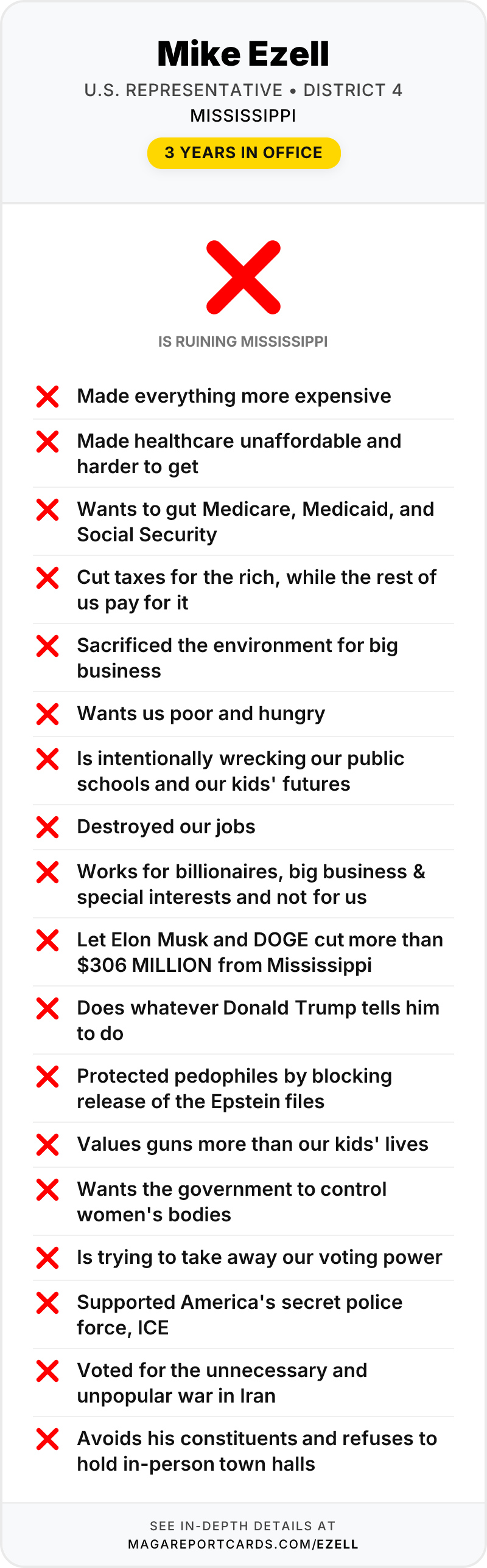
There is a job in the U.S. House whose entire purpose is to look hard at how the Coast Guard spends money. It's the chairmanship of the Coast Guard and Maritime Transportation Subcommittee.
Mike Ezell has it. His official biography says so, and so does the Transportation and Infrastructure Committee, which introduces him as "Coast Guard and Maritime Transportation Subcommittee Chairman Mike Ezell (R-MS)."
Now look at who pays for his campaigns.
The company
Edison Chouest Offshore is a Louisiana marine company. It builds and operates ships, and it sells them to the U.S. government. It also owns a shipyard called Gulf Ship in Gulfport, Mississippi — which is in Ezell's district.
According to FEC records compiled by Who Bought My Rep, people who list Edison Chouest Offshore as their employer have given Ezell's campaigns $39,800. On top of that:
- $12,600 from Gary Chouest, listed as an executive at Edison Chouest Group — he is the company's president and CEO
- $13,400 from Carolyn Chouest
Set aside the generic buckets — "retired," "self-employed," "homemaker" — and no single employer shows up on Mike Ezell's donor list more than Edison Chouest Offshore does.
The chairman of Coast Guard oversight is funded, more than by anyone else, by a company that sells to the Coast Guard.
What that money has bought before
This isn't a hypothetical conflict. There is a documented case study, and it's a big one.
In January 2025, ProPublica's McKenzie Funk published an investigation into the icebreaker Aiviq — a ship Edison Chouest built for Shell's Arctic drilling program and then spent nearly a decade trying to sell to the U.S. government.
ProPublica found that since 2012, Edison Chouest has contributed more than $7 million to state and national parties, PACs, super PACs, and members of the key House and Senate committees — with more than 95% of it going to Republicans.
And it worked. ProPublica's finding on how the purchase was engineered:
"The way Congress wrote the specifications for a 'United States built' icebreaker, however, ensured there was only one the Coast Guard could choose: the Aiviq."
The Coast Guard didn't want it. The Maritime Executive reported that the service "initially resisted, citing concerns over Aiviq's commercial design," and that back in 2016, "two congressmen with ties to Chouest — Representatives Duncan Hunter and Don Young, a longtime friend of the family company — advocated for the Coast Guard to buy a used commercial icebreaker that matched Aiviq's characteristics."
The Coast Guard bought it anyway, in December 2024, from the Chouest subsidiary Offshore Service Vessels LLC, for $125 million.
What taxpayers got for $125 million
The Aiviq's résumé, before the sale:
- In December 2012, in 20-to-30-foot seas in the Gulf of Alaska, it lost power in all of its engines because seawater got into the fuel. The vessel it was towing ran aground and was eventually scrapped.
- Then it sat, "little-used for many years."
ProPublica catalogued the design problems the Coast Guard was buying: a low, wet deck that waves can swamp; a helipad near the bow that's poorly suited to rescue work; a direct-drive propulsion system more likely to jam in ice than the diesel-electric systems the Coast Guard actually uses; waste and discharge systems that don't meet polar code standards; and an inability to break ice much thicker than about four and a half feet.
The government renamed it the USCGC Storis and sent it north.
How the family does business
The Chouest family's approach to Congress is not subtle, and it has been examined by the House ethics process before.
In January 2011, at a Texas fundraiser, Gary Chouest handed Rep. Don Young an envelope. Inside were twelve checks for $5,000 each — $60,000 — written by twelve different family companies, all registered at the same address in Galliano, Louisiana. The legal limit on what one person could give was $5,000.
By the time Young died, Edison Chouest had given him close to $300,000 — more than the Veco executives at the center of Alaska's political corruption scandal ever did.
Young is the man who spent years pushing the Coast Guard to take the Aiviq.
Gary Chouest, who handed over that envelope, is the same Gary Chouest who has given Mike Ezell $12,600.
What Ezell does with the gavel
An oversight chairman's job is to be the hard question in the room. Here is what Ezell's chairmanship sounds like instead.
In March 2025, when the Coast Guard handed Bollinger Mississippi Shipyards a $951 million contract modification for the Polar Security Cutter program, Ezell put out a statement calling it "a major win for America's maritime strength and Arctic presence" and thanking Trump for his leadership.
Six weeks later, in May 2025, Bollinger and Edison Chouest announced a partnership called the United Shipbuilding Alliance, formed specifically to chase the Coast Guard's next big icebreaker contract — the Arctic Security Cutter. Gary Chouest was quoted in the announcement as ECO's president and CEO.
In July 2026, the Coast Guard finalized roughly $3.3 billion in Arctic Security Cutter contracts. Bollinger got about $2.2 billion of it for four ships. (The Coast Guard's award names Bollinger; how the alliance divides the work isn't public.)
Ezell also chaired a February 2025 hearing where he called the Jones Act "quite literally the bedrock and foundation of the nation's shipbuilding industrial base." The Jones Act reserves shipping between U.S. ports for U.S.-built, U.S.-crewed vessels. Edison Chouest builds and crews U.S. vessels.
What's missing from the record is the other half of the job — the chairman asking, in public, whether the government is being taken for a ride.
Why this should bother you
Nobody in South Mississippi is against shipbuilding jobs. Gulf Ship employs people in Ezell's district, and that's real.
But shipyard jobs are not what's at issue. What's at issue is whether the one member of Congress specifically assigned to scrutinize Coast Guard purchases can do that when the company on the other side of those purchases is his biggest corporate backer, and when its CEO writes him personal checks.
We've seen this exact shape before: Diana Harshbarger vice-chairs the health subcommittee that oversees the FDA, is funded by compounding-pharmacy lobbies, asked the FDA to loosen the rules on peptides — and then her son landed a seat on the FDA panel that voted to allow them. Different industry, identical machinery: put your money on the person holding the gavel, and the gavel stops swinging at you.
The Coast Guard said the Aiviq was the wrong ship. Congress bought it anyway, for $125 million, after $7 million in donations. That is the record of the company that funds the man now running Coast Guard oversight in the House.
And what his office offers constituents is a telephone town hall you register for in advance — not a room in South Mississippi where somebody could stand up and ask him about any of this.
Sources
- This Icebreaker Has Design Problems and a History of Failure. It's America's Latest Military Vessel. — McKenzie Funk, ProPublica, January 23, 2025. Photo: Edmund D. Fountain, special to ProPublica.
- Icebreaker owner gave Don Young an envelope with $60,000 in checks in 2011 — Dermot Cole, Reporting From Alaska, January 24, 2025.