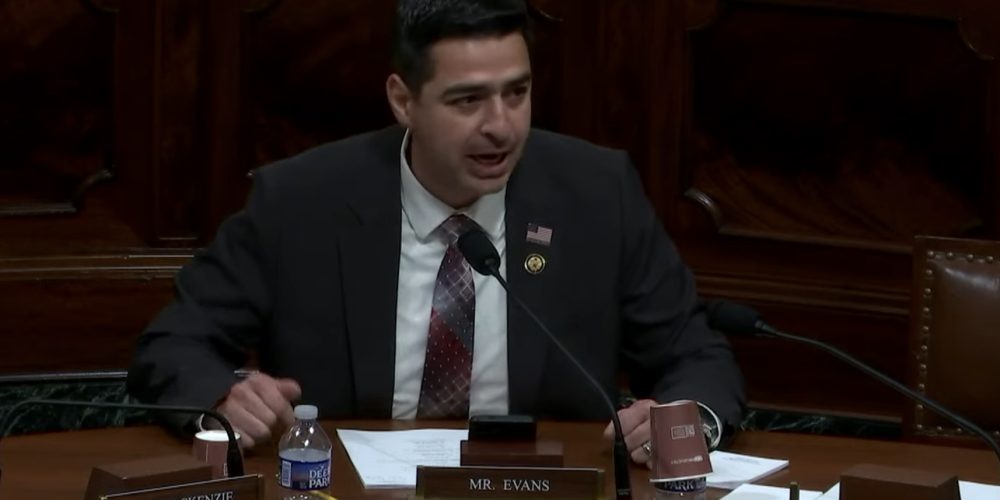
Gabe Evans spent more than a decade as a police officer with the Arvada Police Department before he ran for Congress. It is in every version of his biography, and he uses it constantly. He was a cop.
On January 9, 2025 — six days after he was sworn in — Evans put his name on H.R. 38, the Constitutional Concealed Carry Reciprocity Act.
The two largest police organizations in the United States have asked Congress to reject that bill.
What the cops actually said
In November 2025, the National Fraternal Order of Police and the International Association of Chiefs of Police — which by their own account "collectively represent a majority of rank-and-file officers and police executives" — sent Congress a joint call to action against H.R. 38.
Their objections were not abstract. As Breitbart reported on the letter, the groups warned the bill "exempts any person with a valid photographic identification from state or local firearms law who asserts that they are lawfully carrying a firearm under the laws of their own state of residence." An officer who stops someone would have no way to check.
And then the part that should matter most to a former patrol officer:
"The bill goes further and provides that any person 'who is deprived of any right, privilege, or immunity' may sue a law enforcement officer, who would not be afforded qualified immunity."
Qualified immunity is the doctrine that keeps an officer from being personally sued for a judgment call made in the field. H.R. 38 never uses the phrase; what it does is create a new right to sue "any other person" who deprives someone of the rights it grants. The two organizations read that and told Congress the bill "seems to cancel any qualified immunity for the officer," leaving their members in legal and physical danger: "Any action the officer may take in reaction to the knowledge that the person they have encountered is armed could place that officer in very real legal peril."
This is not new territory for the bill, either. When an earlier version came up, 473 law enforcement agencies from 39 states signed a letter opposing it. Their reasoning was the same then. That letter said there is "currently no system to verify the validity of concealed carry permits across state lines, which means that law enforcement could not confirm whether an individual is carrying a weapon legally." The 2025 call to action puts it the same way: officers "would be expected to interpret and apply laws from all 50 states in real time."
H.R. 38 was reported out of committee and placed on the House calendar on October 3, 2025. Evans's name is still on it.
What it would do to Colorado
Colorado requires a background check and a handgun training course before a sheriff will issue a concealed carry permit. H.R. 38 makes that optional in practice: anyone eligible to carry in their home state can carry here, including people from states that require no permit, no training, and no check at all.
Emma Brown, executive director of Giffords, put it bluntly at a Denver public safety roundtable in May 2026: Evans is "trying to let tourists carry concealed weapons with no training and without ever passing a background check."
"He's actively pushing a deadly agenda that makes it harder and more dangerous for law enforcement officers to do their jobs," Brown said. "As a former member of law enforcement, you would think he'd do better."
The roundtable was opened by Colorado State Sen. Tom Sullivan, whose son Alex was one of the 12 people murdered in the 2012 Aurora theater shooting. Sullivan has spent the years since at the state Capitol passing gun laws. His assessment of his congressman:
"Here in this district, with Gabe Evans, we are not getting that partnership. … We need someone who listens to the people who have been impacted on a day-to-day basis, to hear from them, and do something about it. He made it very clear where his priorities are when he cosponsored the Constitutional Concealed Carry Reciprocity Act."
About 15.3 out of every 100,000 Coloradans died from a gun-related injury in 2024 — 961 people, a rate 19.5% above the national one.
Guns in the classroom
Evans's record on this predates Congress.
Running for the Colorado state House in 2022, he posted on Facebook that "Large numbers of educators WANT to protect their classrooms by carrying concealed. They should be allowed, encouraged, provided resources, and trained!"
Once he got to the legislature, he went after the permit system itself. In 2023 he cosponsored HCR23-1003, a proposed amendment to the Colorado constitution that would have written concealed carry into the state bill of rights "in any area of Colorado except areas prohibited by state law." The list of places the legislature would still have been allowed to keep guns out of was three items long: federal gun-free zones, K-12 school grounds, and public buildings that screen every person at every entrance. Nothing else. It was postponed indefinitely in committee.
This is Colorado — Columbine, the Aurora theater, the Boulder King Soopers, Club Q. The answer Evans arrived at was more guns, carried by more people, in more places, with less checking.
He knows exactly who he's crossing
Plenty of members of Congress cosponsor H.R. 38 without ever having worn a badge. Evans is different, and he trades on the difference. His campaign is built on the Arvada patrol car and the Black Hawk cockpit.
That's what makes the January 9 signature worth pointing at. The Fraternal Order of Police is not a gun control group. The International Association of Chiefs of Police is not a gun control group. They are the organizations that speak for the job Evans used to do, and they told Congress this bill would get officers hurt and get officers sued.
He signed it anyway, in his first week.
Evans has been consistent about one thing across every issue: when his district's interests and his party's demands point in different directions, he goes with the party and hopes nobody reads the roll call. He did it on Medicaid, telling Colorado his vote wouldn't hurt anyone's health care while nurses named 12 hospitals at risk. He is doing it now on a 1,200-bed ICE detention center on his district's edge, where his office declined to discuss the issue at all.
On guns, he isn't even hiding it. He just expects the badge to cover for him.
Source
GIFFORDS, Rep. Pettersen and local officials call out Gabe Evans extreme record on gun safety — GIFFORDS, May 2, 2026, and Gun Control Advocates Criticize Evans for Past Calls to Arm Teachers — Colorado Times Recorder. Photo: Colorado Times Recorder.