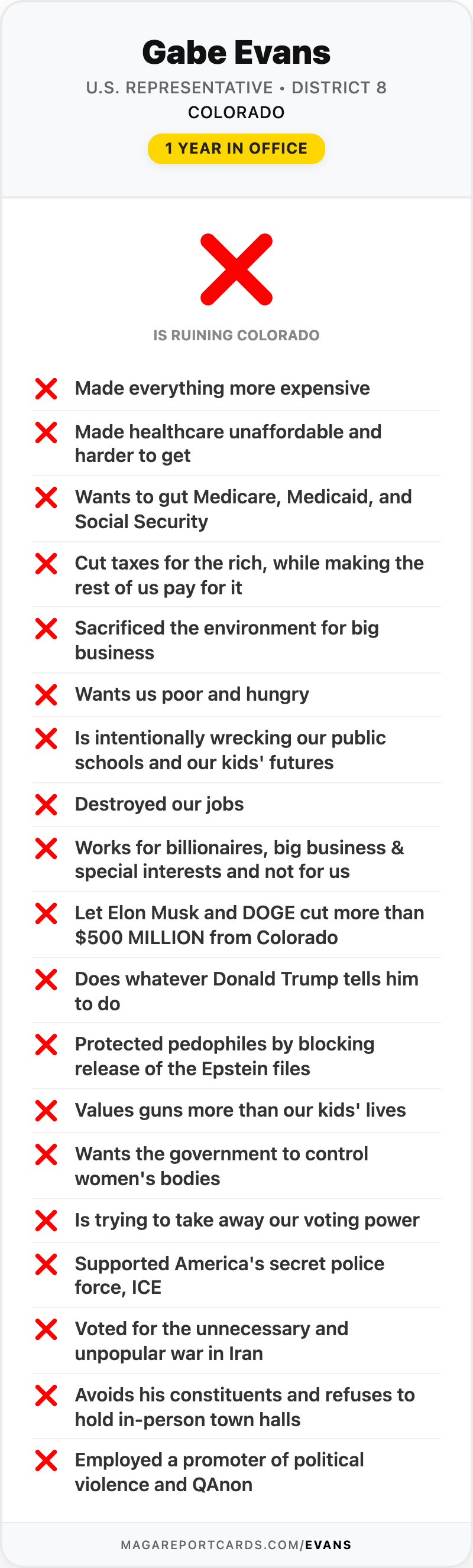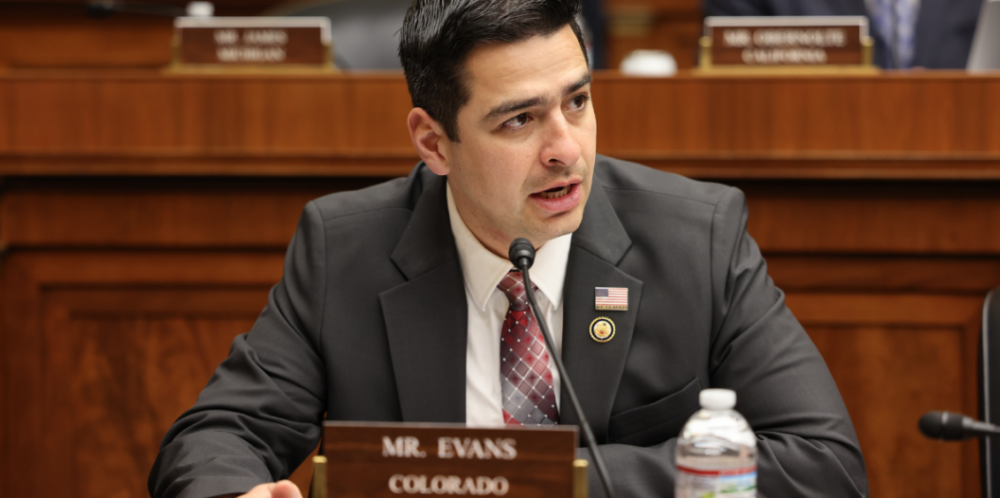
A year ago, Gabe Evans voted for Trump's budget bill and then went out and told Colorado it wouldn't hurt anybody's health care.
He was specific about it. In a May 2025 news release, the Republican representing Colorado's 8th District said this:
"Medicaid spending under the Republican plan is projected to increase every year, and anyone who suggests otherwise is fear mongering for political purposes. This bill follows through on our promises to cut waste, fraud, and abuse while simultaneously protecting coverage for Colorado's most vulnerable populations. As the father of a medically complex kid, I understand how significant programs like this are, and that's why I am committed to protecting Medicaid and ensuring its longevity for the people who need it most."
In August 2025, after the bill was signed into law, he told Colorado Public Radio the same thing in fewer words: "I don't support cuts that harm Colorado providers or patients — I support removing waste and fraud."
We can now check that promise against what actually happened.
Nurses just named 12 Colorado hospitals at risk
Last week, National Nurses United published a list of 12 Colorado hospitals it considers vulnerable because of the federal Medicaid cuts phasing in over the coming years, the Colorado Times Recorder reported. Three of them are in Evans's own district. The full list:
- Banner North Colorado Medical Center — Loveland campus
- Banner North Colorado Medical Center — Greeley campus
- CommonSpirit Longmont United Hospital
- CommonSpirit St. Elizabeth Hospital (Fort Morgan)
- Intermountain Health Lutheran Hospital (Wheat Ridge)
- Intermountain Health Platte Valley Hospital (Brighton)
- St. Vincent General Hospital District (Leadville)
- UCHealth Broomfield Hospital
- UCHealth Grandview Hospital (Colorado Springs)
- UCHealth Greeley Hospital
- UCHealth Highlands Ranch Hospital
- UCHealth Longs Peak Hospital (Longmont)
This isn't one group's opinion. Back in April, Public Citizen put out its own report naming nine Colorado hospitals "at risk" after the Medicaid cuts — including Platte Valley Medical Center in Brighton, North Colorado Medical Center in Greeley, Denver Health, and St. Mary-Corwin in Pueblo. Both lists include a hospital in Greeley, which sits in Evans's district.
Zoom out and it's worse. The Center for Healthcare Quality and Payment Reform, which tracks rural hospitals, counts about 700 rural hospitals nationally on shaky financial ground — six of them in Colorado at risk of closing right away.
What it costs Colorado
Adam Fox, deputy director of the Colorado Consumer Health Initiative, put a number on it:
"Colorado is estimated to lose at least $2.5 billion per year in federal funding for Medicaid by 2032 because of H.R. 1. And that doesn't reflect the broader economic, health, and social costs that will happen from the unnecessary paperwork and administrative red tape requirements that start in January."
Fox had a sharper answer for Evans's claim that the bill didn't really cut Medicaid:
"Saying H.R. 1 doesn't cut Medicaid is like saying the wolf in sheep's clothing is there to protect the flock. The consequences for Coloradans will be tens if not hundreds of thousands losing health coverage and our already dysfunctional health care system being thrown into a catastrophe."
That red tape Fox mentions starts in January. It isn't an abstraction — paperwork requirements are how people who still qualify for coverage lose it anyway.
This lands hardest on his own constituents
Here's the part Evans can't argue with: one of every four people in his district is on Medicaid. That's about 192,000 Coloradans, and nearly 10,000 of them have disabilities that require long-term care, according to the state agency that runs Colorado's Medicaid program.
Democrats on Congress's Joint Economic Committee projected that 29,262 people in Colorado's 8th District will lose health coverage — 22,762 losing Medicaid under the cuts Evans voted for, and roughly 6,500 losing marketplace coverage, largely as the enhanced ACA premium tax credits lapse.
Evans's constituents saw this coming and tried to tell him. In April 2025, more than 100 people gathered at a Democratic-organized "People's Town Hall" in Thornton. Evans didn't come. So they put their questions to a cardboard cutout of him instead. One hospice nurse asked it:
"Hey Gabe, did you know that 25% of your constituents … are on Medicaid?"
He did know. He voted for the cuts anyway, and then told people the cuts weren't real.
A pattern of telling voters it's fine
This is the same move Evans made on food assistance. After voting to cut SNAP, he publicly claimed the Weld Food Bank had told him "we need to cut down on the line" of people needing food — making it sound like they were on his side. The food bank corrected him: the meeting was "strictly informational," and the cuts "will make the line longer, not shorter."
They were right. By last October, the Weld Food Bank was running about 30,000 visits a month, up roughly 230%, and facing a potential $700,000 shortfall.
The pattern is consistent: vote for the cut, tell constituents the cut won't hurt them, and then go quiet when it does. The Colorado Times Recorder emailed Evans's office to ask whether he still stands by his claim that the bill protected coverage for Colorado's most vulnerable. His office didn't respond.
The bottom line
Gabe Evans had one job when this bill came up: look at what it would do to the 192,000 people in his district on Medicaid and vote accordingly. Instead he voted yes, called the people warning about it "fear mongering," and promised he was protecting "the people who need it most."
A year later, nurses have named 12 Colorado hospitals at risk, Colorado is looking at losing $2.5 billion a year, and the paperwork rules that strip coverage from people who still qualify kick in this January.
He was wrong, and his constituents are the ones who pay for it. We deserve better.
Source
This post is based on reporting by the Colorado Times Recorder: Gabe Evans Promised Medicaid Cuts Wouldn't Affect 'People Who Need It Most,' But They're Putting Hospitals at Risk by Jason Salzman.