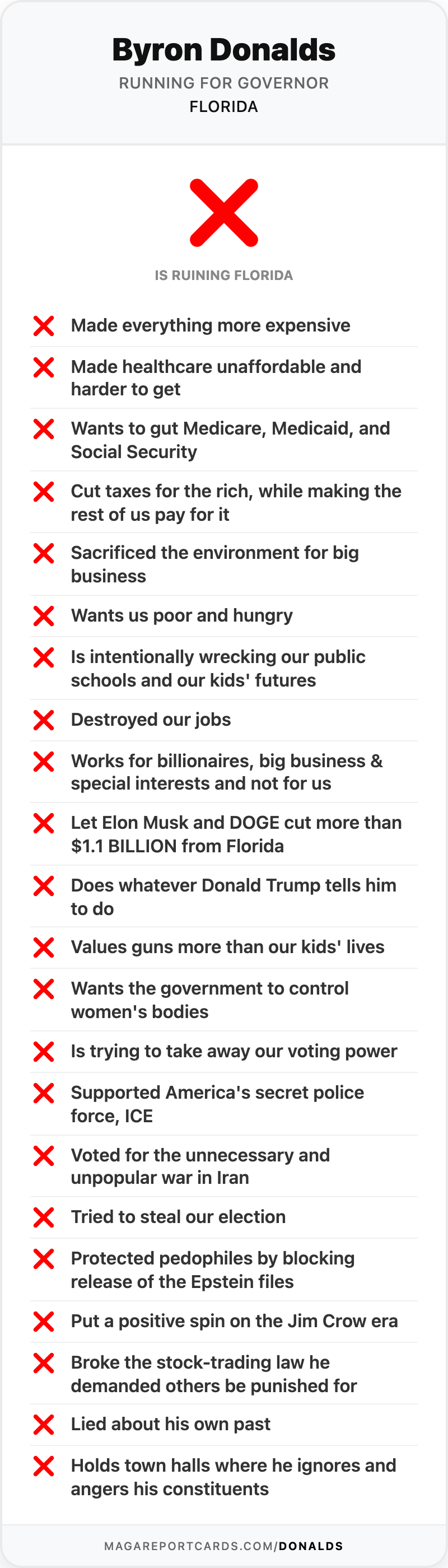
Donald Trump ran for president promising to bring prices down on day one. That promise is the reason a lot of people voted for him.
On Friday, August 21, NBC's Kristen Welker asked Byron Donalds — freshly nominated as the Republican candidate for governor of Florida — whether Trump had broken it.
Donalds said he had not. Trump, he said, has done "incredibly well" on the economy, pointing to wages and GDP growth. NBC titled the clip after his answer: Trump "did not break that promise" to keep prices down.
Then, in the same conversation, he said this about the price of gasoline:
"Do I want to see $4 gas? No, I do not. I don't want anybody to have to pay that."
And then he explained why Floridians should pay it anyway: the higher fuel prices, he said, are what it costs to keep Iran from getting a nuclear weapon.
Read those two answers together
The promise was that prices would go down. The defense is that prices are up for a good reason.
Those are not the same argument, and Donalds made both in one interview. A promise you have to justify breaking is a promise that got broken. If the case for $4 gas is that it's the price of stopping Iran's nuclear program, then say that — but you cannot say it and also say the day-one pledge is intact.
There's a second problem with the reasoning. Donalds also argued the administration is being careful — that Trump has not committed troops on the ground in Iran and won't get stuck in another Afghanistan or Iraq. Fine. But that's an argument about American casualties. It says nothing about whether a Floridian filling up a truck in Immokalee should be paying $4 a gallon for it, or how long they should expect to.
Nobody voted for that trade. It wasn't on the ballot, and it wasn't in the promise.
He is running for governor on affordability
This matters more than a normal cable-news answer, because affordability is the entire platform Donalds is running on in Florida. In the same interview he laid out his plans: tort reform and home hardening to bring down property insurance, a permitting overhaul he says would cut 20–30% off the cost of building a house, and property tax cuts.
That last one is where his own numbers have already run into trouble. Donalds is the loudest voice in Florida for Amendment 3, a property tax cut even Ron DeSantis won't campaign for. When Florida's own state economists priced it at $11.86 billion a year, Donalds' response was that revenue estimators are "often wrong".
So the pattern is consistent. When a number helps him, it's proof. When it doesn't, the people who produced it are unreliable — or the price is justified by something else entirely.
The rest of the affordability record
Donalds has been in Congress since 2021, and his votes there are a better guide to what he'd do about Floridians' bills than a Sunday show appearance.
He cosponsored a bill to block heat protections for Florida's outdoor workers — the people who build the houses he wants permitted faster, working in the state where that protection matters most.
He promised Floridians that data centers won't raise their electric bills. The law doesn't say that, and the developers have given him $894,000.
And one billionaire, Ken Griffin, gave $10 million to a PAC backing him — the single biggest contribution of the race.
What he's actually asking Floridians to accept
Strip away the framing and the ask is simple: keep believing prices are being handled, while paying more, because there's a reason.
Every politician who presides over rising costs eventually reaches for that argument. What's unusual here is watching a candidate make it and insist the original promise is untouched in the same breath — and then run for governor promising to make things affordable.
Florida votes November 3.
Sources
- Byron Donalds promotes his economic plans for Florida, defends Trump's record — WLRN, August 21, 2026
- Byron Donalds says Trump 'did not break that promise' to keep prices down amid Iran war — Meet the Press NOW, NBC News