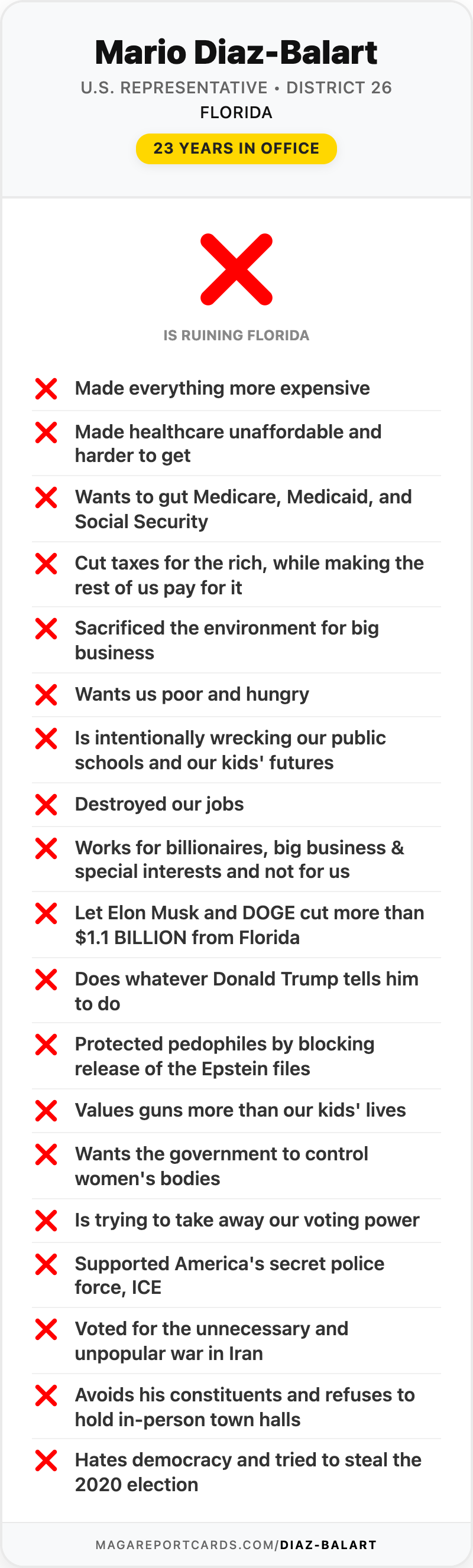
Most members of Congress vote on the foreign aid budget. One member writes it.
Mario Diaz-Balart is Vice Chair of the House Appropriations Committee and chairman of its subcommittee on National Security, the Department of State, and Related Programs — the panel that decides how much money the United States spends on diplomacy, global health, famine relief and every other form of foreign assistance. When that bill comes to the House floor, he is the one standing at the microphone explaining it.
He has used that job to make American foreign aid smaller, and he says so proudly.
"I am proud of these efforts"
In July 2025, after the House passed the Rescissions Act of 2025 — the bill cancelling $9 billion Congress had already approved for foreign aid and public broadcasting — Diaz-Balart put out a statement headlined "Another Promise Made and Kept":
"Today, I joined my colleagues in passing the $9 billion rescissions package … In addition, earlier this week, I was proud to release my FY 2026 NSRP funding bill, which builds upon prior achievements and advances President Trump's America First foreign policy, delivering a 22 percent reduction in funding compared to FY 2025 enacted levels."
His press release then listed what taxpayers were no longer paying for. Some of it was written for laughs — "$3 million for Iraqi Sesame Street," "$500,000 for electric buses in Rwanda." Some of it was not funny at all: $135 million in U.S. contributions to the World Health Organization, $33 million to the UN Population Fund, $8 million to the UN Human Rights Council.
Then he did it again. In the FY2027 bill, Diaz-Balart told the House floor:
"Under Chairman Cole's leadership, House Republicans have delivered nearly $12 billion in responsible cuts within the purview of this subcommittee since 2023. The FY27 bill continues this work with another $2.7 billion reduction."
Assessed U.S. funding for the United Nations: cut by $1.8 billion. No money at all for the UN regular budget. Funds prohibited to the World Health Organization.
What "cannot go on forever" means
The line in that speech that deserves the most attention is about PEPFAR — the President's Emergency Plan for AIDS Relief, started by George W. Bush in 2003, the most successful thing the United States has done in global health in living memory.
Here is Diaz-Balart, in his own words on the House floor:
"Last year, the NSRP Subcommittee focused on responsibly transitioning PEPFAR programs to capable partner countries. PEPFAR is a great success story, but most of us agree the program cannot, and should not, go on forever. Working alongside the Administration, countries are now investing significant resources toward their own health, allowing this Committee to reduce funding, while maintaining the same outcomes."
Read that last clause again: reduce funding, while maintaining the same outcomes.
The State Department's own numbers say PEPFAR has saved 26 million lives since 2003 and allowed 7.8 million babies to be born HIV-free. Those outcomes are people taking antiretroviral drugs every day. When the money stops, the drugs stop. There is no version of HIV treatment where you cut the funding and the patient stays alive on optimism.
Diaz-Balart's assurance that partner countries are picking up the tab is an assertion, not a finding. He offers no evidence for it in the speech, and he is the person whose bill depends on it being true.
What the aid cuts are projected to cost
We do have evidence on the other side of the ledger.
In July 2025, The Lancet published a study modeling what happens if U.S. aid funding stays cut. Researchers looked at data from 133 countries and estimated that USAID-supported programs had prevented 91 million deaths between 2001 and 2021 — about 30 million of them children.
Their projection for what an 83% cut produces by 2030: more than 14 million additional deaths, including more than 4.5 million children under five. That's roughly 700,000 extra child deaths a year.
One of the study's authors, Dr. James Macinko of UCLA, put the price in perspective:
"U.S. citizens contribute about 17 cents per day to USAID, around $64 per year. I think most people would support continued USAID funding if they knew just how effective such a small contribution can be to saving millions of lives."
Seventeen cents a day. That is the "wasteful spending" a senior appropriator is proud of "dramatically reining in."
He knows exactly what this money does
Diaz-Balart is not a newcomer to foreign policy who wandered into this job. He is the son of a Cuban politician, he co-founded the Congressional Hispanic Conference, he co-founded and co-chairs the Congressional Venezuela Democracy Caucus, and for 23 years he has made the case that American power should be used on behalf of people living under repressive governments.
The FY2027 bill he wrote does keep money flowing to the causes he cares about: $3.3 billion in security assistance for Israel, $1.8 billion for partners in the Indo-Pacific including $500 million in military assistance for Taiwan, and continued support for democratic transitions in Cuba, Venezuela and Nicaragua.
So the cuts are not really about the size of government. They're a set of choices about who counts. Weapons and allies: funded at or above prior-year levels. Vaccinations, HIV medicine, maternal health, famine relief, the UN's human rights machinery: cut, cut, cut, and prohibited.
It is also worth noticing what he does with the appropriations power when it points at his own district. In March 2026, Florida Bulldog documented how Diaz-Balart earmarked $12 million toward a Sweetwater development whose owner then gave $250,000 to his joint fundraising committee. Foreign aid is where "every dollar must be justified." Home is where the money flows.
The part that should worry everyone
Congress's power over spending is the check that makes the executive branch answerable to voters. Diaz-Balart's own framing of his bill gives that away:
"This bill is very straightforward. If you are a friend or an ally of the United States, this bill supports you. But, if you are an adversary or are cozying up to our adversaries, then, frankly, you will not like this bill."
That is not a description of an appropriations bill. It's a description of a loyalty test — one that includes a provision requiring the Secretary of State to weigh countries' UN voting records when handing out money, and one that funds "full implementation" of the president's executive orders on DEI, speech and the border.
An appropriator's job is to decide what America should pay for and hold the executive branch to it. Diaz-Balart has redefined it as delivering what the president wants and announcing the total as a promise kept.
Twenty-three years in Congress. He has more control over America's face to the world than almost anyone in the House. And what he wants credit for is the subtraction.
Sources
- Another Promise Made and Kept — Díaz-Balart Leads President Trump's Historic Funding Cuts — Office of Rep. Mario Díaz-Balart, July 18, 2025
- Rep. Díaz-Balart Delivers Opening Remarks on the FY2027 National Security, Department of State, and Related Programs Appropriations Bill — Office of Rep. Mario Díaz-Balart
- Research finds more than 14 million preventable deaths by 2030 if USAID defunding continues — UCLA Fielding School of Public Health, on the study published in The Lancet, July 1, 2025