On January 14, 2025, Minnesota Secretary of State Steve Simon walked into the House chamber to open the legislative session, as state law requires. He read the roll. Only Republicans answered. He announced that the House did not have the 68 members it needed to do business, adjourned the chamber, and left.
The 67 Republicans stayed in their seats. They decided among themselves that 67 was enough. Then they voted to make their leader, Lisa Demuth of Cold Spring, Speaker of the House — a move Democrats immediately called an "unlawful sham with no legal authority."
Ten days later, the Minnesota Supreme Court agreed with the Democrats. Everything Demuth's House had done for two weeks — electing her Speaker, naming officers, handing out committee gavels — was wiped out, because the chamber had never legally been in session at all.
She is now running for governor.
She had a deal. She threw it away when she thought she didn't need it.
Start with what makes this worse: Minnesota voters didn't give either party a majority in November 2024. They elected 67 Republicans and 67 Democrats. A tie.
Demuth and DFL leader Melissa Hortman did what leaders are supposed to do with a tie. They sat down and negotiated a power-sharing agreement — shared committee chairs, shared control, neither side steamrolling the other.
Then, in late December, a judge ruled that a newly elected Democrat in a heavily Democratic district hadn't actually been living there. He resigned. Until a special election could fill the seat, Republicans had a temporary 67-66 edge.
Demuth's caucus used that temporary edge to tear up the deal.
Republicans "scrapped" the power-sharing agreement the moment the seat opened up, the Minnesota Reformer reported, and announced they would organize the entire chamber themselves. Nothing about the election had changed. Voters hadn't given Republicans a majority. A residency lawsuit had, temporarily, in a seat everyone expected Democrats to win right back.
That's the whole story in one sentence: she followed the rules when the rules gave her a tie, and abandoned them the second an accident of litigation gave her an advantage.
The threat underneath it: throwing out an election she lost
The reason Democrats walked out instead of just showing up and losing votes wasn't committee chairs. It was a seat.
Rep. Brad Tabke, a Shakopee Democrat, won reelection by 14 votes in a race where local election officials admitted 20 ballots had been accidentally destroyed without being counted. Republicans wanted a do-over election in a swing district they could win — which would have handed them a real 68-seat majority.
A judge looked at it and ruled that Tabke had won anyway, and that the missing ballots would not have changed the outcome. Republicans lost in court.
Demuth would not commit to seating him regardless. She had said her caucus wouldn't seat Tabke without a do-over. Hortman put a written provision on the table that would have blocked Republicans from unseating him. Republicans rejected it. A source close to House GOP leadership told the Reformer the problem with the offer was that Democrats "sought to unilaterally disarm us on Tabke."
Sit with that phrase. Being asked to promise you won't overturn a certified election result was described as disarmament.
The Minnesota Constitution lets each chamber judge who gets seated. That power exists to handle genuine fraud, not to let a party with a six-week accidental majority delete a lawful winner. Demuth kept the option open anyway, right up until she had to trade it away.
"A majority of the total number of seats"
On January 24, 2025, the Minnesota Supreme Court ruled against her. The Minnesota House's own nonpartisan Session Daily reported the holding plainly: 68 members constitute a quorum.
The court's order was short and blunt:
"We further hold that under Article IV, Section 13, of the Minnesota Constitution, which requires that '[a] majority of each house constitutes a quorum to transact business,' a quorum requires a majority of the total number of seats of each house. Vacancies do not reduce the number required for a majority of each house to constitute a quorum."
Republicans had argued that 67 was a majority of the 133 members currently seated. The court said no — a vacancy doesn't shrink the House. The chamber had 134 seats, so it needed 68. Demuth's two weeks of proceedings had produced nothing official.
Hortman's response is the line that names it:
"Republicans tried to seize power that the voters did not give them."
And Demuth's response? Not a word acknowledging that the state's highest court had just voided everything she'd done. Instead she put out a statement attacking Democrats for "disrespecting not just their own constituents, but the entire state of Minnesota by refusing to do their jobs."
She lost a constitutional case about her own legitimacy and framed it as a scheduling complaint about the other side.
What she said while she was doing it
The gap between Demuth's words and Demuth's conduct is not a matter of interpretation. It's on the record from the same afternoon.
In her acceptance speech — the one for the speakership a court would later erase — she promised to "work tirelessly" to build a "culture of respect and civility" in the House. She told the half-empty chamber that lawmakers owe the people they represent "the respect of agreeing that sometimes we do disagree." She said: "So let's focus on what unites us."
She said all of that minutes after 67 members overruled the presiding officer, ignored an adjournment, and installed her in an office they had no legal power to fill.
Three weeks of nothing, to end up where she started
The standoff dragged on until February 5, 2025, when Republicans finally agreed to seat Tabke and Democrats came back to work. Demuth got the speakership for the full term.
Here is the part worth remembering. The Reformer's summary of the final deal was that "on its face, the final deal looks similar to an offer Democrats extended three weeks ago" — Tabke seated, a Demuth speakership, committee gavels until the special election, a Republican majority on the fraud oversight committee.
Three weeks of paralysis. A trip to the state Supreme Court. A legislature frozen at the start of a budget year in which it had to write a two-year, $60-billion-plus budget for schools, roads, health care, and social services — or shut the state government down at the end of June.
And she landed on terms she'd been offered before any of it started.
That's not hardball that worked. That's three weeks of Minnesotans' time burned so one politician could try to keep a majority the voters never handed her.
This is the pattern, not the exception
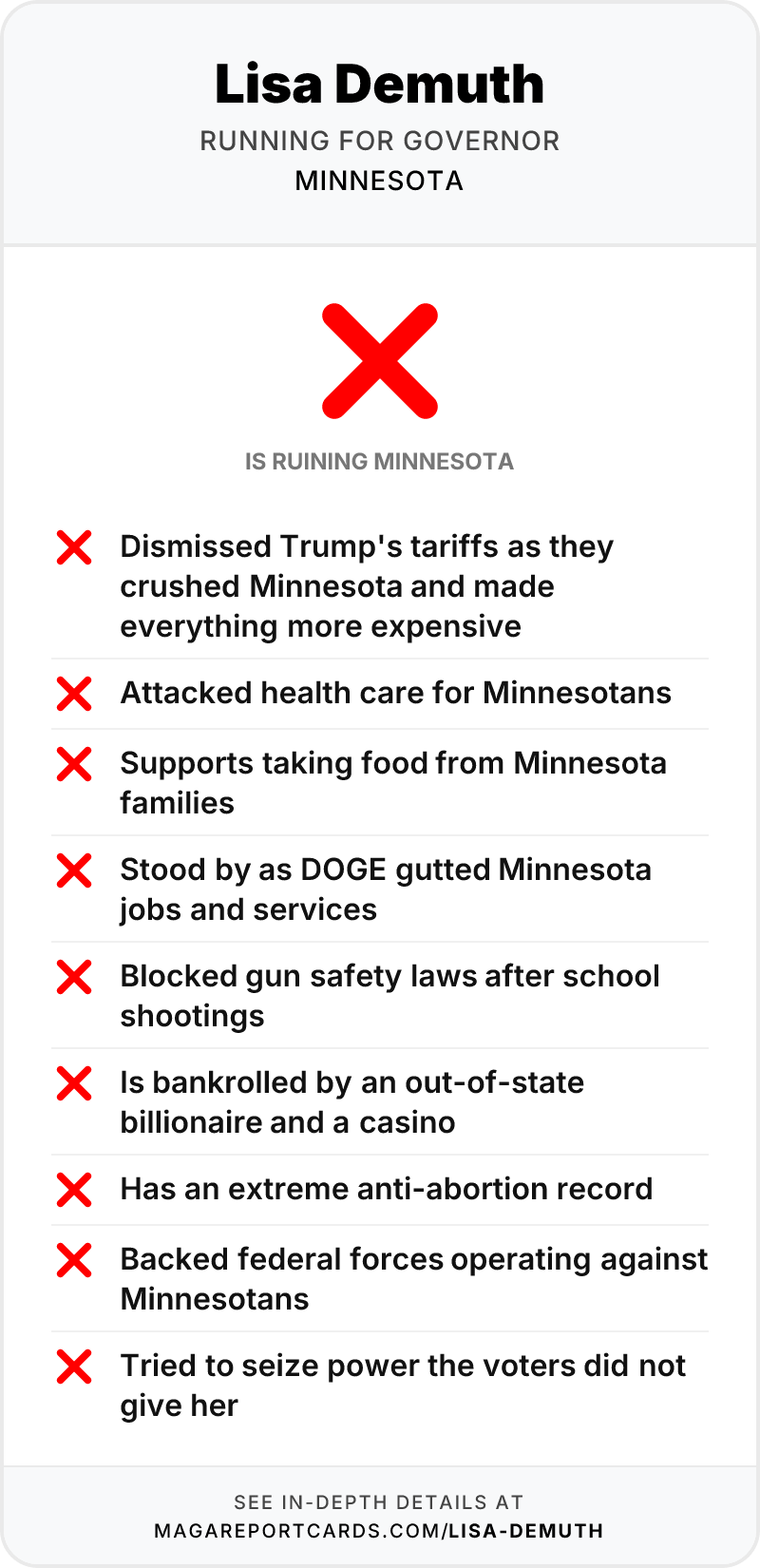
Demuth's defenders will say this was a one-time fight over an unusual situation. Her record as Speaker says otherwise. When she has the gavel, the rules bend toward whatever she wants:
- After the Annunciation school shooting in Minneapolis, a bill banning semiautomatic rifles and high-capacity magazines passed the Minnesota Senate. DFL lawmakers held a days-long sit-in and hundreds packed the Capitol demanding a floor vote. DFL lawmakers said Speaker Demuth was holding the vote up. Minnesotans never got to see their representatives go on the record.
- She is asking voters to make her governor while seeking Donald Trump's endorsement and praising his tariffs as "hard but effective" — as Minnesota farmers lost their export markets.
A governor has real power over what happens when the rules get inconvenient: vetoes, appointments, emergency authority, the National Guard. The question every Minnesotan should ask is simple. In January 2025, handed a temporary and accidental advantage, what did Lisa Demuth do with it?
She took everything she could reach, until a court made her give it back.
We deserve better.
Source
- AP, Democrats boycott first day of Minnesota House session but GOP votes to appoint speaker anyway by Steve Karnowski (Jan. 14, 2025)
- Minnesota Reformer, Minnesota Supreme Court sides with House DFL, invalidating House GOP's work for last two weeks (Jan. 24, 2025)
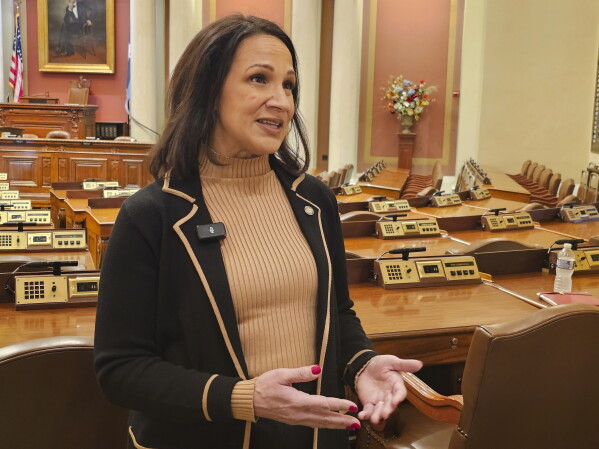
Photo: Minnesota House Republican leader Lisa Demuth speaks to reporters at the State Capitol, Jan. 13, 2025 / AP Photo/Steve Karnowski.