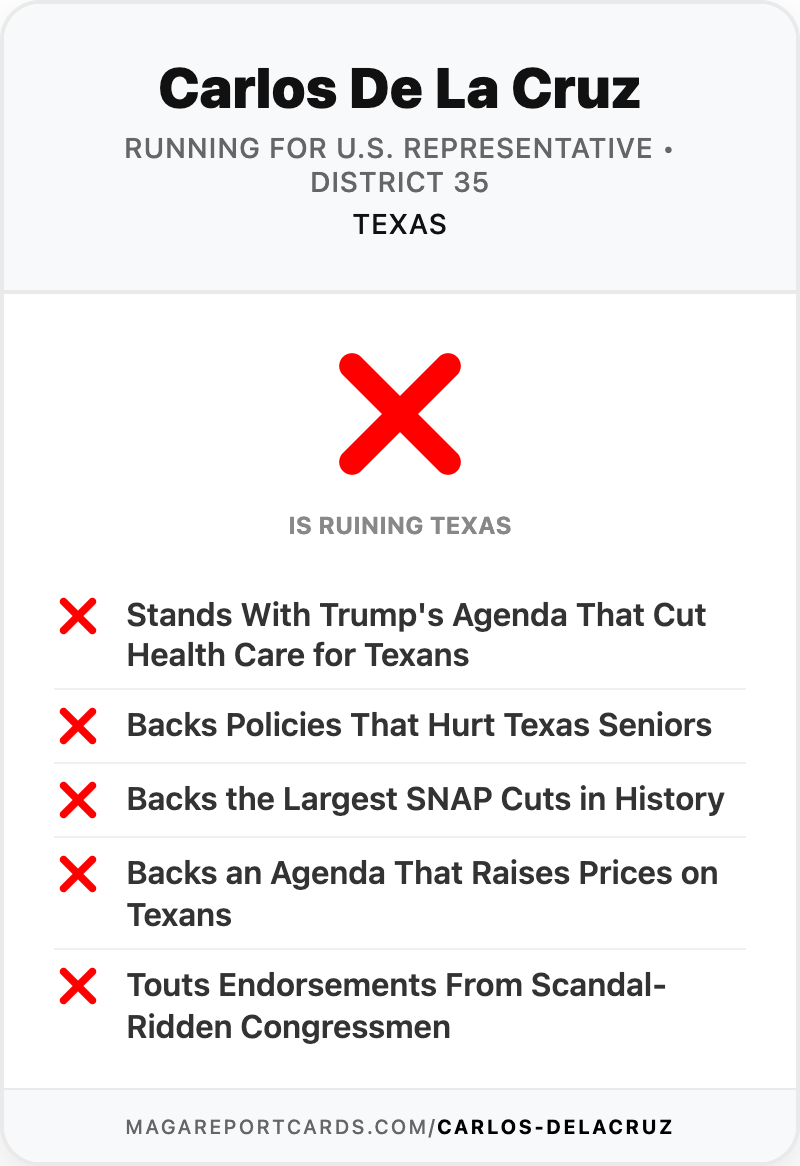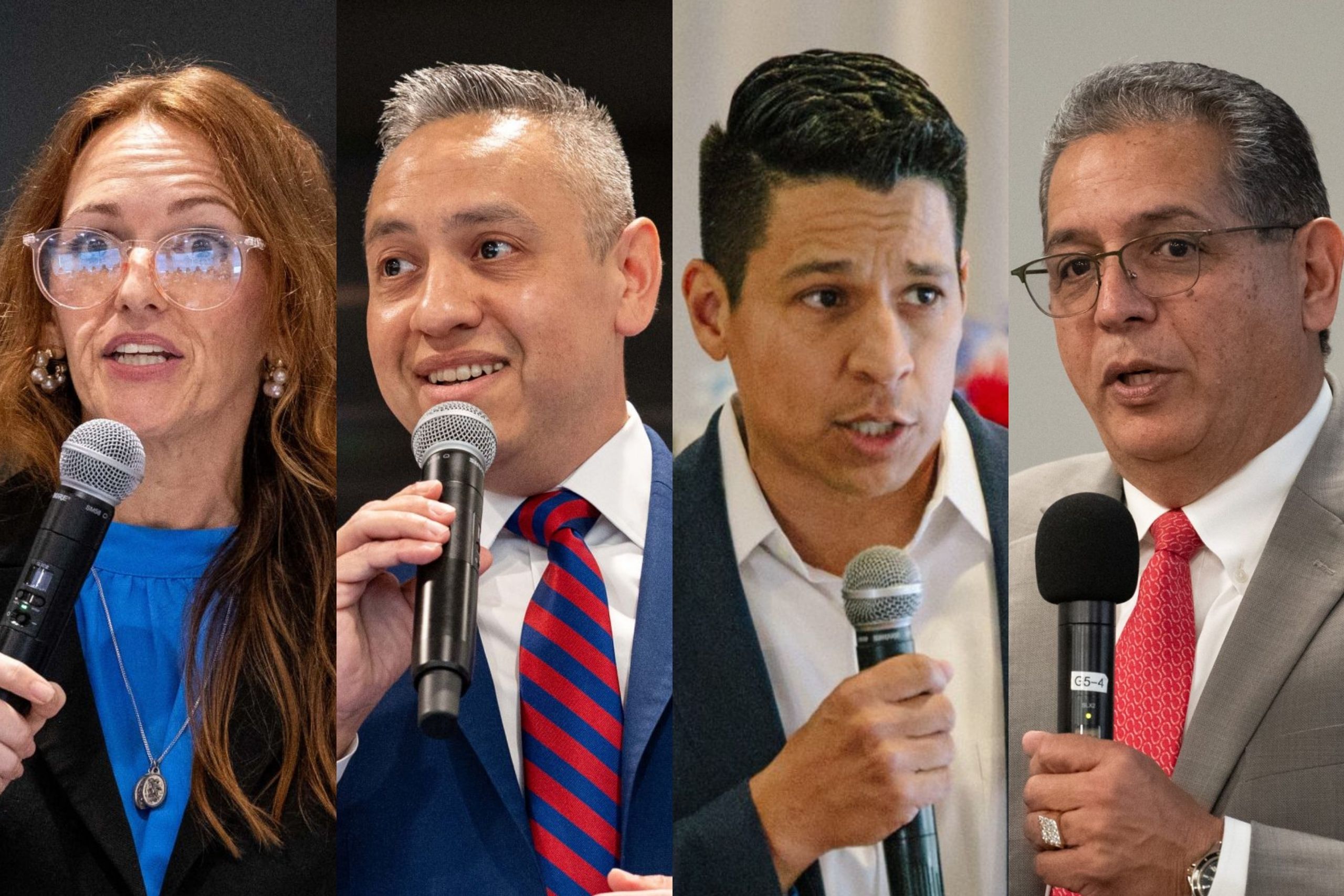
Here is how Carlos De La Cruz explained why Donald Trump endorsed him over a sitting Texas state representative in the race for Texas's 35th Congressional District:
"I think this administration realizes that me being a military veteran, me having been a small business owner, me not being a establishment politician is what this community needs."
He said that to the San Antonio Report in May. His campaign website calls him a political outsider, and his campaign announcement pledged that he would be President Trump's "wingman in Congress in the fight for America's future."
So let's look at who paid for the outsider campaign.
$195,000 from political committees
De La Cruz's campaign committee has taken $195,000 from other political committees this cycle, according to his FEC filings, plus another $28,833 transferred in from two House leaders' joint fundraising committees, which the FEC counts separately. That is not donations from voters in San Antonio. That is committee money, and most of it came from Washington.
Start at the top of the House Republican Party and work down.
Speaker Mike Johnson. Johnson's joint fundraising committee, Grow the Majority — announced in January 2025 as the Speaker's "chief fundraising vehicle to raise resources for Republican House campaigns" — sent De La Cruz $22,374. Johnson's own campaign committee, Mike Johnson for Louisiana, sent another $4,000. A third committee, American Revival PAC, sent $15,000; FEC records show it shares Grow the Majority's treasurer and its Alexandria, Virginia address, and is funded almost entirely by transfers from it.
Majority Whip Tom Emmer. Emmer Majority Builders, his joint fundraising committee, sent $6,459. Electing Majority Making Effective Republicans PAC — affiliated with the Emmer Victory Committee — sent $10,000. Emmer for Congress sent $4,000.
Majority Leader Steve Scalise. The Eye of the Tiger PAC, affiliated with the Scalise Leadership Fund, sent $5,000. Scalise for Congress sent $2,000.
That's the entire top three of House Republican leadership, personally invested in the outsider.
And a dozen more members' leadership PACs
Below leadership, the checks came in from sitting members' leadership PACs — the funds House members keep specifically to hand money to other House members and future colleagues. Most of them are named as jokes:
- Mr. Southern Missourian in the House PAC — $5,000
- Be Victorious Over Democrats PAC — $5,000, affiliated with the Beth Victory Fund of Irving, Texas. That's Beth Van Duyne.
- Raptor PAC — $5,000, affiliated with the Pfluger Victory Fund.
- HELO PAC — $6,000, affiliated with Kiggans. That's Jen Kiggans.
- SIX PAC — $3,000, affiliated with the Miller-Meeks Victory Fund.
- Big Ideas Create Excellence PAC — $3,500, affiliated with the Bice Victory Committee.
- Guarding Our Lasting Democracy PAC — $2,500, affiliated with Goldman.
Plus Jim Jordan for Congress ($2,000), Brian Babin for Congress ($2,000), and Republican Mainstreet Partnership PAC ($5,000).
There is a word for a candidate who arrives in Washington already carrying money from a dozen sitting members and all three leaders. It isn't "outsider."
$21,000 from his sister in Congress
De La Cruz's sister is Rep. Monica De La Cruz, who represents Texas's 15th District.
Her campaign committee, Monica for Congress, gave him $6,000. Keep Texas Texas PAC — her leadership PAC, registered in 2022 and funded by transfers from her own joint fundraising committees — gave another $15,000.
That is $21,000 from a sitting member of Congress to her brother's campaign. Legal, disclosed, and completely ordinary in Washington. It is also the opposite of what "not an establishment politician" is supposed to mean.
The person he beat was the local candidate
The irony here is sharp, and it's worth spelling out.
John Lujan was a sitting state representative from San Antonio. The Texas Legislature, the San Antonio Report reported, "drew it for one of their own" — the new district was designed with Lujan in mind, because Republicans believed he gave them the best chance of winning it in November. Lujan campaigned on endorsements from Gov. Greg Abbott, state Rep. Marc LaHood and local elected officials in the district's more rural counties.
De La Cruz lost the March primary to Lujan. Then, in the words of that same reporting, "his connections in D.C. have been paying off big in his race with Lujan." Trump had endorsed him the day before polls opened in the March primary. Johnson, Emmer and Scalise wrote checks. HHS Secretary Robert F. Kennedy Jr. flew in for a fundraiser on May 2. Super PACs funded by the AI and crypto industries spent $2.1 million on his behalf.
So the actual story of this race is not an outsider beating the machine. It's Washington reaching into a San Antonio primary and overruling the Texas Legislature's own pick — and the winner describing that as proof he isn't part of the establishment.
Why it matters after November
Campaign money isn't just about who wins. It's about who a member listens to once they're in the building.
A freshman who owes his seat to the Speaker's fundraising committee, the Majority Whip's leadership PAC and the Majority Leader's PAC is a freshman who is going to vote the way leadership asks. That is the entire reason those PACs exist. It is why leadership funds candidates in the first place.
And leadership's asks are not abstract. The budget bill House Republican leaders pushed through is projected to cost 17 million Americans their health coverage, made the largest cut to food assistance in history at $187 billion, and triggered $490 billion in Medicare cuts between 2027 and 2034 unless Congress stops them.
De La Cruz has told voters he'll be Trump's wingman. His donors have told us, in filings, who else he'll be working for.
Source
Redistricting roils both parties' runoffs in redrawn TX35 — Andrea Drusch, San Antonio Report, May 14, 2026. Photo: San Antonio Report. Contribution figures from FEC filings covering the 2026 cycle through June 30, 2026.