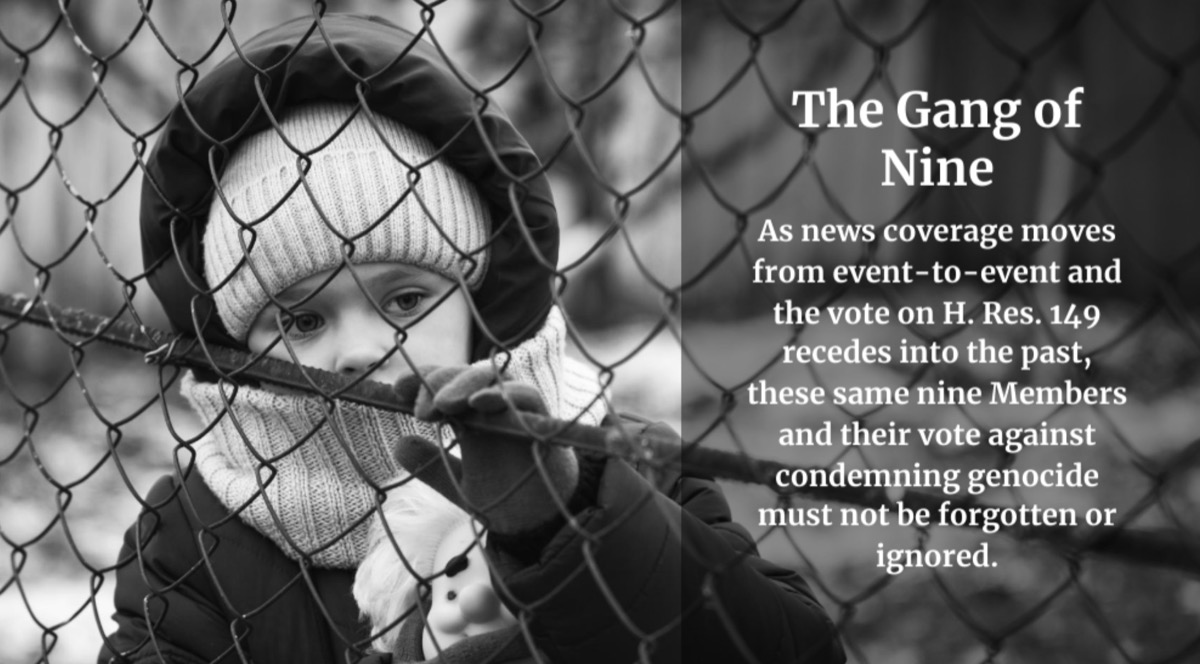
On March 19, 2024, the U.S. House voted on a resolution condemning Russia for taking children out of Ukraine and moving them into Russia to be adopted by Russian families.
It passed 390 to 9.
Warren Davidson was one of the nine. He was also the only member of Ohio's House delegation to vote no — 14 members at the time, with one seat vacant. Every other Ohioan in the House — Republican and Democrat — voted yes. That includes Jim Jordan.
What he actually voted against
It's worth being precise about what was on the floor, because it wasn't money and it wasn't troops.
H.Res.149 is a page of findings and four declarations. The findings lay out the record: that Russia's own Children's Rights Commissioner, Maria Lvova-Belova, "admitted to abducting and forcibly transferring Ukrainian children and facilitating forced adoptions to Russian families." That Russia declared children born in occupied Ukraine after the invasion to be Russian citizens. That Secretary of State Antony Blinken called on Russia to halt "filtration operations" that swept up between 900,000 and 1,600,000 Ukrainians — roughly 260,000 of them children.
Then the resolution declares that the abductions are "contrary to Russia's obligations under the Genocide Convention" and "amount to genocide"; that Russia is "attempting to wipe out a generation of Ukrainian children"; that the invasion has raised children's risk of trafficking, child labor and violence; and that Putin's government is responsible.
That's it. No appropriation. No weapons. No treaty. The Foreign Affairs Committee had already approved it 44 to 0.
His reason names a court the resolution never mentions
Most of the nine offered some explanation for their votes, HuffPost reported. Davidson gave this one:
"This is trying to insert the United States and the International Criminal Court into a dispute" that could "expand the war instead of a path to resolve it."
Now go read the resolution. Search it for the words "International Criminal Court."
They aren't in it. Not once. The resolution names the Genocide Convention — a treaty that took effect in 1951 and to which Russia is a party — and it names Putin. It does not mention the ICC, does not refer anything to the ICC, does not ask the United States to join or support the ICC, and does not create any legal process at all. It is Congress putting an opinion on the record.
Davidson's objection was to something that isn't in the text he voted against. (HuffPost described it as a worry about the resolution's "veiled references" to tribunals like the ICC, which had already issued arrest warrants for Putin and Lvova-Belova.)
Two of the others at least argued with the document in front of them. Tom Tiffany said "every war is not a genocide." Matt Rosendale said calling it genocide "only escalates conflict in the region." You can disagree with those, but they're objections to words that are actually in the resolution. Davidson's isn't.
And notice what his stated reason concedes. He didn't say the abductions weren't happening. He didn't say the evidence was thin. He said condemning them out loud might "expand the war." That is an argument for staying quiet about a documented crime because saying so is inconvenient.
He had already backed four Russia and Ukraine bills in one day
Here's what makes the ICC explanation harder to take at face value.
On May 11, 2022, Davidson voted yes on a run of Russia bills in a single afternoon:
- The Russia and Belarus Financial Sanctions Act, 418–2
- The Ukraine Comprehensive Debt Payment Relief Act, 362–56
- The Isolate Russian Government Officials Act, 416–2
- The Russia and Belarus SDR Exchange Prohibition Act, 417–2
Making U.S. banks' subsidiaries follow Russia sanctions. Isolating Russian officials. Debt relief for Ukraine. Those were bills with real force behind them — one, the SDR exchange ban, became law — and Davidson backed every one of them.
Two years later, a resolution that does nothing but say kidnapping children is wrong was the line he wouldn't cross.
"Leaders of character"
There is one more thing about this particular member casting this particular vote.
Warren Davidson enlisted in the Army out of high school as an infantryman. He was stationed in Germany with the 3rd Infantry Division and watched the Berlin Wall come down. His own official biography says of that moment: "Meeting people experiencing their first hours of freedom shaped his understanding of how precious and fragile liberty is." He went on to West Point, and served as an officer in The Old Guard, the 75th Ranger Regiment and the 101st Airborne.
In May 2019, House leadership put him on the Board of Visitors of the U.S. Military Academy — the academy's governing board. He was the only West Point graduate in Congress serving on it. Here is what he said at the time:
"The United States Military Academy at West Point recruits, educates, and trains leaders of character who commit to a lifetime of service to our nation."
Leaders of character. Five years later, asked to put his name on a piece of paper saying that taking children from their parents is a crime, he said no — and explained it by pointing at a court that isn't in the document.
The company he kept
The eight others who voted no were Andy Biggs, Eric Burlison, Marjorie Taylor Greene, Clay Higgins, Thomas Massie, Matt Rosendale, Chip Roy and Tom Tiffany. The U.S.-Ukraine Foundation later noted that the nine of them have 29 children between them, and wrote that they "embarrassed themselves, the Republican Party, Congress, and given the international attention, embarrassed our country."
We've written about what this vote looked like from Missouri, where Eric Burlison was the only member of his delegation to vote no and never explained why at all.
Ohio's version is different only in that Davidson did explain — and the explanation doesn't survive a read of the resolution.
Davidson has two children. So does Burlison. Between the nine of them, there are 29.
We deserve better.
Source
"Gang of Nine House Republicans who voted against resolution to condemn Putin's abduction of Ukrainian children," U.S.-Ukraine Foundation, April 5, 2024. Member explanations were reported by HuffPost (Jonathan Nicholson, March 20, 2024).