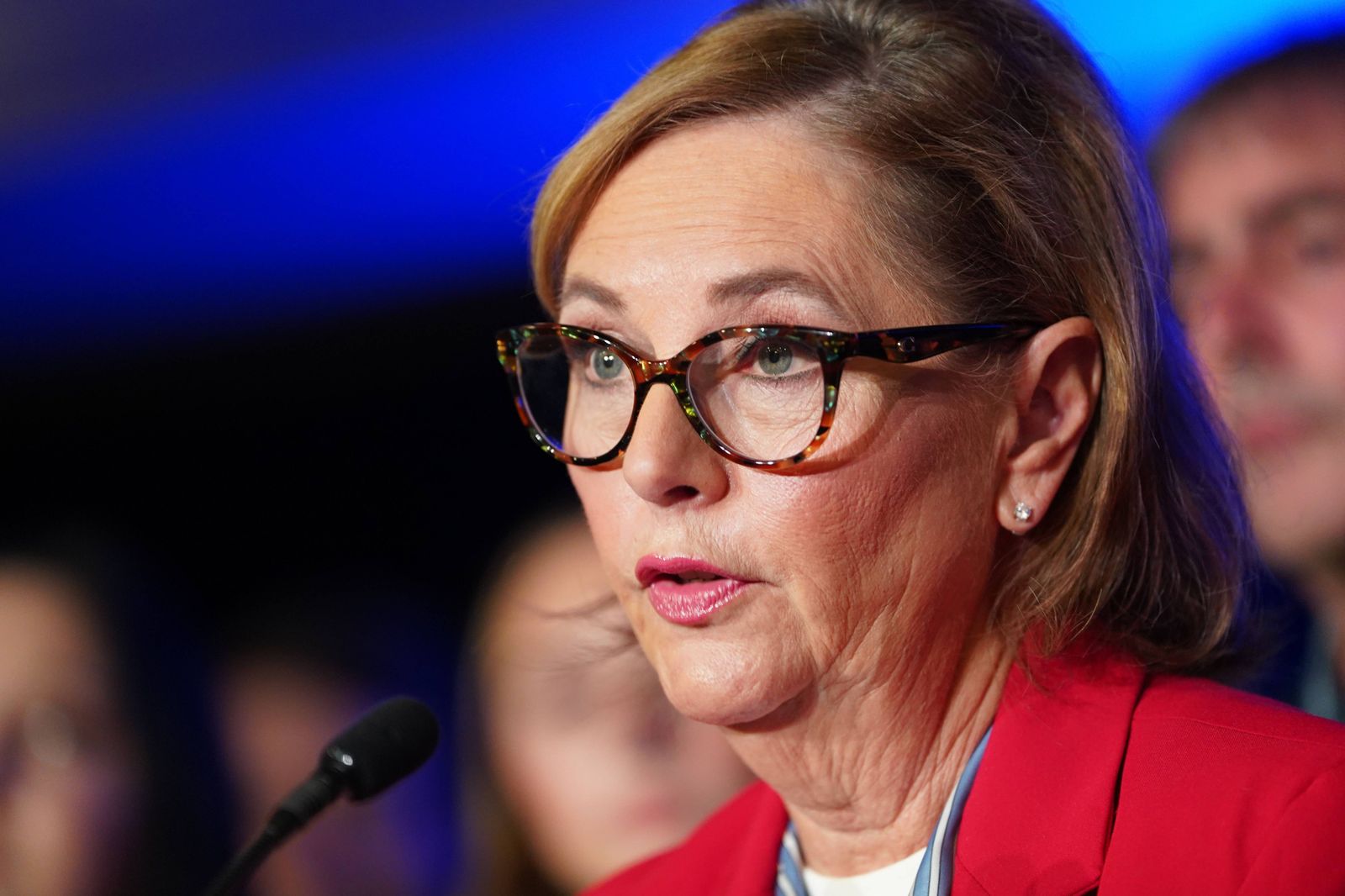
Darline Graham won South Carolina's Republican Senate runoff on Tuesday, August 25, 2026. What she chose to talk about that night was health care.
"Government run health care…. bad idea after bad idea," she told the crowd, naming her Democratic opponent. "Annie Andrews backs it all."
Then she explained why she felt that way, using her own family. Her parents ran the Sanitary Cafe in Central, South Carolina — a bar, pool hall and liquor store; she and her brother grew up in a single room behind it. There were no vacations.
"If they were sick, they had to get up and go to work, because if the doors weren't open, we weren't making money."
She followed it with this: "My mother passed away when I was 11, and my father just over a year later."
She told that as a story about grit. Common Dreams' Julia Conley reported it on August 26. What it actually describes is two people who could not afford to stop working when they were sick, and who did not live long.
Andrews — who is a pediatrician — answered: "No family should have to suffer simply because generations before them did."
What is happening in South Carolina right now
Graham is not describing a hypothetical future under a plan nobody has passed. She is a sitting senator, appointed in July to the seat her late brother Lindsey Graham held, and the health care in her state is already coming apart.
The advocacy group Protect Our Care put together a fact sheet for every state, and South Carolina's numbers are these:
- 235,000 people have lost their ACA subsidies or their coverage under Medicaid or the Children's Health Insurance Program.
- Premiums have doubled for more than 587,000 South Carolinians in the past year.
- 14 hospitals, clinics and nursing homes have shut down or are on the verge of it.
- Health care facilities in the state face a $1.5 billion loss in funding.
- Hospitals and clinics are facing a 26.9% spike in demand for uncompensated care — treatment nobody pays them for.
That last one is worth pausing on. A 26.9% spike in demand for uncompensated care means more people walking into an emergency room with no coverage at all — the most expensive way in the world to get sick, and the bill lands on everyone else's premiums.
None of this is the result of "government run health care." It followed the Republican health care cuts, on both tracks Protect Our Care counts: 74,940 South Carolinians pushed off Medicaid or CHIP, and 159,190 who dropped their ACA coverage after premiums skyrocketed. Nationally, 2.6 million Americans have already lost their health insurance as marketplace enrollment fell 12%.
What she did with her first month
Graham's remarks aren't just rhetoric she is stuck with. She has a voting record now, and it is short enough to read in full.
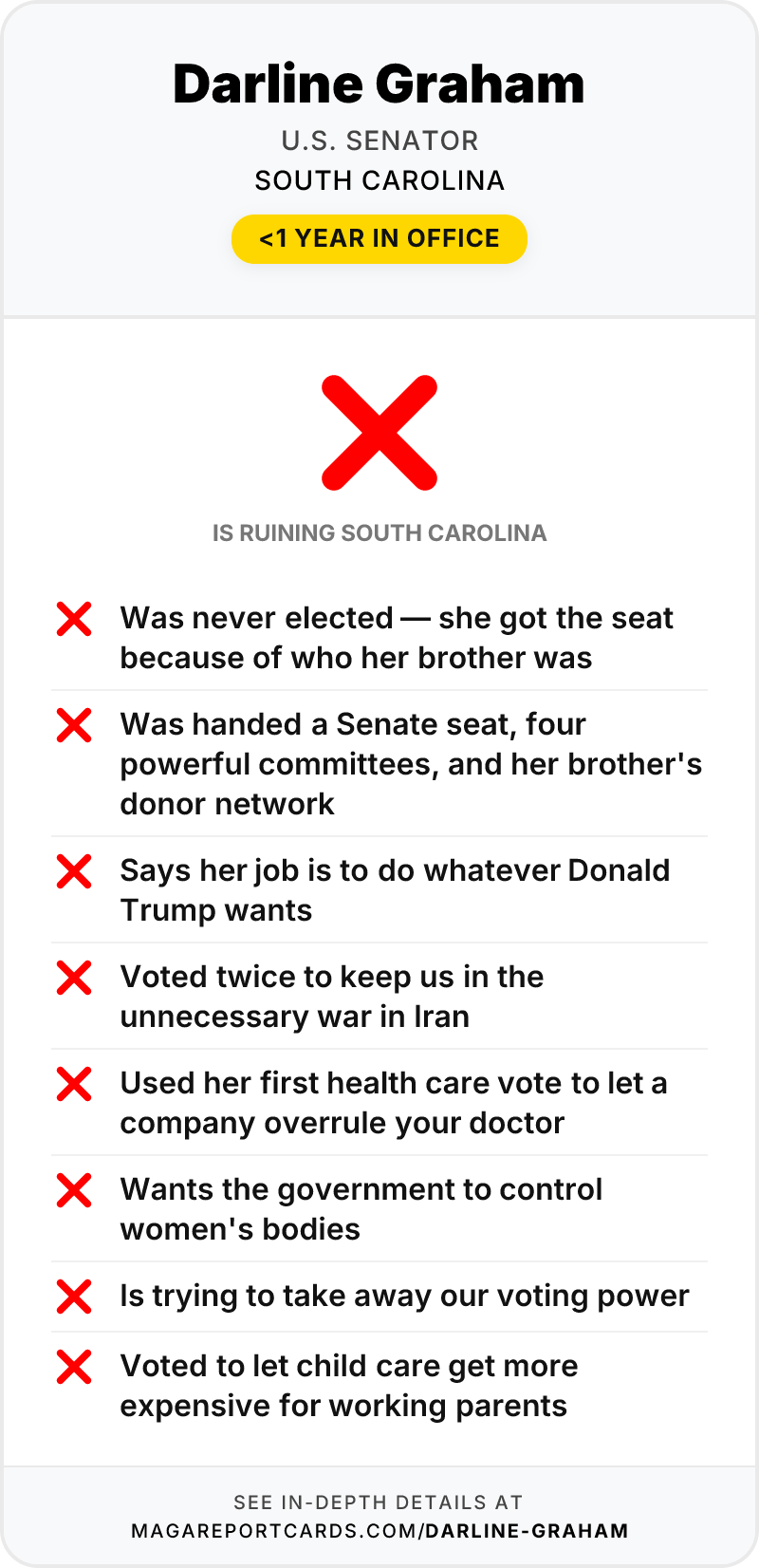
Two days into the job, on July 16, 2026, the Senate voted on whether to take up a resolution overturning the administration's WISeR model, which brings prior authorization into traditional Medicare for a set of services. Prior authorization is the step where an insurance company decides whether you get the care your doctor already ordered. The motion failed 46–50. Graham voted no.
We laid out that vote and the others in her first weeks in a look at how her Senate record compares to her career — and the comparison is the strange part. Graham spent 12 years at South Carolina's Vocational Rehabilitation Department as its business services and communications director, and since 2019 has led the state's Commission for the Blind. In 2022 she was part of the bipartisan South Carolina effort to end subminimum wage for workers with disabilities. Disability advocates in the state speak well of her.
Then she got to Washington and voted to leave insurance-company gatekeeping inside Medicare — a program that is, definitionally, government-run health care.
Which raises the obvious question about "bad idea after bad idea." Medicare is government-run. So is Medicaid. So is the VA, and so is the CHIP coverage sitting right there on the list of things 235,000 South Carolinians just lost. The phrase does a lot of work precisely because it never has to name any of them.
The argument she is actually making
Strip the applause line away and Graham's runoff-night speech contains a real claim: that going to work sick because the doors have to stay open is how it's supposed to be, and that anything designed to spare people that is a bad idea.
Journalist Ahmed Baba summarized what that sounds like from the outside: "'Government-provided healthcare is a bad idea. I'd rather Americans work long, hard hours, not receive sick leave, and die young' is one hell of a message."
Her parents didn't have a choice. That's the part of her story that's true and that nobody should make light of. The choice is the one in front of her now — she holds a Senate seat, 235,000 people in her state have lost coverage, and 14 facilities have closed or are close to it. She can vote to change that. So far she has voted the other way, and campaigned on it.
What the record shows
Protect Our Care counts 235,000 South Carolinians who have lost their ACA subsidies or their Medicaid and CHIP coverage, premiums doubled for more than 587,000 others, 14 hospitals, clinics and nursing homes shut down or on the verge of it, $1.5 billion in funding lost, and a 26.9% spike in demand for uncompensated care. Darline Graham used her runoff victory speech to call government-run health care "bad idea after bad idea," offering her parents' inability to take a sick day as the reason. She has been a U.S. senator since July. Two days into the job she voted against overturning a rule that puts insurance-company prior authorization into traditional Medicare.
Source
Julia Conley, "Trump-Backed Darline Graham Bashes 'Government-Run Healthcare,' Glorifies Working While Sick", Common Dreams, August 26, 2026. Photo via Common Dreams: Graham gives her election victory speech in Columbia, South Carolina, on August 25, 2026 (Megan Varner/Getty Images).